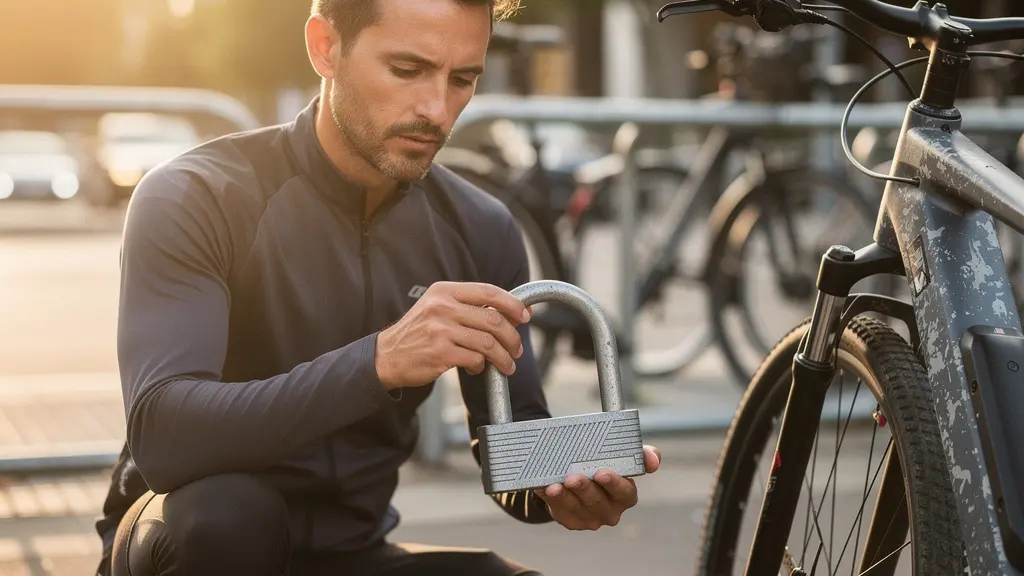
Your high-value e-bike is a target, and standard locks are an open invitation. The only effective defence is a security ecosystem designed to make stealing your bike an unprofitable, high-risk job for a professional.
- Angle grinder resistance (Sold Secure Diamond) is the non-negotiable baseline, as it directly counters the professional’s primary tool.
- A single lock is a single point of failure. A multi-lock strategy using different types forces thieves to carry more tools, increasing their risk and effort.
Recommendation: Stop thinking about “the best lock” and start implementing a layered security strategy. This includes the right locks, secure anchoring, component protection, and accurate insurance.
As a city dweller, leaving your expensive e-bike unattended can feel like a gamble. You’ve likely heard the standard advice: buy a “good” lock, maybe use two, and hope for the best. This approach is fundamentally flawed. It treats professional bike theft as a random act of misfortune when, in reality, it’s a calculated business. A professional thief evaluates your bike’s security setup and makes a simple return on investment (ROI) calculation: is the value of this bike worth the time, tools, and risk required to steal it?
The common wisdom about buying a heavy-duty lock is only a fraction of the solution. Many cyclists invest in a single, expensive lock, creating a false sense of security. They overlook vulnerable components, weak anchor points, and the financial devastation of being under-insured. This thinking is a critical error because it focuses on a single product rather than the thief’s entire process.
This guide changes the paradigm. We will not be discussing which lock is “unbeatable”—no lock is. Instead, we will adopt the mindset of a security consultant. The true key to protecting your asset is not just about resisting an attack, but about systematically dismantling a thief’s ROI. It’s about building a security ecosystem so layered and inconvenient that the thief decides your bike isn’t worth the effort and moves on to an easier target.
We will deconstruct this strategy piece by piece, analyzing the real meaning of security ratings, the tactics for securing your entire bike, the material science behind different locks, and the critical financial backstops that most owners ignore. By the end, you will have a clear, actionable framework for securing your investment.
Contents: A Strategic Approach to E-Bike Security
- Why “Sold Secure Gold” Is the Minimum Standard for E-Bikes
- How to Lock Your Frame and Wheels to Prevent Component Theft
- Folding Locks vs D-Locks: Convenience vs Maximum Security
- The Risk of Locking Near the Ground or Weak Anchor Points
- Insurance Approved Locks: Matching the Lock to the Policy Value
- The Risk of Overnight Parking at Train Stations Without Lockers
- The Financial Risk of Under-Insuring Your $4000 Bike
- Survival Guide: Navigating Complex Intersections on an E-Bike
Why “Sold Secure Gold” Is the Minimum Standard for E-Bikes
The Sold Secure rating is the industry benchmark for lock security, but most people misinterpret its levels. For a standard bicycle, a “Gold” rating might seem sufficient. For a high-value e-bike, it is dangerously inadequate. The reason is simple: the testing methodology. Gold-rated locks are tested against a range of tools that includes large bolt cutters and drills but critically, does not include an angle grinder. In today’s world of professional bike theft, this is like testing a fortress against catapults but ignoring airstrikes. The angle grinder is the modern thief’s weapon of choice for its speed and effectiveness.
This is where the Diamond rating becomes the only logical baseline. Sold Secure Diamond is the first tier specifically designed to address this threat. To achieve this certification, Sold Secure Diamond locks must withstand a 5-minute attack that explicitly includes a 1.5-minute assault with an angle grinder. While 90 seconds may not sound like a long time, in the context of a street theft, it is an eternity. It generates a massive amount of noise, sparks, and attention, all of which drastically increase the thief’s risk and crater their ROI.
Understanding these tiers is crucial for making an informed decision, as the tool resistance directly correlates to the time you are buying yourself against a determined attacker. This comparative analysis from a recent breakdown of security ratings makes the hierarchy clear.
| Rating Level | Testing Duration | Tools Tested Against | Recommended Use |
|---|---|---|---|
| Bronze | 1 minute | Basic concealed tools | Short stops only |
| Silver | 3 minutes | Small bolt cutters, hacksaw | Medium-risk areas |
| Gold | 5 minutes | Large bolt cutters, no grinder | High-value bikes |
| Diamond | 5+ minutes | Angle grinders included | E-bikes & highest risk |
Therefore, framing “Sold Secure Gold” as a minimum standard for e-bikes is an outdated and hazardous piece of advice. For any e-bike of value, Powered Cycle Diamond is the only responsible starting point. Anything less is an open invitation to a professional equipped with the right tools.
How to Lock Your Frame and Wheels to Prevent Component Theft
A Diamond-rated lock on your frame is an excellent start, but it only protects the frame. A professional thief who is deterred from stealing the entire bike can still strip it of its valuable components—wheels, seat, and handlebars—in minutes, leaving you with a useless husk. This is where the concept of a security ecosystem comes into play. Your goal is to make every part of the bike inconvenient and unprofitable to steal.
The most effective strategy is layering your defences and forcing a thief to require multiple tools. An angle grinder is loud and bulky; bolt cutters are quieter but useless against a grinder-resistant lock. Forcing them to carry and use both significantly increases their effort and exposure. The core of this tactic is the two-lock method, properly executed.
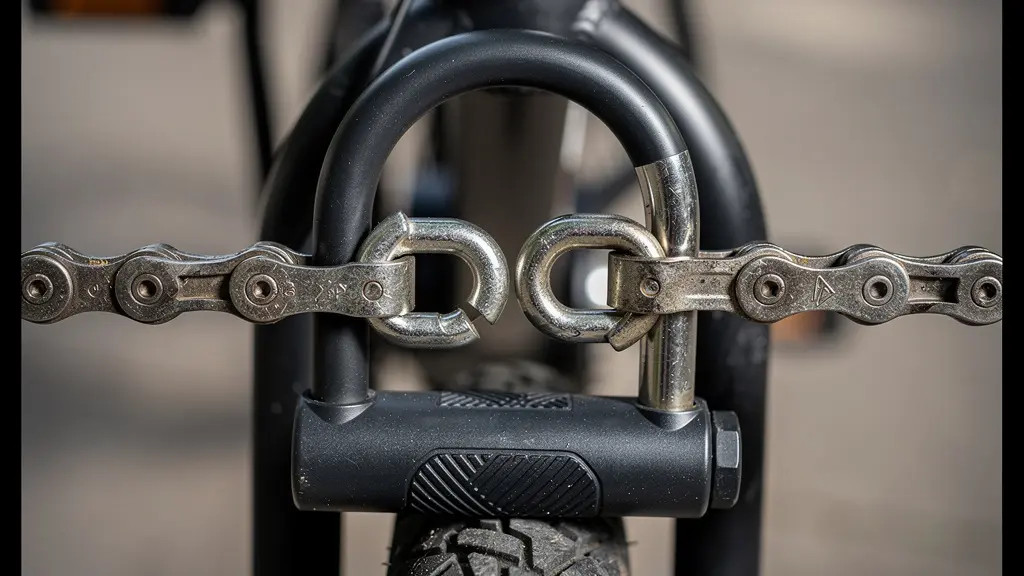
As this setup demonstrates, the primary lock (a grinder-resistant D-lock) should secure the rear wheel and the frame (specifically through the rear triangle) to an immovable object. The secondary lock, ideally a high-quality hardened steel chain of at least 12mm, should then secure the front wheel to the frame. This creates a closed loop that protects all major components and presents two different material challenges to a thief.
Case Study: Professional Thief ROI on Component Stripping
An analysis by UK police noted that a layered defence drastically reduces the profitability of component theft. When thieves are forced to defeat two different lock types (e.g., a ceramic-composite D-lock and a hardened chain), the time and tool requirements escalate. Furthermore, when components like wheels are secured with non-standard hex bolts instead of quick-release skewers, and the frame is marked with a security identifier like BikeRegister, the resale value of the stripped parts plummets. This combination of increased effort and decreased reward makes the theft a bad business decision.
Beyond locks, replacing quick-release skewers on your wheels and seatpost with hex-bolt or proprietary anti-theft systems is a small investment that adds another layer of required tools and time for a thief. Every additional step you force upon them makes your bike a less attractive target.
Folding Locks vs D-Locks: Convenience vs Maximum Security
The choice between a folding lock and a D-lock (or U-lock) is a direct trade-off between convenience and absolute security. While high-quality folding locks, like the Abus Bordo Granit, offer impressive resistance to bolt cutters, they are fundamentally more vulnerable to an angle grinder attack than their top-tier D-lock counterparts. The reason lies in their material science and construction.
A folding lock’s strength is limited by its weakest points: the pivot pins connecting the bars. While the bars themselves may be hardened, the pins present a smaller, more accessible target for a grinder. In contrast, a high-security D-lock is a solid shackle of hardened material. Modern, grinder-resistant D-locks use advanced materials that actively fight back against a grinder. For instance, some angle grinder-resistant D-locks provide up to 20 times more resistance than standard hardened steel, thanks to ceramic composite coatings that can shred grinder discs upon contact.
Material Science Analysis: Abus Bordo vs. Litelok X1
Lab tests reveal the stark difference. A top-of-the-line folding lock like the Abus Bordo Granit XPlus 6500, with its 6mm boron-carbide coated bars, can take a commendable four minutes to cut. However, this is still a finite battle against a determined grinder attack. In contrast, the solid shackle of a lock like the Litelok X1, fused with a ceramic composite like Barronium, is designed not just to resist but to destroy the tool itself. An attack on this type of lock can exhaust multiple grinder discs, dramatically increasing the time, cost, and noise for the thief.
This does not mean folding locks have no place. For a low-risk, short-duration stop (e.g., a quick coffee), a quality folding lock offers a reasonable level of security with superior portability. However, for any situation involving high-value e-bikes left for extended periods or in high-risk urban areas, the debate is over. The structural integrity and advanced materials of a Diamond-rated, grinder-resistant D-lock offer a level of security that a folding lock, by its very design, cannot match.
The Risk of Locking Near the Ground or Weak Anchor Points
The best lock in the world is useless if it’s attached to a weak anchor point or used in a way that gives the thief a tactical advantage. A common and critical mistake is locking the bike low to the ground. This seems trivial, but it provides a massive benefit to a thief using an angle grinder. By placing the lock on or near the pavement, the thief can use the ground to stabilize the grinder, allowing them to apply consistent pressure and use their body weight for leverage. This results in a faster, cleaner cut.
As one security expert analysis bluntly puts it, the height of your lock is a key defensive measure. Locking higher up the frame forces the thief into a more awkward, less stable position.
Locking high off the ground prevents the thief from using the pavement to stabilize the grinder or their body, making the attack more difficult, less precise, and more conspicuous with sparks at eye-level.
– Security Expert Analysis, The Best Bike Lock – Angle Grinder Proof Testing
Equally important is a rigorous inspection of your anchor point. Thieves often scout and even prepare locations by partially cutting through bike racks or signposts, returning later to finish the job quickly. Never assume a rack is secure just because it’s there. You must develop a threat-scape mentality, constantly assessing your environment for vulnerabilities. A flimsy signpost, a scaffold pole that can be easily dismantled, or a rack with suspicious saw marks are all red flags.
Your Action Plan: Anchor Point Security Inspection
- Visual Inspection: Look for fresh saw marks, grinding marks, or loose bolts on posts and racks. Trust your instincts.
- Stability Test: Firmly shake the structure. If it moves or feels loose, it’s not properly cemented. Find another spot.
- Height Assessment: Always aim to lock your bike at least 12-18 inches (30-45 cm) off the ground to prevent grinder stabilization.
- Thickness Check: The anchor point should always be thicker and appear more robust than your lock’s shackle. Never lock to something that can be cut faster than your lock.
- Coverage Scan: Avoid CCTV blind spots, poorly lit areas, and deserted corners. Thieves thrive in anonymity.
If an anchor point seems remotely suspicious, do not use it. The inconvenience of walking an extra 50 feet to a secure, well-lit, and sturdy anchor is insignificant compared to the cost of replacing your bike.
Insurance Approved Locks: Matching the Lock to the Policy Value
Your security ecosystem has a final, crucial layer: the financial backstop of insurance. However, an insurance policy is not a magic shield. It is a contract with strict terms and conditions, and insurers are increasingly savvy about the realities of e-bike theft. Many policies for high-value e-bikes (e.g., over $2000/£2000) now explicitly mandate the use of a Sold Secure Diamond-rated lock. Using a Gold-rated lock, or even a non-rated one, can void your coverage entirely, leaving you with a denied claim and a total financial loss.
You must treat your lock as an integral part of your insurance contract. The logic is simple: the insurer is underwriting your risk, and they require you to take specific, verifiable steps to mitigate that risk. This means you must be able to prove you used the correct lock, and that you used it properly, at the time of the theft. Failure to provide this proof is one of the most common reasons for a claim being rejected.
The relationship between your bike’s value and the required lock is non-negotiable. As the value of your asset increases, so does the level of security your insurer demands. Ignoring this correlation is a form of financial negligence. The initial cost of a top-tier, grinder-resistant lock may seem high, but it is insignificant compared to the total loss of an uninsured or improperly insured e-bike. Furthermore, some specialist insurers may offer premium discounts for using a higher-rated lock, providing a direct financial ROI on your security investment.
Navigating the fine print of an insurance policy is critical. Many contain exclusions for overnight street parking or require you to keep the damaged lock as proof of forced entry. Your responsibility does not end after you buy the lock; it requires ongoing diligence.
The Risk of Overnight Parking at Train Stations Without Lockers
Certain locations are fundamentally more dangerous than others, and train stations are a prime example of a high-threat environment. From a thief’s perspective, they are a perfect hunting ground. They offer a target-rich environment with a high concentration of valuable bikes, and the constant flow of commuters provides anonymity. Most importantly, they offer a predictable window of opportunity. A bike locked at a station at 8 AM is likely to remain there for at least 8-9 hours, giving a thief an almost unlimited amount of time to work, especially overnight.
The “one-minute rule”—the idea that a thief won’t attempt a lengthy attack in a high-traffic area—completely breaks down in this context. After the evening rush hour, a station’s bike racks can become deserted and poorly lit. Research in major urban centers has consistently shown a strong correlation between low light and high theft rates. A sustained, overnight attack with an angle grinder, involving multiple battery or disc changes, becomes not only possible but practical.
Case Study: The Professional’s Hunting Ground
Security analyses of theft patterns reveal that professional thieves don’t just happen upon bikes; they scout locations. Train stations are prized because they allow for methodical work. A thief can assess multiple targets, select the one with the weakest security, and return after dark. Even the best grinder-resistant lock can eventually be defeated if a thief has hours of uninterrupted time in a secluded spot. Many insurance policies recognize this elevated risk and contain specific clauses that void coverage for bikes left in public spaces overnight.
Leaving an expensive e-bike at a train station overnight without the protection of a dedicated, secure bike locker is not a calculated risk; it is a near certainty of loss. The combination of time, seclusion, and target value is an irresistible proposition for any professional thief. If your commute requires leaving your bike, you must either find a route that avoids it, use a low-value “beater” bike for that leg of the journey, or confirm your station has secure, enclosed bike lockers and use them without exception.
The Financial Risk of Under-Insuring Your $4000 Bike
One of the most catastrophic financial errors an e-bike owner can make is under-insuring their asset. This often happens not out of negligence, but out of a misunderstanding of the bike’s true replacement cost. You might have paid $4000 for the bike itself, but that is rarely the full story. The pedals you upgraded, the ergonomic saddle, the high-powered lights, the bike computer, the pannier racks and bags—all these accessories add up, often pushing the real-world replacement cost hundreds, if not thousands, of dollars higher.
This is a critical oversight because e-bikes are a high-priority target. Data consistently shows they are stolen at a much higher rate than conventional bicycles; according to one 2025 report, e-bikes are 3 times more likely to be stolen. When you file an insurance claim for your stolen $4000 bike, the policy will only cover the declared value. You will be left to pay out-of-pocket for all the upgrades and accessories you forgot to include. This gap can easily turn a difficult situation into a financial disaster.
A meticulous inventory of every component and its cost is not optional; it is a mandatory step in securing your investment. This table, based on data from cycling security organizations, illustrates how quickly hidden costs can accumulate.
| Component | Often Overlooked | Typical Additional Cost |
|---|---|---|
| Base Bike Price | No | $4000 |
| Pedals & Saddle Upgrades | Yes | $200-400 |
| Lights & Computer | Yes | $150-500 |
| Racks & Bags | Yes | $100-300 |
| Security Devices (Locks, GPS) | Yes | $200-400 |
| True Replacement Cost | – | $4650-$5600 |
When selecting a policy, always opt for “New for Old” coverage over “Market Value,” especially for a bike more than a year old, to ensure you receive enough to buy a brand new replacement. It is your responsibility to provide the insurer with an accurate valuation. Failure to do so means you are effectively self-insuring a significant portion of your bike’s value.
Key Takeaways
- Adopt a Thief’s Mindset: Security is about destroying a thief’s Return on Investment (ROI) by increasing their time, effort, and risk.
- Diamond is the Baseline: For any e-bike, Sold Secure Diamond is the only rating that matters as it’s the first to test against angle grinders. Gold is obsolete.
- Layer Your Defences: A single lock is a single point of failure. Use two different lock types to force a thief to carry multiple tools.
Survival Guide: Navigating Complex Intersections on an E-Bike
We’ve established that robust security is non-negotiable. This, however, comes with a direct and unavoidable trade-off: weight. A formidable, grinder-resistant D-lock and a heavy secondary chain can easily add 4-5 kg (9-11 lbs) to your setup. This extra weight is not just a burden to carry; it has a tangible impact on your bike’s handling and your personal safety, especially in the dynamic environment of a complex urban intersection.
The added mass, whether carried in a backpack or mounted to the frame, alters the bike’s center of gravity. This can make the bike feel top-heavy and less responsive during the low-speed, sharp-turn maneuvers required to navigate dense traffic, pedestrians, and changing signals.
A 2-3 kg grinder-resistant lock on your back or frame affects the e-bike’s balance and agility, especially during the low-speed, sharp-turn maneuvers common at complex intersections.
– Urban Cycling Safety Analysis, Cycling Electric – E-bike Lock Weight Impact Study
This reality forces a shift in mindset. Your daily ride is no longer just about traffic safety; it’s about holistic risk management. Experienced urban cyclists who carry heavy security systems report that it changes their route-planning criteria. They begin to operate with a “threat-scape mentality,” simultaneously scanning their environment for both traffic hazards and security vulnerabilities. The decision to ride down a certain street might be influenced as much by the quality of its bike lanes as by the availability of secure locking infrastructure at the destination.
This is the true cost of high security. It’s not just the purchase price of the locks; it’s the cognitive load and physical adjustment required every single day. You must practice handling your bike with its full security loadout in a safe area to get a feel for its altered dynamics before you need to execute a sudden evasive maneuver in traffic. Acknowledging and adapting to this weight is the final step in creating a security strategy that is not just effective, but also sustainable and safe for you as the rider.
Ultimately, protecting your investment requires a commitment to this comprehensive strategy. Start today by auditing your current security setup against these principles, calculating your bike’s true replacement cost, and upgrading your locks and insurance to a level that reflects its real value.