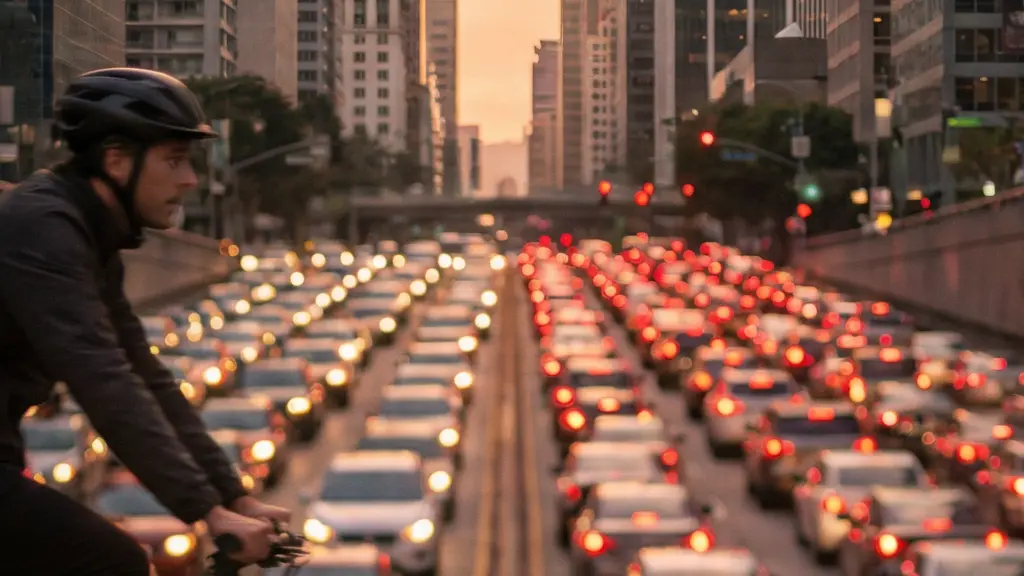
For the frustrated urban commuter, switching to an e-bike isn’t just a minor improvement; it’s a systemic overhaul that can cut travel time by up to 40%.
- Car commuting is plagued by non-driving time sinks: stop-start traffic reduces average speeds to a crawl, and the search for parking adds significant, unpredictable delays.
- E-bikes excel by maintaining consistent momentum, legally filtering through congestion, and eliminating parking friction, leading to highly predictable and faster arrival times.
Recommendation: Re-evaluate your commute not by a vehicle’s top speed, but by its average door-to-door efficiency. The e-bike consistently wins this real-world calculation.
The daily grind of urban commuting often feels like a losing battle. You leave with ample time, only to watch the minutes evaporate in a sea of red tail lights. For a car commuter trying to cover just a few miles, that one-hour journey is a familiar frustration. The common advice—leave earlier, try a different route—nibbles at the edges of a systemic problem. We’re told e-bikes are a “green” alternative, a way to get some exercise. But these points miss the most compelling argument for the frustrated driver.
The true power of the e-bike is not in its environmental credentials, but in its strategic superiority as a tool for navigating dense urban environments. It’s about fundamentally changing the rules of the game. Instead of being a passive victim of traffic, you become an active agent, navigating the city with an efficiency that cars simply cannot match. The key isn’t about the e-bike’s top speed, but its mastery over the two greatest enemies of the urban commute: time volatility and momentum loss.
This analysis moves beyond generic praise and dissects the commute as a system. We will quantify the inherent inefficiencies of car travel in gridlock and demonstrate, with data and logic, how an e-bike exploits these weaknesses. We’ll explore why a car’s average speed plummets in the city, how the e-bike maintains its pace, and what the true financial and temporal costs of your commute really are. This is the data-driven case for reclaiming your time and sanity.
While this article focuses on the strategic and logistical advantages of e-biking, the technology powering this revolution is equally fascinating. For those interested in the heart of the e-bike, the following video, though in Spanish, offers a deeper look into the rise of the advanced battery technology that makes this efficiency possible.
To understand the full scope of this commuting paradigm shift, this article breaks down the core components of urban travel. We will analyze everything from traffic dynamics and safety to financial costs and the crucial “last mile” problem, providing a comprehensive framework for why the e-bike is the superior choice for efficient city navigation.
Summary: A Systemic Analysis of the E-Bike’s Urban Advantage
- Stop-Start Traffic: Why Cars Average 9mph in City Centers
- How to Lane Split Safely Where Legal
- Parking Fees vs E-Bike Depreciation: The Monthly Math
- The Risk of Conflict with Drivers Stuck in Jams
- Leaving 10 Minutes Later: How E-Bikes Offer Predictable Arrival Times
- Class 1 or Class 3:Is Your E-Bike Really Green? Calculating the Carbon Offset vs Cars
- How to Momentum-Coast to Save Energy in Urban Stop-and-Go
- Best E-Mobility Solutions for the Last 2 Miles of Your Commute
Stop-Start Traffic: Why Cars Average 9mph in City Centers
The primary failure of car commuting in cities isn’t the vehicle itself, but the system it operates within. A car capable of 120 mph is rendered impotent by urban gridlock. The constant cycle of acceleration and braking, known as stop-start traffic, decimates average speed. This isn’t just a feeling; it’s a quantifiable reality. Data consistently shows that in major urban centers, the actual achieved speed of a car during peak hours is a fraction of its potential.
The core issue is traffic density. Each vehicle occupies a significant footprint and requires a safe stopping distance, creating a chain reaction where a single braking event can ripple backwards, causing a standstill. In this environment, the system’s throughput collapses. In fact, an analysis of traffic patterns confirms this bottleneck effect, with average speeds in downtown areas dropping below 10 mph during congested periods, according to the 2023 INRIX Global Traffic Scorecard. For a 5-mile commute, this translates directly into a 30-minute travel time before even considering parking.
An e-bike fundamentally bypasses this systemic failure. Its small footprint and maneuverability allow it to maintain momentum where a car cannot. While a car is trapped in a linear queue, an e-bike can utilize dedicated infrastructure and legal filtering to maintain a much higher and more consistent average speed. The car is a slave to the vehicle in front of it; the e-bike rider is an independent operator within the system.
How to Lane Split Safely Where Legal
“Lane splitting” or “filtering” is one of the e-bike’s most significant advantages in congested traffic, but it demands a heightened state of awareness and responsibility. Where legally permitted, it allows a cyclist to move between lanes of stopped or slow-moving cars. This is not an aggressive act but a calculated technique to maintain progress. The key is not speed, but predictability and visibility. A safe filter is performed at a low-speed differential, ensuring the rider can react to sudden door openings or lane changes.
Effective filtering is a mental discipline. It requires scanning far ahead, monitoring mirrors, making eye contact with drivers, and positioning oneself to be seen. The goal is to be a smooth, predictable element in a chaotic environment, not a surprising one. This demands complete focus, a state of mind where the rider is fully present and anticipating the actions of others.

As the image suggests, the focus is intense and internal. The surrounding chaos becomes a blur, while the path ahead is crystal clear. This mental clarity is a prerequisite for safety. You must assume you are invisible and ride accordingly, covering your brakes and being prepared to stop instantly. It’s a skill that transforms the rider from a passive participant in a traffic jam into an active navigator, methodically and safely reclaiming lost time.
Parking Fees vs E-Bike Depreciation: The Monthly Math
The advertised cost of a car is merely the price of entry. The true financial burden lies in the relentless operational costs, or “friction costs,” that accumulate daily. Among the most significant in an urban setting are parking fees. Whether it’s a monthly garage pass, metered street parking, or occasional fines, this cost is a direct tax on urban car ownership. For many commuters, monthly parking costs can easily exceed hundreds of dollars, a sunk cost that provides zero return.
When analyzing the total cost of ownership, the numbers are stark. For example, the latest AAA data reveals that new car ownership costs have risen to $12,297 per year, or over $1,000 per month. This figure includes depreciation, fuel, insurance, maintenance, and financing. A significant portion of this, especially in cities, is tied directly or indirectly to parking and the simple act of storing the vehicle.
An e-bike radically alters this financial equation. A quality e-bike might cost between $1,500 and $4,000. Even if one were to write off its entire value over three years (a conservative depreciation schedule), the monthly cost is roughly $40-$110. This is often less than a single week’s worth of downtown parking. The e-bike eliminates parking fees, drastically reduces fuel and maintenance costs, and often lowers insurance needs. When you replace a car commute with an e-bike, you are not just saving on gas; you are opting out of a system designed to continuously drain your finances.
The Risk of Conflict with Drivers Stuck in Jams
Navigating a congested city street on an e-bike requires technical skill, but it also demands a high degree of emotional intelligence. A traffic jam is a high-stress environment, and a car driver who has been stationary for twenty minutes may not be in a receptive state of mind. The simple act of an e-bike rider gliding past can trigger feelings of frustration, jealousy, or perceived injustice, occasionally leading to conflict.
The psychology at play is rooted in a sense of entrapment. The driver is physically and mentally stuck, with no control over their situation. The cyclist, by contrast, represents freedom and mobility. This disparity can sometimes manifest as hostility: a sudden close pass, an angry honk, or an aggressive lane change. While these incidents are not the norm, their potential is a real risk that every urban cyclist must manage. The best defense is a proactive, de-escalating strategy. This involves empathy and spatial awareness.
Understanding that the driver’s frustration is not personal is the first step. The second is to create a buffer. This means avoiding lingering in blind spots, giving ample space, and communicating intentions clearly with hand signals. It means choosing a path that minimizes surprises and riding with a calm, assertive confidence that does not translate as aggression. A cyclist who is predictable, visible, and courteous is far less likely to be perceived as a threat or an antagonist, reducing the risk of a negative interaction and ensuring the commute remains safe and efficient.
Leaving 10 Minutes Later: How E-Bikes Offer Predictable Arrival Times
For the car commuter, time is elastic and unreliable. Leaving at 8:00 AM might result in a 45-minute trip one day and a 75-minute trip the next. This “time volatility” is a major source of stress and inefficiency, forcing drivers to build in large, often wasted, buffer periods to guarantee on-time arrival. The commute is not just long; it’s unpredictably long. An accident, construction, or even a minor weather event can cause the system to collapse.
The e-bike’s greatest tactical advantage is its ability to deliver predictability. Because it is largely insulated from the primary causes of traffic congestion, its travel times remain remarkably consistent. An 8-mile e-bike commute will take almost the exact same amount of time on Tuesday as it does on Thursday. This reliability fundamentally changes your relationship with time. You no longer have to plan for the worst-case scenario; you can plan for the typical scenario.
This concept is about transforming a chaotic system into a controlled one. The tangled, unpredictable mess of car traffic is replaced by the precise, reliable mechanics of an e-bike journey. This allows the rider to reclaim control. You can confidently leave 10, 15, or even 20 minutes later than you would in a car, knowing you will arrive at your destination at the expected time. This isn’t just about saving time on the journey itself; it’s about reclaiming the buffer time you were forced to sacrifice to the unpredictability of the car.

Class 1 or Class 3: Is Your E-Bike Really Green? Calculating the Carbon Offset vs Cars
While the primary advantage for a frustrated commuter is time, the environmental co-benefit of switching to an e-bike is substantial. However, a nuanced analysis is required. The “green” credentials of an e-bike are not absolute; they are relative to the mode of transport it replaces. The manufacturing of an e-bike, particularly its battery, has a carbon footprint. The electricity used to charge it also has an associated emission factor depending on the grid’s energy mix. A Class 1 (pedal-assist up to 20 mph) and Class 3 (pedal-assist up to 28 mph) e-bike have different energy demands, but both are orders of magnitude more efficient than a car.
The real calculation is the carbon offset. An average passenger car emits around 400 grams of CO2 per mile. An e-bike’s impact, including battery manufacturing and grid electricity, is typically estimated at 5-15 grams of CO2 per mile. Therefore, for every mile you replace a car trip with an e-bike trip, you are preventing approximately 95-98% of the carbon emissions. This offset is immediate and significant. The initial carbon “debt” from manufacturing the e-bike is typically “repaid” in just a few hundred miles of riding compared to driving.
Furthermore, the cycling industry is increasingly focused on sustainability throughout the product lifecycle. Companies are setting ambitious goals to reduce their environmental impact, with major manufacturers like Trek Bicycles committing to a 30% reduction in Scope 3 emissions by 2032 as outlined in their sustainability reports. Programs that extend product life are also becoming more common.
Case Study: Trek’s ‘Red Barn Refresh’ Program
Trek’s ‘Red Barn Refresh’ program became the first manufacturer-led bike trade-in and refurbishment program, directly addressing the lifecycle impact by extending the usable life of bikes and reducing waste. By creating a circular economy for bicycles, this initiative proves that the industry is thinking beyond just tailpipe emissions and considering the entire environmental footprint of its products.
How to Momentum-Coast to Save Energy in Urban Stop-and-Go
In the world of urban commuting, momentum is currency. Every time a car brakes to a full stop, it dissipates kinetic energy as heat, which must then be regenerated using fuel upon acceleration. This is the fundamental inefficiency of stop-and-go driving. An e-bike rider can employ a technique called “momentum-coasting” to play a different game, preserving energy and time by minimizing full stops. This is the art of reading the traffic flow far ahead and adjusting your speed early to “coast” through potential bottlenecks.
The technique involves anticipating stale green lights, four-way stops, and pedestrian crossings. Instead of pedaling hard until the last second and then braking sharply, the rider eases off the power 100-200 feet before the intersection. This allows the bike to slow gradually. Often, by the time you reach the intersection, the light has changed or the path has cleared, allowing you to pass through at a slow roll without ever putting a foot down. You have effectively used a potential stop as a “yield,” saving the significant energy required to accelerate from a dead start.
This strategy not only extends your battery range but also contributes to a smoother, faster, and safer ride. It keeps you in a state of flow, making the commute feel less like a series of frustrating interruptions and more like a fluid dance with the city’s rhythm. Mastering momentum-coasting transforms you from a simple operator into a truly efficient urban navigator.
Action Plan: Mastering Momentum-Coasting
- Scan Ahead: Constantly look 1-2 blocks ahead, not just at the car in front of you. Identify traffic lights, intersections, and pedestrian zones early.
- Anticipate Stale Greens: If a traffic light has been green for a long time, assume it will change. Ease off the power and prepare to coast rather than sprinting towards it.
- Feather Your Brakes: Use light, progressive braking to modulate speed instead of sudden, hard stops. Your goal is to slow down, not to halt abruptly.
- Use Lower Assist Levels: When approaching a potential stop, downshift your pedal-assist level. This gives you more control over your speed and conserves battery.
- Practice the “Slow Roll”: Challenge yourself to navigate a familiar route with the fewest possible full stops. Aim to roll through intersections safely instead of stopping completely.
Key Takeaways
- The true measure of commute efficiency is average door-to-door speed, a metric where cars fail dramatically in cities, often averaging below 10 mph.
- E-bikes offer superior time predictability by being immune to the primary drivers of traffic congestion, eliminating the need for large, stressful time buffers.
- The financial benefits extend far beyond fuel savings, eradicating major costs like urban parking and reducing the overall cost of ownership by over 90% compared to a new car.
Best E-Mobility Solutions for the Last 2 Miles of Your Commute
Even for those who must drive part of the way, the e-bike offers a powerful solution to the “last-mile problem.” This is the notoriously inefficient final leg of a journey, from a major transit hub or a peripheral parking garage to the final destination. Driving these last one or two miles can often take as long as the first ten, bogged down by one-way streets, pedestrian congestion, and the desperate search for exorbitant parking. This is where a multimodal commute shines.
By parking on the edge of the congested city center and completing the journey with a portable e-bike or a shared micromobility service, you combine the range of a car with the agility of an e-bike. This strategy, known as “park and ride,” surgically removes the most stressful and time-consuming part of the car commute. You avoid the gridlock, the parking hunt, and the high fees, gliding into the office while others are still circling the block.
The growth in this sector is a testament to its effectiveness. People are increasingly recognizing that the right tool for the job changes with the environment. In fact, recent data shows shared micromobility use increased by 8.6%, indicating a clear trend towards these flexible, last-mile solutions. Whether it’s a folding e-bike you keep in your trunk or a dockless e-scooter you pick up near your parking lot, these tools are redefining the modern commute. They prove that the smartest solution isn’t always a single vehicle, but a flexible system of them.
Ultimately, the choice between a car and an e-bike for urban commuting is a choice between two different philosophies: being subject to a failing system or mastering it. The data overwhelmingly shows that in the metrics that matter—time, predictability, and cost—the e-bike is not merely an alternative, but the superior strategic choice. The next logical step is to move from analysis to action. Calculate your own potential time and cost savings, and experience the difference firsthand.