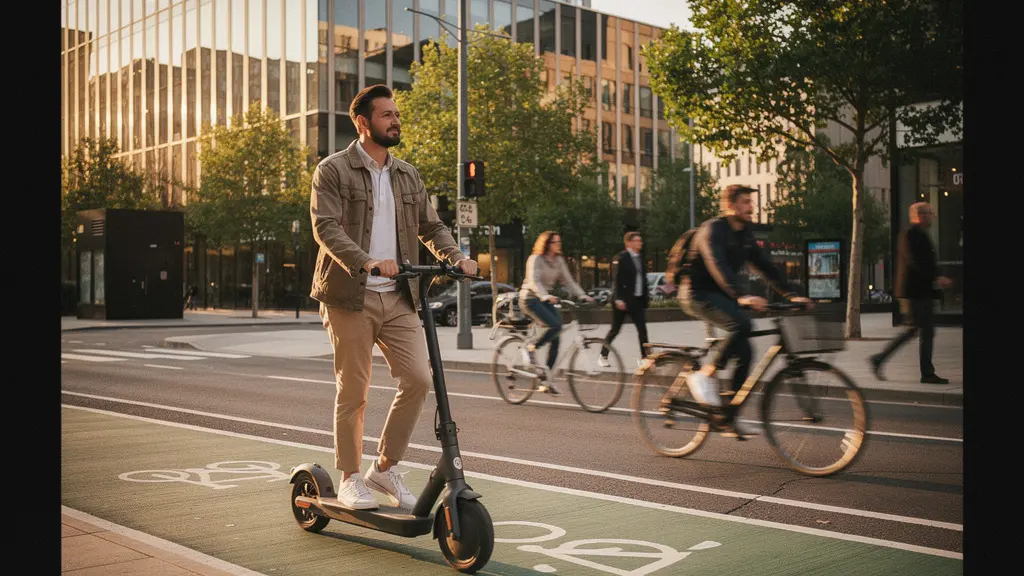
That 20-minute walk from the transit hub to your office isn’t just an inconvenience; it’s a significant drain on your daily productivity and focus. This guide reframes the last-mile problem, moving beyond simple device comparisons. It provides a strategic system for choosing and integrating a personal e-mobility tool—like a scooter or folding e-bike—not as a gadget, but as a critical component of your professional toolkit to reclaim wasted time and arrive at your desk energized and ready to perform.
The final leg of your commute—that gap between the train station or bus stop and your office door—feels like a dead zone. For many professionals, it’s a mandatory 20-minute walk, a twice-daily tax on your time and energy. You arrive slightly flustered, maybe a little sweaty, and already behind schedule. This “last mile” is the single biggest point of friction in an otherwise optimized day.
Most advice focuses on the obvious: buy an e-scooter or a folding bike. But this approach misses the point. The challenge isn’t just about moving faster; it’s about creating a seamless, integrated system that eliminates logistical headaches and preserves your mental energy for high-value work. Simply owning a device isn’t the solution. The key is mastering its integration into your entire commute, from crowded subways to office storage.
But what if the true solution wasn’t just choosing a device, but building a personal mobility system? This guide shifts the perspective. We’re not just looking at gadgets; we are treating your last-mile commute as a critical productivity lever. It’s about making a strategic choice that considers storage, professional appearance, safety, and a sweat-free arrival as non-negotiable outcomes. This is how you stop losing time and start leveraging your commute to your advantage.
This article will dissect the real costs of inaction, evaluate the most viable personal mobility tools through the lens of a busy professional, and provide actionable strategies to transform this daily friction point into a streamlined, productive part of your day.
Summary: A Strategic Guide to Last-Mile E-Mobility
- Why Walking Is Costing You 3 Hours of Productivity Per Week
- Why Dockless Bikes Are Often Poorly Maintained
- How to Combine Trains and Folding E-Bikes for a Seamless Commute
- Folding vs Detachable: Best Option for Crowded Subways?
- Electric Skateboard vs Unicycle: Which Fits in a Backpack?
- How to Store Your E-Scooter Under a Desk Without Annoying Colleagues
- Arriving Sweat-Free: Managing Speed on Summer Days
- The Danger of Riding on Sidewalks When Bike Lanes End
Why Walking Is Costing You 3 Hours of Productivity Per Week
That daily walk from the station might feel like a healthy, unavoidable part of your routine, but its cost is far greater than the 40 minutes it eats from your schedule. At five days a week, you’re losing over three hours—time that could be dedicated to focused work, strategic planning, or simply decompressing. This isn’t just about lost time; it’s about squandered cognitive potential. You arrive at your desk already having expended mental and physical energy just to get there, starting your workday at a deficit.
The impact of commute length on performance is not trivial. It directly affects your capacity for high-level thinking. For instance, a detailed study found that for every six miles a commute increased, there was a 5 percent decrease in the number of patents developed and a 7 percent decrease in their quality. While your walk is shorter, the principle holds: the friction and time spent on your commute actively chip away at your innovative and productive output. Every minute spent in transit is a minute not spent creating value.
The “Productivity Time Value” (PTV) of this lost time is immense. Beyond the obvious hours, consider the hidden costs. There’s the accelerated wear on professional shoes, the potential for weather-related rideshare expenses on rainy days, and the mental load of carrying a heavy bag. You’re not just walking; you’re actively depleting resources. By reclaiming this time with a personal mobility device, you’re making a direct investment in your most valuable asset: your focus. The goal is to transform this unproductive gap into a strategic advantage, arriving at your desk not just faster, but sharper.
Why Dockless Bikes Are Often Poorly Maintained
At first glance, dockless bike and scooter services seem like the perfect solution to the last-mile problem. They promise convenience without the commitment of ownership. You just find one, unlock it with an app, and go. However, for a professional whose primary goal is reliability and efficiency, this convenience is often an illusion. The core issue with the shared model is the complete lack of control over the equipment’s condition.
You can’t count on a shared device being where you need it, when you need it, or in a safe, usable state. This uncertainty introduces a new form of “commute friction.” You might spend ten minutes hunting for a bike, only to find it has a flat tire, faulty brakes, or a dead battery. This unpredictability completely negates the time-saving benefit and adds a layer of stress to your morning. Your optimized commute system cannot be built on a foundation of unreliability.
To mitigate this, a quick pre-ride inspection is non-negotiable, but it also adds another task to your journey. Before unlocking, you must become a quality control inspector. A thorough 30-second check should include:
- Brake Tension: Squeeze both brake levers. They should engage firmly without touching the handlebar.
- Tire Pressure: Press your thumb firmly into each tire. They should be hard with minimal give.
- Unusual Noises: Lift and spin each wheel, listening for rattles or grinding sounds from the chain or bearings.
- Lights and Reflectors: Ensure they are present, clean, and functional for visibility.
- Bell or Horn: Test the alert system to make sure it works.
If you find any issues, you must document them and start your search over again. This process underscores the fundamental flaw for a productivity-focused professional: you are outsourcing your reliability to a system with no guaranteed quality. Owning your device means you control its maintenance, its readiness, and ultimately, your own punctuality.
How to Combine Trains and Folding E-Bikes for a Seamless Commute
For the professional navigating a multimodal commute, the folding e-bike represents a powerful solution for achieving a “seamless transition.” It bridges the gap between high-speed rail and your final destination with efficiency and comfort. This isn’t just about replacing your walk; it’s about integrating two modes of transport into one fluid system. With data showing that 25% of urban trips are less than 2 miles, the e-bike is perfectly suited to conquer that last leg of the journey.
The electric assist is the game-changer. It allows you to cover distance quickly without the physical exertion that leads to arriving at work sweaty and out of breath. You can maintain a professional appearance while leveraging the speed and flexibility of a bicycle. The key is to view the e-bike not as a separate activity, but as an extension of your train ride. The process of unfolding your bike and riding off should be as routine as walking out of the station.
Mastering this combination requires a strategic approach to your train journey. Experienced hybrid commuters know that positioning is everything. The first or last cars of a commuter train are often significantly less crowded, providing more space to manage your folded bike. According to commuting experts, it is generally easier to deal with a scooter on trains, but many services have designated areas in these end cars that make handling a folding e-bike much more manageable. Planning your platform position to board these specific cars can eliminate the stress of navigating a packed carriage.
By a-dopting this mindset, the folding e-bike becomes more than just a vehicle; it’s a tool for logistical optimization. It shrinks the perceived distance between the station and the office, turning a frustrating daily trek into a smooth, controlled, and even enjoyable part of your day.
Folding vs Detachable: Best Option for Crowded Subways?
Once you’ve committed to an e-bike, the next critical decision centers on its form factor, especially for rush-hour subway or train travel. The choice between a folding and a detachable model is a trade-off between speed of deployment and ease of carrying. This isn’t a minor detail; it’s a core component of reducing “commute friction” in the most constrained part of your journey. Your choice will directly impact how you navigate turnstiles, crowded platforms, and staircases.
A folding e-bike offers the ultimate convenience in speed. Most models can be collapsed in 15-30 seconds, transforming from a full-sized bike into a relatively compact, rollable package. However, this comes at the cost of carrying ergonomics. They remain a single, often heavy (35-53 lbs) and awkwardly shaped unit, making them difficult to carry up and down stairs. A detachable e-bike, on the other hand, prioritizes portability. It separates into two or more lighter, more manageable pieces. While the disassembly/reassembly process is longer (45-60 seconds), carrying two balanced 20-25 lb parts is far easier and safer on stairs or through dense crowds.
The following analysis breaks down the practical footprint of each option during peak travel times:
| Configuration | Floor Space (sq ft) | Carry Weight | Fold/Detach Time | Stairway Navigation |
|---|---|---|---|---|
| Folding E-Bike | 2.5 folded | 35-53 lbs single unit | 15-30 seconds | Difficult – single heavy unit |
| Detachable E-Bike | 3.5 detached | Two 20-25 lb parts | 45-60 seconds | Easier – balanced weight distribution |
| Compact Folding | 1.8 folded | 26-30 lbs | 10-15 seconds | Manageable – lighter weight |
The data clearly shows the dilemma. For the professional prioritizing a quick transition from train to street, the standard folding bike is superior. But for the commuter facing multiple flights of stairs or extremely packed train cars, the superior weight distribution of a detachable model may be worth the extra minute of setup time. The “Compact Folding” option, often found in non-electric models or specialized e-scooters, presents a compelling middle ground, offering the best of both worlds with a smaller footprint and lower weight.
Electric Skateboard vs Unicycle: Which Fits in a Backpack?
For the ultimate minimalist commuter, the goal is to have a last-mile solution that completely disappears when not in use. This is where ultra-portables like electric skateboards and electric unicycles (EUCs) enter the picture. Their primary advantage is a footprint so small they can often be carried in a backpack or by hand without a second thought. However, this extreme portability comes with significant trade-offs in learning curve and professional perception.
The electric skateboard is lighter and has a more familiar form factor, but its length makes it awkward for many standard backpacks. It’s more of an “under the arm” device. The learning curve is moderate, but achieving confident proficiency in mixed traffic can take weeks. In a corporate environment, arriving on a skateboard can sometimes be perceived as unprofessional, depending on the office culture.
The electric unicycle (EUC), while heavier, boasts a remarkably compact, vertical form factor that allows it to fit inside larger backpacks. Its defining feature is the steep learning curve, often taking months to achieve confident, safe riding. However, once mastered, it offers unparalleled agility. An EUC is a definite conversation starter, but its novelty can attract unwanted attention in a professional setting.
This comparative table highlights the key differences for a professional weighing these ultra-portable options against a more conventional compact e-scooter.
The choice between these devices hinges on your tolerance for a steep learning curve and how you wish to be perceived at your destination. A detailed portability comparison of compact e-mobility devices provides a clear breakdown:
| Device | Average Weight | Folded Dimensions | Learning Curve | Professional Perception |
|---|---|---|---|---|
| Electric Skateboard | 15-22 lbs | 38″ x 10″ x 6″ | 2-4 weeks to basic proficiency | May appear unprofessional in corporate settings |
| Electric Unicycle | 25-35 lbs | 18″ x 7″ x 18″ | 1-3 months to confident riding | Conversation starter but attracts attention |
| Compact E-Scooter | 26-30 lbs | 42″ x 17″ x 20″ folded | 10 minutes to learn | Widely accepted in professional environments |
For most professionals, the compact e-scooter strikes the best balance. Its near-zero learning curve and widespread acceptance make it the most practical and lowest-friction choice for immediate integration into a daily commute. While not backpack-portable, its ease of use and professional image provide a more reliable and efficient solution straight out of the box.
How to Store Your E-Scooter Under a Desk Without Annoying Colleagues
The final, and often overlooked, challenge of commuting with a personal electric vehicle is “office integration.” Where do you put it for eight hours? The ideal solution is a clean, discreet storage spot under your own desk. Achieving this without becoming a nuisance to your colleagues requires a deliberate strategy. It’s about being a considerate office citizen, ensuring your mobility tool remains unseen, unheard, and out of the way.
The first rule is to invest in a waterproof, absorbent mat. This is non-negotiable. Place this mat under your desk in the designated storage area. On rainy or snowy days, your scooter’s wheels will be wet and dirty. This mat protects the office carpet, contains any drips, and signals to your colleagues that you are proactively managing the mess. It’s a small investment that pays huge dividends in professional courtesy.
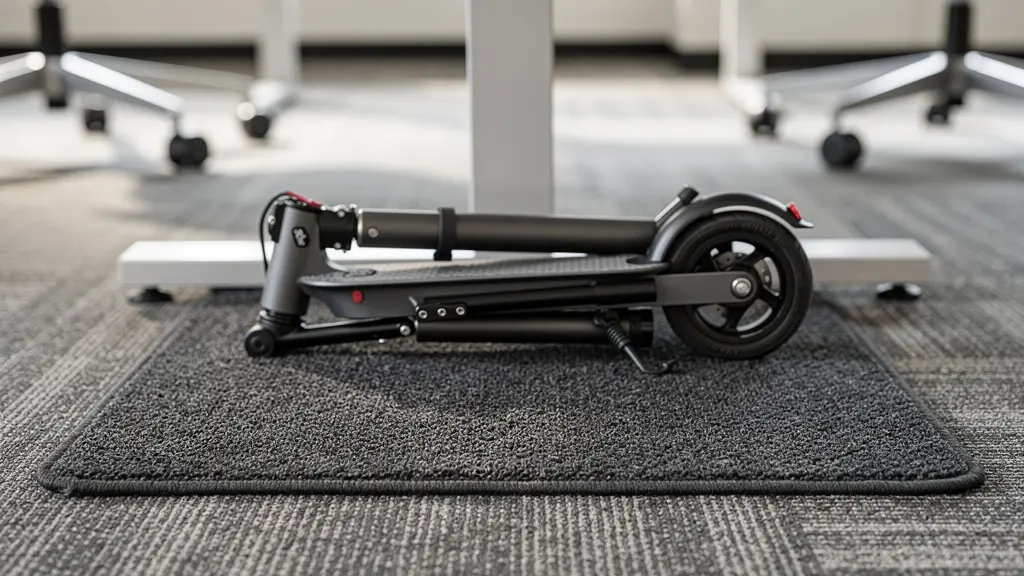
Secondly, master the art of the silent fold. The loud click-clack of a folding mechanism can be incredibly distracting in a quiet office. Practice folding and unfolding your scooter at home until the motion is smooth, fast, and quiet. When you arrive, perform the fold in a transitional space like a hallway or elevator lobby, not directly at your desk. Walk the folded scooter the final few feet to your workspace. This simple act of spatial awareness minimizes disruption and demonstrates respect for your colleagues’ focus.
Finally, ensure your scooter is completely stable and self-contained. Use a small bungee cord if necessary to keep the folded parts from springing open. The goal is for your device to become a static, inert object once stored. It should not create a tripping hazard or be visually distracting. By following these steps, your e-scooter becomes a seamless part of your personal workspace, not an invasive piece of outdoor equipment.
Arriving Sweat-Free: Managing Speed on Summer Days
One of the biggest deterrents to active commuting is the fear of arriving at the office feeling hot and sweaty. This is a valid concern that can undermine your professional presence. However, with an e-scooter, arriving cool and comfortable is not a matter of luck; it’s a matter of strategic speed management. The key is to shift your mindset: the goal is not to travel at max speed, but to use the electric motor to eliminate exertion.
Your e-scooter’s power is a tool for maintaining a steady, breezy pace, not for racing from the station. Since 80% of commutes are under 10 miles, you have ample battery life to prioritize comfort over velocity. On warm days, the objective is to generate airflow, not to break speed records. By keeping your speed to a moderate 12-15 mph, you create a constant, cooling breeze without pushing the motor—or your body—to its limits.
To perfect this, practice the “throttle feathering” technique. This involves using short bursts of power to get up to your desired cruising speed, then letting off the throttle completely and coasting for as long as possible. This method maximizes airflow while minimizing motor heat and battery consumption. A great approach is to:
- Use 3-second power bursts followed by 10-second coasting periods.
- Maintain an upright posture to maximize airflow around your torso.
- Plan your route to take advantage of tree-lined streets or corridors with building shadows.
- Give yourself an extra five minutes for your commute to remove any time pressure that encourages speeding.
This deliberate, relaxed pace transforms your commute. You are no longer battling the clock or the heat. Instead, you are using your device to create a comfortable, controlled glide. You leverage the motor to do the work, allowing you to arrive at your destination feeling as fresh and composed as when you left the train station. This is the ultimate expression of using technology to enhance, not disrupt, your professional readiness.
Key Takeaways
- Your last-mile commute is a system; optimize it by treating your e-device as a productivity tool, not a toy.
- Reliability is paramount. Ditch unpredictable dockless services in favor of a personal device you maintain and control.
- The right device is a balance of portability for transit (folding vs. detachable) and seamless integration into your office environment.
The Danger of Riding on Sidewalks When Bike Lanes End
The most dangerous moment of any last-mile journey occurs at the transition points—specifically, where a protected bike lane abruptly ends and forces you onto a sidewalk or into mixed traffic. This is where your “situational awareness” becomes your most important safety feature. Relying solely on the infrastructure is a recipe for disaster; you must proactively manage these high-risk zones.
Riding on the sidewalk is often illegal and always dangerous. It puts you in direct conflict with pedestrians, who are unpredictable and have the right of way. Their movements are erratic; they stop suddenly, change direction, or step out of doorways without looking. A professional’s commute cannot afford the risk of a collision that could cause injury and liability. The solution is not to jump onto the sidewalk, but to learn how to safely and confidently “take the lane” when necessary.
Taking the lane means positioning yourself in the center of the traffic lane, making you visible and predictable to motorists. This is often the safest place to be when a bike lane disappears. However, this maneuver and the navigation of transition zones require a specific skillset. You must learn to read the environment and anticipate hazards before they materialize.
Your Action Plan: Navigating High-Risk Transition Zones
- Identify the Zone: Recognize high-risk transition zones at least 50 feet before a bike lane ends. Look for tell-tale signs like bus stops, building entrances, and blind corners where conflicts are likely.
- Execute the Maneuver: To “Take the Lane,” you must signal your intention clearly, perform a shoulder check for traffic, and then move decisively to the center of the traffic lane to maximize your visibility to drivers.
- Read Pedestrian Cues: When near sidewalks, actively scan for pedestrian body language. Look for headphones, phone usage, or tourist behavior that signals a lack of awareness and a high potential for unpredictable movement.
- Practice Defensive Dismounting: In extremely chaotic zones, the smartest move is to dismount. Walk your device through the 50-foot danger zone rather than trying to ride through a complex mix of pedestrians and vehicles.
- Anticipate Car Doors: When passing parked cars, always use the ‘Dutch Reach’ principle in your mind. Ride far enough away from the doors to avoid being hit by one that opens unexpectedly.
By internalizing these defensive riding techniques, you shift from being a passive victim of poor infrastructure to an active manager of your own safety. This is the final piece of the productivity puzzle: ensuring your commute is not only fast and comfortable, but consistently safe and stress-free.
Frequently Asked Questions About Best E-Mobility Solutions for the Last 2 Miles of Your Commute
How can I minimize noise when folding/unfolding my scooter?
Perform folding operations in transition areas like elevator lobbies or stairwells rather than at your desk. Practice the folding mechanism at home to develop a smooth, quiet technique that takes under 10 seconds.
What are acceptable alternative storage locations if under-desk isn’t viable?
Greater portability offers a higher degree of flexibility when storing your rideable in your apartment or placing it under or near your desk at work. Consider coat closets, unused conference room corners, or dedicated bike storage areas if available.