
For high-stress professionals, the commute home is often seen as dead time or another source of stress. This is a misunderstanding. By treating your ride as a deliberate biochemical protocol—manipulating rhythm, environment, and intensity—you can actively dismantle the day’s accumulated cortisol. This article reframes the journey home not as a passive trip, but as your most powerful and controllable tool for achieving a full mental reset before family life begins.
The workday is over, but the work isn’t. It follows you. The lingering tension from your last meeting, the weight of a dozen unanswered emails, and the physiological hum of high-alert stress hormones—it all gets packed into your bag and carried home. For many high-stress professionals, the transition between the office and the front door is a non-existent buffer, leading to a blurred, stressful state where you’re never fully “off.” You arrive home physically, but your brain is still in a state of high-cortisol fight-or-flight.
The common advice is often generic: “exercise more” or “try to relax.” But this ignores the unique opportunity presented by the commute itself. What if that journey wasn’t just a way to get from point A to point B, but a dedicated decompression chamber? What if the ride home was more critical for your well-being than the ride there? The key isn’t just to pedal; it’s to pedal with purpose. It’s about transforming a simple bike ride into a precise, scientific protocol designed to systematically lower stress hormones and reset your cognitive state.
This guide moves beyond platitudes. We will explore the specific mechanisms that turn your commute into a cortisol detox. We’ll examine how rhythmic pedaling, route selection, and riding intensity become levers you can pull to engineer your own mental recovery. This isn’t about fitness; it’s about reclaiming the “third space” between your work self and your home self, ensuring you walk through your front door present, calm, and fully restored.
This article breaks down the science and strategy behind the ultimate stress-reducing commute. Explore the sections below to build your personalized cortisol-detox protocol.
Summary: Engineering Your Commute for a Mental Reset
- How Rhythmic Pedaling Lowers Stress Hormones in 20 Minutes
- Green Corridors vs Busy Streets: Impact on Cortisol Spikes
- Meditation vs Cycling: Which Reduces Anxiety Faster?
- The Risk of Aggressive Riding Negating Mental Health Benefits
- Forest Bathing on a Bike: Combining Nature and Motion
- Heatmaps vs Official Trails: Finding the Quietest Routes
- Why Silent Transport Improves Neighborhood Mental Health
- The “Slow City” Movement: How E-Bikes Reconnect Communities
How Rhythmic Pedaling Lowers Stress Hormones in 20 Minutes
The foundation of your cortisol detox is not speed or power, but rhythm. When your body is under chronic stress, your hypothalamic-pituitary-adrenal (HPA) axis remains on high alert, continuously pumping out cortisol. The smooth, predictable, and repetitive motion of pedaling acts as a powerful signal to down-regulate this system. This process is known as rhythmic entrainment, where the brain’s chaotic, stressed-out firing patterns begin to synchronize with the steady cadence of your legs. Within 15 to 20 minutes, this effect can begin to take hold, shifting you out of a “fight-or-flight” state and into a more balanced one.
Interestingly, this process involves an acute, temporary spike in stress hormones as a catalyst for deeper relaxation later. Don’t be alarmed if the first few minutes feel like work; it’s part of the protocol. A controlled study on late-evening exercise documented a 477.3% average cortisol increase during the session, yet this was followed by a significantly lower cortisol awakening response the next morning. This “stress and release” mechanism is what makes the ride home so effective: you use controlled physical stress to purge the lingering mental stress of the day, leaving your system primed for rest and recovery.
Think of it as a reset button. The consistent motion tells your nervous system that the “threat” (the stressful workday) is over and it’s safe to stand down. The key is consistency in your pedal stroke. Find a comfortable gear and focus on maintaining a smooth, circular motion rather than mashing the pedals. This is the first and most crucial step in your biochemical reset.
Green Corridors vs Busy Streets: Impact on Cortisol Spikes
Your brain processes millions of data points every second. When you ride on a busy street, you are subjecting it to a high-stimulus environment: the roar of engines, the visual clutter of traffic lights and advertisements, and the constant threat assessment of cars and pedestrians. This state of hyper-vigilance keeps your cortisol levels elevated, effectively canceling out the benefits of your rhythmic pedaling. The solution is to practice what we can call “environmental downshifting”: consciously choosing a route with minimal cognitive load.
This is where green corridors—bike paths, park trails, and tree-lined residential streets—become essential components of your decompression protocol. These environments drastically reduce the amount of information your brain needs to process. The sounds are softer, the visual field is simpler, and the perceived level of threat is near zero. This shift allows your mind to disengage from external monitoring and turn inward, amplifying the meditative effects of the ride.
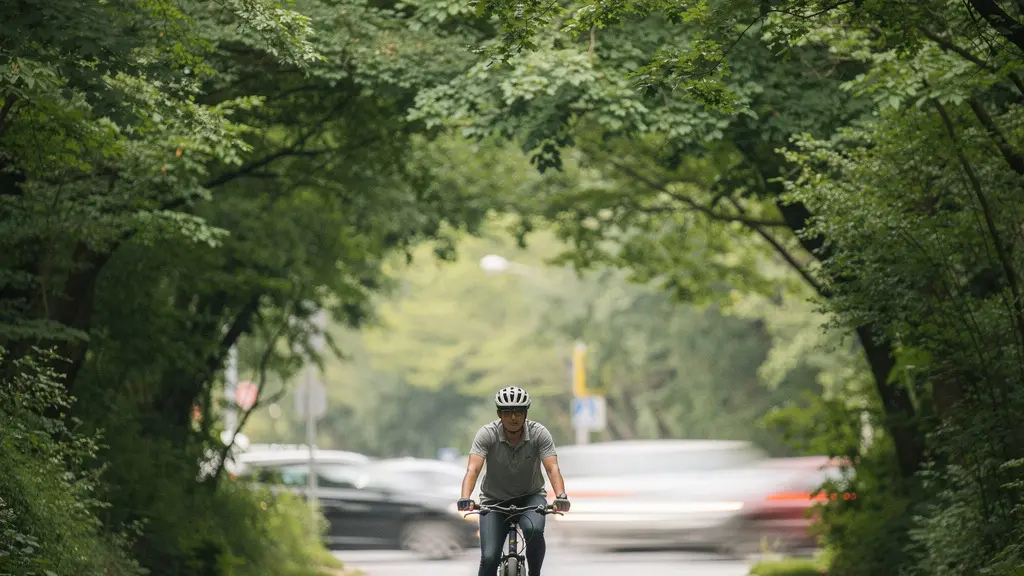
As the image above illustrates, the transition from urban chaos to natural tranquility is not just an aesthetic preference; it’s a neurological one. Moving into the green corridor is like closing dozens of noisy tabs in your brain’s browser. Suddenly, there is bandwidth available for your mind to wander, process the day’s events passively, and begin the work of cognitive decompression. Your route choice is as important as your bike; it is the landscape in which your mental reset will occur.
Meditation vs Cycling: Which Reduces Anxiety Faster?
Mindfulness meditation is a proven tool for anxiety reduction, but for a high-stress professional at the end of a long day, sitting still can sometimes feel like a battle. The restless energy and racing thoughts can make it difficult to drop into a calm state. This is where active, moving meditation like cycling presents a powerful alternative. It doesn’t require you to fight your body’s restlessness; it uses it as the very vehicle for achieving calm.
The science supports this. While both practices are effective, cycling can offer more immediate anxiolytic (anxiety-reducing) effects by providing a physical outlet for nervous energy. The focus required to balance, steer, and pedal occupies just enough cognitive space to prevent the mind from spiraling into rumination, creating the conditions for a flow state. A recent systematic review explored this, and while it confirms the complexity of the issue, it found that in 53% of tested conditions, a single bout of exercise significantly reduced state anxiety. This suggests that under the right circumstances—like a non-competitive, low-intensity ride—cycling is a highly reliable tool for a quick mental shift.
The choice isn’t about which is “better” in a universal sense, but which is more effective for you in that specific moment. After a day spent in meetings and in front of a screen, the body often craves motion. Cycling meets that need directly, providing a kinesthetic pathway to mindfulness that can be more accessible than stationary meditation. It bypasses the need for intense mental discipline and instead lets the rhythm of the ride do the heavy lifting.
The Risk of Aggressive Riding Negating Mental Health Benefits
There is a dangerous trap many professionals fall into: turning the commute home into another competition. Weaving through traffic, racing away from stoplights, and chasing personal records on Strava segments may feel productive, but it’s biochemically counter-productive to your goal of decompression. This aggressive, high-intensity riding style keeps your body in the very fight-or-flight mode you’re trying to escape. Your heart rate soars, your muscles tense, and your brain continues to pump out cortisol.
The intensity of your ride is a critical variable in your detox protocol. You must intentionally shift from an anaerobic, high-effort pace to a steady, low-intensity aerobic one. The goal is not to exhaust yourself, but to soothe your nervous system. Evidence shows that rides at higher intensities, like 60% and 80% of your VO2max, actively increase cortisol, whereas riding at a lower intensity of around 40% VO2max does not. In layman’s terms: if you are breathing too hard to hold a conversation, you are likely working against your goal of stress reduction.

This image of a tense hand gripping the handlebar is a perfect metaphor for the “commuter-racer” mindset. It represents a state of tension, not release. To truly decompress, you must consciously relax your grip, ease your pace, and let go of the impulse to “win” the ride home. Your only objective is to arrive calmer than when you started. This requires a mental shift from performance to presence.
Forest Bathing on a Bike: Combining Nature and Motion
The concept of “environmental downshifting” by choosing green corridors is powerfully amplified when you apply the principles of Shinrin-yoku, or “forest bathing.” This Japanese practice is not about hiking or exercise, but about simply immersing oneself in the atmosphere of a forest to soak in its health benefits. When you combine this intentional immersion with the rhythmic motion of cycling, you create a uniquely potent recipe for stress reduction.
The benefits are not merely poetic; they are physiological. Natural environments are rich in stimuli that are inherently restorative to the human brain. The fractal patterns in leaves, the dappled light through a canopy, and the earthy smells (known as phytoncides) have been shown to lower blood pressure, improve mood, and, most importantly, reduce stress hormones. A foundational meta-analysis confirmed this, reporting that salivary cortisol was significantly lower in forest groups compared with urban ones after the intervention. Cycling through a forest or a dense park allows you to experience these benefits in a dynamic way.
To practice forest bathing on your bike, engage all your senses. Pay attention to the sound of the wind through the trees and your tires on the soft earth. Notice the different shades of green and the way the light filters through the branches. Take deep breaths and smell the air. This isn’t a race to the other side of the park; it’s a slow, deliberate journey through a healing environment. The bike becomes a tool that allows you to cover more ground than walking, creating a flowing, immersive experience with nature that is profoundly calming to the nervous system.
Heatmaps vs Official Trails: Finding the Quietest Routes
You are now convinced of the need for quiet, green routes. But in a dense urban or suburban landscape, how do you find them? Relying solely on official, marked bike trails can be a trap; these are often the most crowded and predictable paths. The true art of the cortisol-detox commute lies in discovering the “secret” network of quiet residential streets, forgotten service roads, and small neighborhood parks that create a seamless, low-stress corridor. This is where modern technology becomes an unlikely ally in your search for tranquility.
Cycling apps like Strava offer a “Heatmap” feature, which visualizes the most frequently ridden routes by its users. Your first instinct might be to follow the brightest lines, but the real value is in what the heatmap *doesn’t* show. The bright, thick lines are the “busy streets” of the cycling world. Your goal is to use them as a guide to find the opposite: the faint, barely-there blue threads or, even better, the “cold” gray spaces between them. By inverting your use of the heatmap, you can identify underutilized paths and piece together a route that is optimized for solitude, not popularity. Strava’s own documentation explains that its Global Heatmap shows activity over the last year, giving you a long-term view of traffic patterns.
This strategy allows you to become the architect of your own peace and quiet. Combine heatmap analysis with satellite views from mapping services to spot green spaces and potential shortcuts. The perfect decompression route often isn’t a single path, but a curated sequence of low-stress segments that you stitch together yourself.
Your 5-Step Cortisol Detox Route Planner
- Identify Start & End Points: Map the most direct route between your work and home. This is your baseline to improve upon.
- Analyze the Heatmap Inversely: Open a cycling heatmap and locate your baseline route. Now, actively search for parallel streets, alleys, or paths that are “cold” (have little to no activity shown).
- Scan for Green Pockets: Switch to a satellite view. Look for parks, cemeteries, canal paths, or even large, tree-lined residential blocks that you can thread through, connecting the “cold” spots you identified.
- Test and Refine: Ride the new proposed route. Note any high-stress points (e.g., a difficult intersection, a noisy industrial zone). Go back to the map and find a way to bypass them.
- Save Your Protocol: Once you have a route that is 80% or more low-stress, save it. This is now your official “Decompression Protocol” route, ready to be deployed after a tough day.
Why Silent Transport Improves Neighborhood Mental Health
Your personal quest for a quiet commute is a microcosm of a much larger public health issue: the psychological toll of noise pollution. The constant, low-grade auditory stress from traffic—engine noise, horns, sirens—contributes to elevated cortisol levels, sleep disturbances, and increased annoyance for entire communities. When you choose to ride a bicycle, you are not only detoxing your own system but also contributing to the collective calm of the environment you pass through.
Silent transport is a form of civic kindness. Unlike a car or a motorcycle, a bicycle adds almost no noise to the soundscape. This has a tangible, positive impact. In neighborhoods with lower traffic noise, residents report lower stress levels and a greater sense of peace. Your choice becomes a vote for a different kind of urban environment—one where the sounds of nature and community are not drowned out by the internal combustion engine. This creates a positive feedback loop: as more people choose silent transport, neighborhoods become quieter and more pleasant, which in turn encourages more people to walk and cycle.
By seeking out and using quiet routes, you are reinforcing their value and helping to build a case for their preservation and expansion. Your personal cortisol-detox protocol is therefore not a selfish act, but one that aligns perfectly with the creation of healthier, more humane communities. You are reclaiming silence, both for yourself and for those whose windows you glide past.
Key Takeaways
- Your commute is not wasted time; it’s a controllable “third space” for active mental decompression.
- The goal is not speed but rhythm. A steady, moderate cadence helps down-regulate stress hormones like cortisol.
- Route selection is critical. Prioritize low-stimulus green corridors over high-stress, noisy streets to reduce cognitive load.
The “Slow City” Movement: How E-Bikes Reconnect Communities
The principles of a deliberate, stress-reducing commute align perfectly with the broader “Slow City” or Cittaslow movement. This philosophy prioritizes quality of life over the frantic pace of modern urbanism, advocating for less traffic, more green space, and a stronger sense of community. By choosing to ride slowly and intentionally, you are personally enacting the core tenets of this movement. You are choosing connection over speed, and presence over efficiency-at-all-costs.
This shift is being powerfully enabled by the rise of the e-bike. For many professionals, the barriers to a cycle commute are real: distance, hills, or the fear of arriving home drenched in sweat. The e-bike elegantly removes these obstacles. It provides just enough assistance to make the ride feel gentle and manageable, keeping your heart rate in that ideal, low-intensity aerobic zone for stress reduction. It democratizes the cortisol-detox commute, making it accessible to people of all fitness levels and across varied topographies.
The e-bike allows you to fully embrace the “slow” ethos. You can cover significant distances without falling into the “commuter-racer” trap. This encourages exploration, allowing you to choose longer, more pleasant routes through parks and quiet neighborhoods without worrying about time or exhaustion. It’s the ultimate tool for effortless intentionality, amplifying all the benefits of a decompression ride. As more people adopt this technology, we move closer to creating cities that are not just faster, but fundamentally calmer and more connected.
Your commute home is no longer a passive event, but an active choice. By applying these principles, you can transform it into a non-negotiable part of your mental health routine. Start tonight by redesigning your route and reclaiming your peace of mind, one pedal stroke at a time.