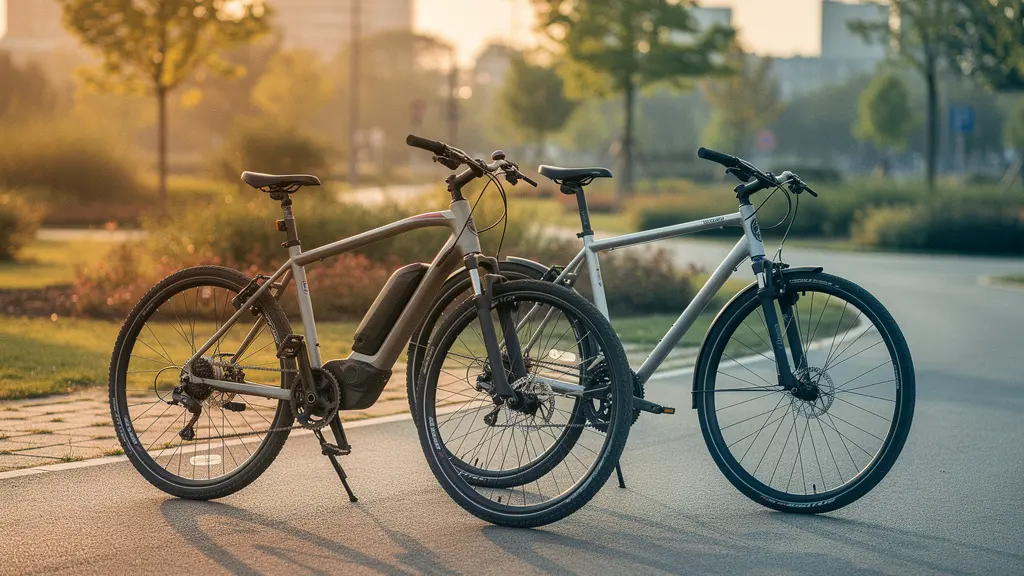
E-bikes can create superior weight loss outcomes compared to acoustic bikes through metabolic consistency and reduced compensatory behaviors, not despite the motor assistance.
- Frequency of moderate effort overcomes lower per-session caloric expenditure by preventing the collapse of non-exercise physical activity common after intense sessions
- Moderate intensity regulates appetite hormones more favorably than high-intensity cycling, reducing post-ride compensatory eating
- Standard e-bike displays overestimate human calorie burn by failing to distinguish rider power from motor contribution
Recommendation: Prioritize consistent daily moderate rides over sporadic intense suffering to maximize sustainable fat loss.
The prevailing anxiety among weight-conscious cyclists—that pedal-assist e-bikes represent a “cheat” that sabotages fat loss—reflects a fundamental misunderstanding of metabolic physiology. While the immediate sensation of sweating and suffering on an acoustic bike suggests superior caloric destruction, single-session energy expenditure proves remarkably poor at predicting long-term body composition changes. The metabolic narrative has historically prioritized acute intensity over sustainable frequency, leading riders to conflate physical discomfort with weight management efficacy.
This misconception stems from observational data showing that vigorous cycling burns more calories per minute than assisted pedaling. However, such snapshots ignore compensatory reductions in daily movement, hormonal appetite dysregulation, and the sustainability constraints that govern real-world adherence. The “no pain, no gain” framework fails to account for the neuroendocrine and behavioral adaptations that often nullify the benefits of heroic weekend efforts.
Metabolic research reveals a more nuanced reality: sustainable weight management depends on total weekly energy balance integrated with appetite regulation and recovery capacity. E-bikes alter the physics of cycling without eliminating the biological stimulus for adaptation, creating distinct metabolic advantages through increased ride frequency and reduced compensatory behaviors. This analysis examines the physiological mechanisms—including non-exercise activity preservation, post-exercise appetite signaling, and the psychology of energy compensation—that determine whether a cycling modality supports or sabotages weight loss goals.
The following sections deconstruct the specific metabolic, psychological, and technological factors that determine the true caloric impact of electric versus acoustic cycling.
Table of Contents: The Science of Sustainable Calorie Burn
- Why You Might Burn More Total Calories on an E-Bike (Frequency Effect)
- How to Calculate Real Calories Burned Without a Power Meter
- Post-Ride Hunger: Do E-Bikers Eat Less After Riding?
- The Risk of “Moral Licensing” with Food After a Short Ride
- Fasted Riding: Is It Safe on an E-Bike?
- Why Your E-Bike Display Overestimates Calories Burned by 40%
- How Moderate Effort Burns More Fat Than High Intensity (Sometimes)
- Using E-Bike Metrics to Manage Recovery Rides for Cyclists
Why You Might Burn More Total Calories on an E-Bike (Frequency Effect)
The assumption that acoustic cycling always yields superior weight loss stems from a misunderstanding of exercise energetics. While a single intense session on a traditional bike may elevate acute energy expenditure, a 2023 review reports that about 67% of studies found a compensatory decrease in non-exercise physical activity (NEPA) following structured high-intensity training. This phenomenon—where riders unconsciously reduce daily walking, standing, and fidgeting after exhausting workouts—can negate the caloric advantage of that brutal Sunday ride.
Conversely, e-bike commuting operates at a sustainable metabolic sweet spot. A field study measuring oxygen consumption during real-life commuting reports a mean intensity of approximately 5.9 METs, classifying it as moderate-to-vigorous activity that remains repeatable five days a week. Because the effort feels manageable rather than punishing, riders maintain higher baseline activity levels throughout the remainder of the day, avoiding the NEPA collapse that sabotages many high-intensity programs.

The mathematical reality favors consistency: five rides at 300 calories each totals 1,500 weekly calories burned, while one exhausting 600-calorie acoustic ride that suppresses movement for two days afterward often results in lower net weekly expenditure. Sustainable frequency overcomes lower per-session intensity when total energy balance is calculated across seven days.
How to Calculate Real Calories Burned Without a Power Meter
Consumer wearable devices and e-bike displays typically rely on algorithms that equate speed with human effort, creating significant error margins. Without isolating rider power from motor assistance, these devices attribute mechanical work to biological work. Speed-based consumer algorithms frequently misestimate energy expenditure in contexts where velocity is decoupled from muscular work, rendering most fitness trackers unreliable for e-bike riders.
For accurate tracking without laboratory equipment, the Compendium of Physical Activities provides metabolic equivalent (MET) values that account for assist levels. The updated Compendium lists e-bike MET values showing that energy cost varies strongly by support level, ranging from approximately 6.8 MET without electronic support down to 4.0 MET with high electronic support.
Action Plan: Calculate Your Real Calorie Burn Without a Power Meter
- Select a realistic MET value for your ride segment (use Compendium data: 6.0 for light assist, 4.0 for high assist)
- Apply the standard formula: Calories per minute ≈ (MET × 3.5 × body mass in kg) / 200
- Multiply by ride duration in minutes, summing segments if assist levels varied during the trip
- Validate using the talk test: if you can speak in full sentences, you are likely in the moderate 4-6 MET range; breathlessness indicates higher intensity
- Log your assumptions (MET selected, duration, body weight) to enable week-to-week comparisons rather than obsessing over absolute accuracy
Post-Ride Hunger: Do E-Bikers Eat Less After Riding?
Exercise intensity modulates appetite-regulating hormones through distinct pathways. High-intensity cycling typically suppresses acylated ghrelin temporarily, while moderate-intensity efforts produce different appetite signaling patterns. However, this hormonal suppression following intense efforts often triggers compensatory hyperphagia later in the day, particularly when high-intensity sessions are sporadic rather than habitual.
E-bike riders typically sustain moderate aerobic zones where ghrelin dynamics remain stable, potentially avoiding the rebound appetite spikes that characterize “weekend warrior” patterns. As Kara Anderson, Ph.D., notes, “Exercise should be thought of as a ‘drug,’ where the ‘dose’ should be customized based on an individual’s personal goals”. For weight management, the moderate, repeatable “dose” of e-bike commuting may outperform erratic high-intensity sessions that dysregulate subsequent feeding behavior.
The practical implication involves timing and composition of post-ride nutrition rather than rigid restriction. Moderate-effort riders often report better adherence to caloric targets because they avoid the ravenous hunger that follows glycogen-depleting intense efforts. Appetite stability across the 24-hour period proves more valuable than acute caloric destruction followed by uncontrolled eating.
The Risk of “Moral Licensing” with Food After a Short Ride
The psychological phenomenon of “moral licensing” presents a significant barrier to weight management among casual cyclists. A recent scoping review on eating after exercise found that 23 studies investigated this psychology, identifying how short bouts of activity trigger permission-based eating. Riders unconsciously license indulgence because the physical sensation of effort—however brief—creates a subjective sense of “earned” calories.

“Individuals may consume additional food to refuel their energy stores after exercise (psychological compensatory eating), or consume unhealthy or energy dense foods to reward themselves after exercise, especially if exercise is experienced negatively (post-exercise licensing).”
– Alice Porter et al., Journal of Nutritional Science
E-bike riders face particular vulnerability here because the reduced physical suffering may paradoxically increase licensing tendencies—”I didn’t work that hard, but I still exercised.” Combating this requires reframing the activity not as a caloric transaction to be rewarded, but as metabolic infrastructure supporting overall health. Pre-planning post-ride meals rather than making ad-hoc decisions in a depleted state mitigates this risk.
Fasted Riding: Is It Safe on an E-Bike?
Fasted riding—whether on acoustic or electric bicycles—requires careful risk stratification. While the practice appeals to those seeking enhanced fat oxidation, Mandy Hagstrom states that “The evidence doesn’t support the superiority of fasted exercise for weight loss, or sports performance.” The metabolic advantage commonly attributed to fasted cardio largely dissipates when total daily energy balance is equated.
For e-bike riders specifically, safety concerns center on hypoglycemia risk during morning commutes. A randomized clinical trial in JAMA Network Open examining time-restricted eating in adults with type 2 diabetes highlights the importance of medication timing and monitoring when exercising in fasted states. Even for metabolically healthy individuals, fasted e-bike riding—particularly at higher assist levels that encourage faster speeds in traffic—may impair reaction times or decision-making if blood glucose drops.
Practical guidelines suggest limiting fasted rides to low-traffic routes under 45 minutes, carrying rapid glucose sources, and avoiding high-assist modes that mask physiological distress signals. The moderate intensity inherent to most e-bike commuting actually makes fasted riding safer than high-intensity acoustic efforts, but individual tolerance varies significantly. Situational awareness remains paramount when metabolic reserves are depleted.
Why Your E-Bike Display Overestimates Calories Burned by 40%
E-bike displays systematically overestimate human caloric expenditure because they cannot distinguish between watts generated by the rider versus watts contributed by the motor. This algorithmic confusion leads to commonly cited overestimation figures, though individual variance depends on assist level and terrain. Without torque sensor data isolating rider power, displays attribute the entire mechanical output to biological work.

Controlled off-road comparisons demonstrate that while conventional mountain biking demands higher oxygen uptake than electric-assisted variants, the critical error occurs when displays fail to account for this differential. When assistance levels are high, the disparity between displayed calories and actual human expenditure widens significantly. Advanced systems utilizing power meters can separate human work from total work, but most stock displays lack this capability.
Riders should treat displayed calories as arbitrary “effort units” rather than dietary currency. The mechanical reality of shared powertrains means that speed and distance metrics become decoupled from metabolic cost, rendering simple algorithmic estimates physiologically meaningless for energy budgeting purposes.
How Moderate Effort Burns More Fat Than High Intensity (Sometimes)
The “afterburn effect” or Excess Post-exercise Oxygen Consumption (EPOC) has been overstated in popular fitness culture. Controlled studies measuring EPOC after isocaloric workouts demonstrate that the differences between exercise modalities are metabolically insignificant in the context of weekly energy balance. The modest additional caloric burn following intense exercise fails to compensate for the sustainability advantages of moderate efforts.
This reality challenges the high-intensity superiority narrative. While vigorous exercise burns more calories per minute during the activity, the limited EPOC differential means that total weekly volume often favors the modality that allows daily participation. Acoustic bike riders frequently cannot maintain the frequency necessary for significant fat loss because high-intensity sessions require substantial recovery, whereas e-bike riders accumulate more total weekly minutes in zones where fat oxidation rates are highest.
The “fat burning zone”—typically 60-70% of maximum heart rate—aligns perfectly with the sustainable output of pedal-assist commuting. Rather than pursuing maximal acute calorie destruction, effective weight management prioritizes the accumulation of moderate-duration sessions that spare muscle glycogen while creating manageable dietary deficits. Metabolic consistency ultimately trumps acute suffering.
Key Takeaways
- Frequency of riding matters more than per-session intensity for total weekly calorie expenditure
- E-bike displays overestimate calories by failing to separate human power from motor assistance
- Moderate effort reduces compensatory eating behaviors and appetite hormone dysregulation compared to high-intensity cycling
Using E-Bike Metrics to Manage Recovery Rides for Cyclists
Sustainable weight loss through cycling requires periodization strategies that prevent overreaching while maintaining caloric consistency. E-bike metrics—particularly when utilizing heart rate monitors and perceived exertion scales—enable riders to modulate recovery rides precisely. Unlike acoustic cycling, where terrain dictates intensity, e-bike assistance allows riders to enforce true recovery zones (conversational pace) regardless of hills or headwinds.
This technological advantage supports the central thesis: weight management succeeds through metabolic consistency rather than heroic suffering. By using low-assist modes for active recovery and higher assistance when fatigue accumulates, riders can maintain seven-day-per-week movement patterns without the orthopedic or hormonal costs of constant high-intensity work. The ability to standardize effort across varying topography ensures that recovery days remain genuinely restorative rather than accidentally becoming secondary stressors.
Long-term adherence data suggests that the flexibility afforded by pedal-assist systems correlates with higher retention rates in exercise programs. When riders eliminate the dread of mandatory suffering, they transform cycling from a punitive chore into sustainable lifestyle infrastructure. The periodization flexibility offered by variable assistance ultimately supports the consistent energy deficit required for fat loss without the burnout that derails acoustic-only cyclists.
Evaluate your current riding patterns against these metabolic principles to determine whether your approach prioritizes sustainable frequency or unsustainable intensity—and adjust your strategy accordingly.