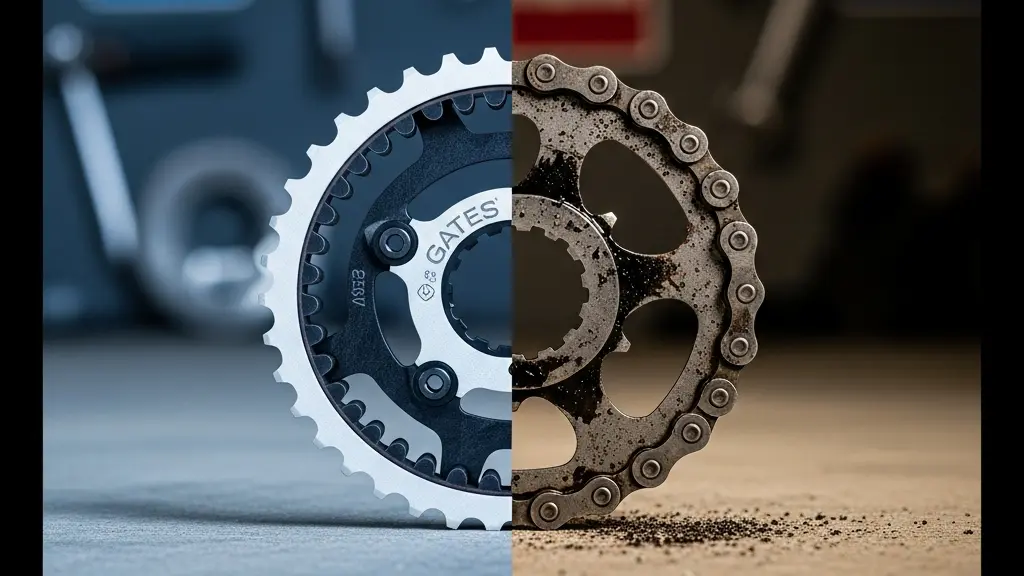
A belt drive’s “maintenance-free” reputation is earned, not given; its superior durability hinges on a perfectly integrated and configured system.
- While efficiency is nearly identical when new, a belt drive maintains its performance edge over a worn, stretched chain in real-world conditions.
- The primary sources of failure are not the belt itself, but incorrect tension and poor frame alignment, which are non-negotiable factors for reliability.
- The choice of an internally geared hub (IGH) and motor type has a greater impact on performance and ride feel than the belt-vs-chain decision alone.
Recommendation: For a hilly commute where reliability is paramount, a mid-drive motor paired with a robust IGH like a Rohloff offers the most balanced and durable belt-drive experience, justifying the premium investment.
For any commuter tired of weekly chain lubrication and the tell-tale grease mark on their right pant leg, the Gates Carbon Drive system feels like a revolution. It promises a clean, quiet, and virtually maintenance-free existence. The debate often boils down to a simple trade-off: higher upfront cost for long-term convenience. But this surface-level comparison misses the crucial engineering reality. The legendary durability of a belt isn’t an automatic feature you buy; it’s the outcome of a precisely engineered system.
The transition from a chain to a belt is not a simple component swap. It involves a cascade of considerations, from frame stiffness and drivetrain alignment to the specific internally geared hub (IGH) and motor you pair it with. The real question isn’t just whether a belt is better than a chain, but rather: is your entire bike system, from hub to motor, optimized to unlock the belt’s true potential? Ignoring these interconnected factors can lead to premature wear, frustrating performance issues, and the feeling that the premium price wasn’t worth it after all.
This article moves beyond the “clean vs. greasy” platitudes to dissect the critical, often-overlooked technical trade-offs. We will analyze the specific wattage drag, the system’s vulnerability to environmental factors like gravel, and the critical role that component pairing plays in creating a truly reliable, low-maintenance drivetrain that lives up to the promise.
For those who prefer a visual guide, the following video demonstrates one of the unique handling characteristics of a carbon belt—the proper technique for coiling it for transport or storage, a task that requires a different approach than a traditional chain.
To fully understand if this drivetrain evolution is right for your needs, we will break down the key performance characteristics and system requirements. This structured analysis will provide a clear, evidence-based framework for your decision.
Summary: The Definitive Engineering Comparison of Belt vs. Chain Drivetrains
- Why Belts Need Higher Tension Than Chains (And How to Measure)
- How Gravel Destroys Belts: The Risk of Open Belt Guards
- Wattage Drag: Does a Belt Really Slow You Down?
- The Risk of Offset Wheels Causing Rapid Belt Wear
- Pairing Belts with Enviolo vs Rohloff: The Ultimate Drivetrain
- Belt Drive vs Chain: Which Transmission Suits Your Motor?
- Why Chains Wear Out Faster on E-Bikes (And How to Check)
- Mid-Drive vs Hub Motor: Which Is Best for Hilly Commutes?
Why Belts Need Higher Tension Than Chains (And How to Measure)
Unlike a chain, which engages sprockets with rolling metal links, a carbon belt relies on high tension to ensure its teeth mesh securely with the pulley-like cogs. This isn’t a design flaw; it’s a fundamental feature. The tension, or ‘preload’, prevents the belt from skipping over the teeth under heavy load, such as when starting from a standstill or climbing a steep hill. A skipping belt is not only a jarring experience but can also damage the internal carbon fiber cords, compromising its integrity. Therefore, maintaining the correct tension is the single most important maintenance task for any belt-drive owner.
This required tension means the system has a baseline level of friction even when you aren’t pedaling. However, the goal is not to achieve the highest tension possible, but the correct tension specified by the manufacturer. Too little tension leads to skipping, while excessive tension can dramatically increase drag and, more critically, place destructive stress on the bearings inside the internally geared hub or bottom bracket, leading to premature failure of much more expensive components.
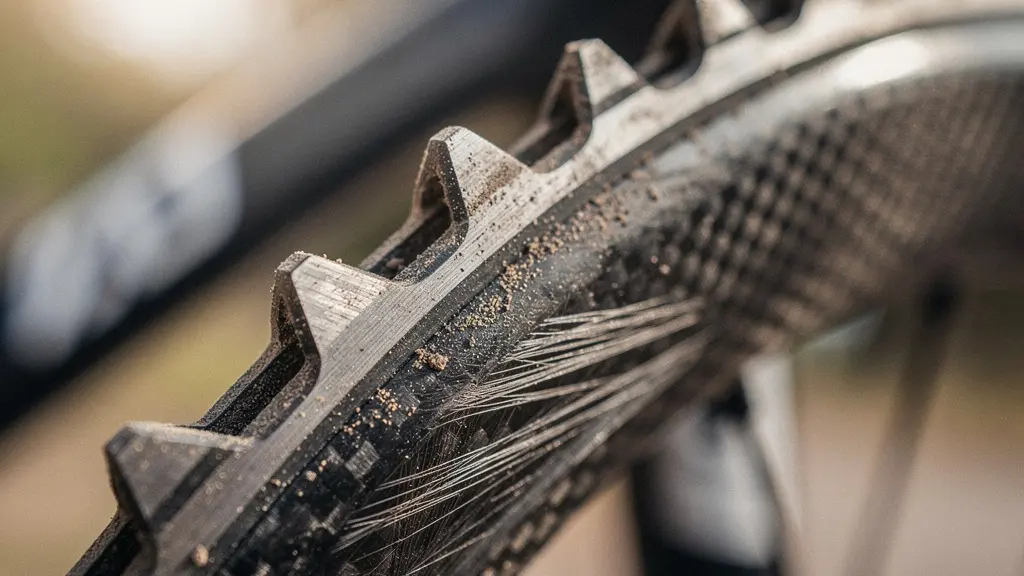
Measuring this tension is more science than art. While experienced mechanics can get a feel for it, the most reliable method for consumers is using frequency measurement. The Gates Carbon Drive smartphone app uses your phone’s microphone to listen to the ‘note’ the belt produces when plucked like a guitar string, translating that frequency into a tension reading. This provides a quantitative way to ensure your drivetrain is operating within its optimal window.
Essential Checklist for Measuring Belt Tension
- Download the App: Get the official Gates Carbon Drive app (iOS/Android), which uses your phone’s microphone to read the belt’s vibration frequency (Hz).
- Prepare the Bike: Place the bike on a stable stand so the rear wheel can spin freely. Perform the measurement in a quiet environment to avoid interference.
- Pluck and Read: Hold your phone’s microphone near the center of the belt and pluck it firmly like a guitar string. For most e-bikes with an IGH, the target frequency is between 35 Hz and 50 Hz.
- Check for Consistency: Take readings at multiple points by rotating the cranks a quarter turn for each measurement. Gates considers a tension variation of up to 10-15 Hz acceptable.
- Cross-Verify if Needed: If you get wildly inconsistent results, consider cross-checking with a mechanical tool like a Gates Krikit gauge, as phone microphones can be unreliable in noisy settings.
How Gravel Destroys Belts: The Risk of Open Belt Guards
A belt drive’s greatest strength—its clean, lubrication-free surface—is also the source of its primary weakness: vulnerability to debris. While a chain can operate caked in mud and grime (albeit inefficiently), a carbon belt system is far less tolerant. The precise fit between the belt’s teeth and the sprocket’s grooves leaves no room for error. A single piece of gravel or a small rock becoming lodged in the sprocket can be catastrophic. As the belt rotates over the trapped debris, the immense pressure can sever the internal carbon fiber tensile cords, leading to sudden and complete belt failure.
This risk is especially high for cyclists venturing off pristine asphalt. Touring bikes used on gravel paths or in sandy environments are particularly susceptible. While some belt systems, like Gates’ CenterTrack design, feature a central channel to help shed debris, they are not immune. A small rock wedged in just the right way can still cause irreparable damage, turning a low-maintenance dream into a costly roadside nightmare.
Case Study: CenterTrack Belt Failure in Harsh Touring Conditions
Multiple long-distance touring cyclists have documented belt failures when riding through sandy or gravel-heavy regions. One rider in Norway reported the complete destruction of their belt, resulting in a replacement cost of €110 for the belt and shipping alone. For expeditions through parts of Asia, South America, or Africa, Gates itself recommends that riders carry two spare belts and an extra set of sprockets due to the extreme conditions and lack of parts availability. These real-world examples underscore that while belts are durable, their reliability is conditional on the environment and highlights the importance of proper alignment and tension, as any misalignment dramatically accelerates wear when abrasive debris is present.
For this reason, many urban and commuter bikes equipped with belt drives feature fully enclosed chain guards or cases. These are not just for keeping your pants clean; they are a critical protective element for the drivetrain. If you plan to ride frequently on anything other than paved roads, an open or minimalist belt guard significantly increases your risk of a trip-ending failure.
Wattage Drag: Does a Belt Really Slow You Down?
One of the most persistent arguments against belt drives centers on efficiency. The high tension required for a belt to function correctly inherently creates more drag than a well-lubricated new chain, especially at lower power outputs. This has led to the perception that belts are “slower” than chains. However, this simplistic view ignores the most important factor for a daily commuter: how efficiency changes over time and in real-world conditions.
Laboratory tests confirm that a brand-new, perfectly lubricated chain is marginally more efficient than a new belt at casual power outputs. The crossover point where they become equal is typically around 200-210 watts of rider input—a strong, sustained effort. Above that, the belt becomes more efficient. But nobody’s drivetrain stays new for long. As a chain wears, its rollers and plates degrade, and lubricant gets contaminated with grit. This is where the belt’s key advantage emerges. A belt’s efficiency remains remarkably consistent throughout its lifespan. It doesn’t stretch or require lubrication, so its performance on day one is nearly identical to its performance thousands of miles later.

For the average commuter riding in all weather, this long-term consistency is far more valuable than a marginal 1-watt advantage on a brand-new chain. In fact, comprehensive testing has shown that a worn chain drive is about 4% less efficient than a worn belt drive. The initial efficiency penalty of the belt is effectively erased and reversed over the usable life of the components.
| Condition | Chain Drive (Watts Lost) | Belt Drive (Watts Lost) | Winner |
|---|---|---|---|
| New, low power (~75W casual) | ~2.92W average | ~3.93W average | Chain (+1W advantage) |
| New, crossing ~208-212W | Equal | Equal | Tie |
| New, high power (250W+) | Higher losses at tension | Inherently more efficient | Belt |
| Worn (after real-world riding) | ~4% less efficient than new | Maintains original efficiency | Belt (significant advantage) |
| New belt vs new chain (overall) | Difference is approximately 0.5% | Negligible | |
The Risk of Offset Wheels Causing Rapid Belt Wear
While tension is the most talked-about aspect of belt maintenance, drivetrain alignment is an equally critical, and often overlooked, factor. A carbon belt must run on a perfectly straight line from the front chainring to the rear cog. Unlike a chain, which has lateral flexibility to accommodate the angle of a derailleur, a belt has virtually zero tolerance for misalignment. If the rear wheel is not perfectly centered in the frame, or if the frame itself lacks sufficient stiffness, the belt will be forced to run at a slight angle. This is a recipe for disaster.
When misaligned, the edge of the belt will constantly rub against the flange of the sprockets. This continuous friction rapidly frays the sides of the belt and can cause it to “walk” off the cog, leading to accelerated wear and potential failure. This is why belt drives are only found on bikes with internally geared hubs or single-speed setups; the fixed, straight chainline is a non-negotiable requirement. Furthermore, the bicycle frame itself must be specifically designed for a belt drive. It requires not only a “split” in the rear triangle to allow the one-piece belt to be installed, but also significantly higher stiffness than a standard frame to prevent flex under load, which would alter the alignment.
Diagnosing a misalignment can be tricky. One of the tell-tale signs is inconsistent tension readings as you rotate the cranks. If the measured frequency (Hz) jumps around significantly at different points in the rotation, it’s a strong indicator that the belt is being pulled tighter and looser due to an offset, a problem no amount of tension adjustment can fix. This issue highlights the importance of a quality frame and professional initial setup. A cheap frame that flexes easily will doom a belt drive system to a short and noisy life, completely negating its benefits.
Pairing Belts with Enviolo vs Rohloff: The Ultimate Drivetrain
A belt drive is only one half of the transmission equation; its performance is inextricably linked to the internally geared hub (IGH) it partners with. For premium e-bikes, the choice often comes down to two titans: the continuously variable Enviolo hub and the legendary Rohloff Speedhub. They represent two fundamentally different engineering philosophies, and the right choice depends entirely on your riding style and terrain.
The Enviolo hub is a continuously variable transmission (CVT), meaning it has no distinct gears. Instead, a twist shifter allows for seamless adjustment across its range, even under load. It’s praised for its intuitive, user-friendly operation and is often paired with automatic shifting systems (Automatiq) for a true “set-and-forget” experience. However, its 380% gear range can feel limited on very steep climbs, and its internal design based on tilting ball bearings creates more inherent drag than a traditional gear system. It is a sealed-for-life unit, meaning it’s not designed to be serviced, with an expected lifespan of 20,000-30,000 miles.
Conversely, the Rohloff E-14 Speedhub is the pinnacle of mechanical engineering. It offers 14 distinct, evenly spaced gears operated by an electronic shifter, providing a massive 526% gear range. This makes it far superior for tackling long, steep climbs. Its planetary gear system is more mechanically efficient (less drag) than the Enviolo. While it requires an oil change every 5,000 km, the hub is designed to be fully serviceable and can last for well over 60,000 miles. The trade-off is its significantly higher cost and the stepped, rather than smooth, shifting.
Case Study: Rider Switches from Enviolo to Rohloff for Mountainous Terrain
A retired engineer building a high-torque (120Nm) belt-drive e-bike for use in mountainous terrain contacted both companies directly. Enviolo’s engineers confirmed their hub was designed primarily for urban riding on flat to rolling hills. The Rohloff team, however, affirmed their hub was specifically engineered to handle the sustained torque and low-speed demands of long, steep climbs. The rider ultimately chose the Rohloff, reflecting a broad consensus that while Enviolo excels in urban simplicity, its 380% range is often insufficient for demanding terrain, making Rohloff the superior choice for serious hill-climbing performance.
Belt Drive vs Chain: Which Transmission Suits Your Motor?
The rise of e-bikes has intensified the belt vs. chain debate, particularly with the advent of powerful mid-drive motors. A mid-drive motor applies its torque directly to the cranks, meaning all that power is amplified through the drivetrain to the rear wheel. This places enormous stress on both chains and belts. While a belt is inherently stronger, its success is dependent on being part of a cohesive system, and new motor technologies are fundamentally changing that system architecture.
The most revolutionary development is the integrated motor-gearbox unit, exemplified by the Pinion MGU (Motor Gearbox Unit). This groundbreaking system combines an 85 Nm motor and a 12-speed gearbox (with a massive 600% range) into a single, sealed unit at the bottom bracket. This design makes the rear derailleur obsolete. Because all gear-shifting happens within the central gearbox, the transmission to the rear wheel only requires a simple, single-speed connection. In this architecture, a Gates Carbon Drive belt isn’t just a good option; it’s the most logical one. It creates a supremely durable, almost entirely maintenance-free system, free from the vulnerabilities of an exposed derailleur and chain.
This integration also offers significant performance benefits. By moving the weight of the gearbox from the rear hub to the center of the frame, the Pinion MGU dramatically reduces unsprung mass at the rear wheel. This allows the suspension to work more effectively and improves handling over rough terrain, providing a smoother and more controlled ride. It represents a paradigm shift where the motor, gearbox, and belt are conceived as a single, optimized unit, delivering a level of integration and reliability that separate components cannot match.
Why Chains Wear Out Faster on E-Bikes (And How to Check)
While a standard bicycle chain on a non-electric bike can last for several thousand miles with proper care, the same cannot be said for e-bike chains, especially those paired with powerful mid-drive motors. The immense and instantaneous torque from the motor places a level of stress on the chain that it was never originally designed to handle. This results in accelerated “stretch,” where the bushings and pins in the chain wear down, increasing the distance between links.
This accelerated wear is not a minor issue. A stretched chain no longer meshes properly with the teeth of the cassette and chainring, leading to poor shifting, increased noise, and, most importantly, rapid wear of these more expensive components. In extreme cases, the torque can be enough to physically break the chain, often at the master link, leaving the rider stranded. Riders of powerful mid-drive e-bikes have reported breaking multiple chains in a single month. This has led to the development of “e-bike specific” chains with thicker plates and stronger pins, but even these are a compromise.
This is where the durability of a Gates Carbon Drive truly shines. The carbon fiber tensile cords are incredibly resistant to stretching. In side-by-side laboratory stress tests, the contrast is stark. According to Gates’ own testing data, e-bike specific chains failed at just 275 miles under peak load conditions, whereas the CDX belt is rated to last for over 10,000 miles under the same stress. For a commuter who relies on their bike daily, this difference in lifespan and reliability is the most compelling argument for the belt’s higher initial cost. Checking for chain wear is simple with a chain checker tool; if it shows 0.5% to 0.75% wear, it’s time for a replacement to save the rest of your drivetrain.
Key Takeaways
- Tension is a critical feature, not a flaw. A belt’s reliability is directly tied to maintaining the correct tension, making it the most important check for any owner.
- Long-term efficiency is the real prize. While a new chain is slightly more efficient, a belt maintains its performance over thousands of miles, while a worn chain becomes significantly less efficient.
- The system is everything. The choice of hub (Enviolo vs. Rohloff) and motor (mid-drive vs. hub) has a greater impact on performance and durability than the belt itself.
Mid-Drive vs Hub Motor: Which Is Best for Hilly Commutes?
For a belt-drive commuter facing a route with significant hills, the choice of motor architecture—mid-drive versus hub motor—is arguably more important than the belt-versus-chain decision. Each system interacts with the belt and geared hub in fundamentally different ways, with profound implications for climbing performance, handling, and even roadside maintenance.
A hub motor, located in the center of the rear wheel, provides power directly to the wheel, bypassing the drivetrain. This means the belt is not subjected to the motor’s torque, reducing wear on the transmission. However, the motor operates at a fixed 1:1 ratio with the wheel. On a long, steep climb, the motor is forced to spin slowly under high load, causing it to bog down, lose efficiency, and potentially overheat. Furthermore, combining a heavy hub motor with a heavy internally geared hub places a massive amount of unsprung weight on the rear wheel, leading to a harsh ride over potholes and poor handling.
A mid-drive motor, located at the bottom bracket, drives the chainring. This means its power is multiplied by the bike’s gears. By shifting to a lower gear on a climb, the rider allows the motor to spin at its optimal, more efficient RPM range. This keeps the motor cool and provides far superior climbing torque. This system also centralizes weight low and in the middle of the bike for balanced handling. The recent development of motor-gearbox units takes this a step further, as an analysis of the Pinion E-Drive System shows it can save up to 800g of unsprung mass at the rear wheel compared to a conventional setup. The primary downside is that the motor’s full torque is put through the belt, demanding a perfectly tensioned and aligned system.
For the daily commuter facing hills, the verdict is clear. The mid-drive motor is the superior choice, leveraging the gear range of an IGH to provide efficient and sustainable climbing power. While the upfront investment for a complete system—a stiff frame, a quality mid-drive motor, a robust IGH like a Rohloff, and a Gates Carbon Drive belt—is significant, it is the only way to truly achieve the promise of a powerful, reliable, and genuinely low-maintenance vehicle that is worth the premium.