
A gravel e-bike is the ultimate mixed-surface commuter, but only if you actively manage its inherent trade-offs.
- True versatility comes from specific tuning—like tire pressure and suspension—for the different surfaces on your route.
- Component choice is a balancing act between urban efficiency (slick tires, aero bars) and trail control (knobby edges, wide bars).
Recommendation: Stop looking for a “do-it-all” bike and start building a “tuned-for-your-ride” system by applying the principles in this guide.
The daily commute is rarely a simple A-to-B journey on pristine pavement. It’s a real-world gauntlet of potholed asphalt, cracked bike lanes, and the tempting gravel shortcut through the park. For riders facing this varied terrain, the gravel e-bike emerges as a seductive promise: the speed of a road bike, the capability of a mountain bike, and an electric motor to flatten the hills. It’s often hailed as the ultimate versatile machine. But this popular view misses a crucial point.
The true power of a gravel e-bike isn’t in its passive, out-of-the-box versatility. It’s in its potential as a high-performance platform that you must actively tune and configure. The idea that one bike can perfectly handle every surface without compromise is a myth. The reality is a series of strategic trade-offs. Are you willing to sacrifice some rolling speed for superior grip on a dirt path? Do you prioritize being seen by traffic over illuminating a dark trail? These are not limitations; they are the very questions that unlock the bike’s potential.
This guide moves beyond the generic praise. Instead, we’ll explore the specific adjustments and component choices that allow you to manage these trade-offs effectively. We’ll delve into how to create a system that isn’t just a hybrid, but a solution perfectly tailored to the beautiful chaos of your daily commute.
To help you navigate these critical choices, this article breaks down the key areas of customization. From tires and suspension to cockpit setup and route planning, you’ll learn how to transform your gravel e-bike from a jack-of-all-trades into a master of your specific journey.
Contents: The Ultimate Hybrid Solution?
- Why Slick Centers with Knobby Edges Are Best for Mixed Use
- How to Adjust Fork Rebound for Potholes and Roots
- Drop Bars vs Flat Bars: Control in Traffic vs Comfort on Trails
- The Risk of Insufficient Fender Clearance on Gravel Bikes
- Lighting Positioning: Seeing the Trail vs Being Seen by Cars
- Why Mid-Drives Offer Better Handling on Technical Terrain
- Why Suspension Forks Need to Be Beefier for E-Bikes
- Komoot vs Strava: Which Planner Is Best for E-Bike Touring?
Why Slick Centers with Knobby Edges Are Best for Mixed Use
The tires are your bike’s first and most important point of contact with the world, and nowhere is the concept of trade-off management more apparent. For a commute that blends smooth roads with loose gravel, you need a tire that can perform two contradictory functions. A full-knobby tire provides excellent grip on trails but feels sluggish and inefficient on pavement. A slick road tire is fast on asphalt but terrifyingly unstable on a dirt path.
The solution is a purpose-built hybrid design: tires with a slick or file-tread center and knobby side edges. When riding straight on pavement, you’re primarily on the fast-rolling center strip, minimizing rolling resistance and conserving energy. This is crucial for an e-bike, as research on e-bike efficiency shows that higher rolling resistance directly translates to increased battery consumption. By keeping the center slick, you maximize your range for the longest parts of your commute.
The magic happens when you lean into a turn or hit a patch of loose gravel. As the bike tilts, the aggressive shoulder knobs engage with the ground, providing the bite and traction needed for control and confidence. This dual-personality design means you don’t have to choose between speed and safety; you get the right performance characteristic exactly when you need it. Mastering your tire pressure is the final step, allowing you to fine-tune this balance for each day’s ride, adding PSI for road-heavy days and reducing it for better grip on trails.
How to Adjust Fork Rebound for Potholes and Roots
If your gravel e-bike includes a suspension fork, you’ve gained a powerful tool for comfort and control—but only if you learn to use it. Many riders ask if suspension is even necessary, and the answer depends on your willingness to tune it. The most misunderstood setting is rebound damping. This doesn’t control how the fork compresses over a bump, but rather how quickly it springs back to its original position. A properly set rebound is the key to a smooth ride that doesn’t feel like a pogo stick.
For a mixed-surface commute, your rebound needs to handle everything from sharp-edged city potholes to gnarled tree roots on a trail. If your rebound is too fast (the “rabbit” setting), the fork will bounce back aggressively, unsettling the bike after every hit. If it’s too slow (the “turtle” setting), the fork won’t have time to recover between successive bumps (like a series of roots), “packing down” and becoming harsh. The goal is a setting that is as fast as possible without being uncontrolled.
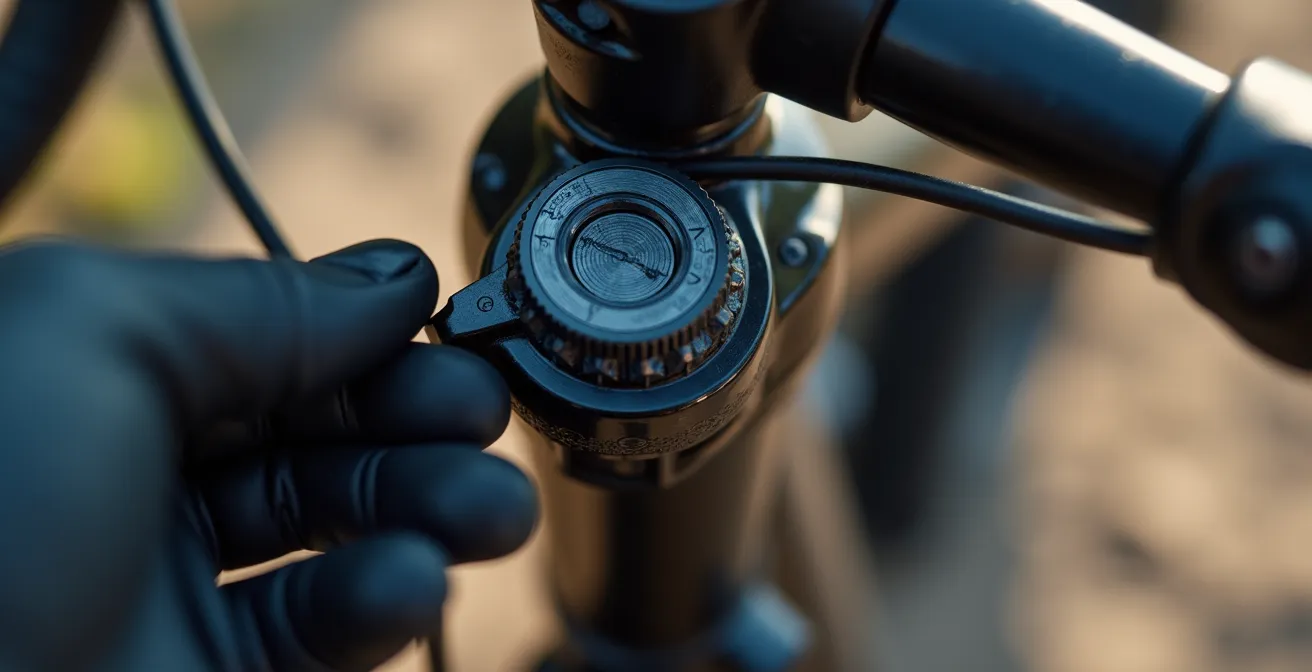
A simple “curb test” is the best way to dial this in. Stand next to your bike, push down hard on the fork to compress it, and quickly let go. Watch the front wheel. It should return to its starting position in one smooth motion and stop, without bouncing. Adjust the rebound dial (usually a red knob at the bottom of a fork leg) until you achieve this stable return. This simple adjustment ensures the fork is working for you, absorbing impacts and keeping your tire planted on the ground, whether it’s broken pavement or a dusty trail.
The Real Cost of Comfort: Suspension Service
Owning a suspension fork introduces a maintenance consideration. According to suspension experts, damper service should be performed every 150-200 riding hours to maintain performance, a service that can cost between $100 and $200. While many riders extend these intervals with diligent cleaning, it’s a long-term cost to factor into the comfort equation.
Drop Bars vs Flat Bars: Control in Traffic vs Comfort on Trails
The handlebar debate is central to the gravel bike’s identity. Drop bars offer aerodynamic advantages and multiple hand positions for long road sections, while flat bars provide wider leverage and a more upright posture, boosting control and confidence on technical terrain. On a gravel e-bike used for commuting, this choice is further complicated by the integration of electronic controls.
As the Cycling Weekly Review Team notes in their “Best Electric Gravel Bikes Review 2026,” there’s a significant challenge to consider:
The e-bike cockpit clutter issue is real – integrating displays, controllers, bell, and lights onto drop bars is an ergonomic challenge.
– Cycling Weekly Review Team, Best Electric Gravel Bikes Review 2026
This is a crucial point. While drop bars are narrower and better for filtering through traffic, the space on the bar is at a premium. Flat bars, though wider, offer ample real estate for mounting the e-bike display, control pad, a powerful light, and a smartphone mount without creating an ergonomic nightmare.
Your choice depends entirely on the balance of your commute. If your route is 90% road with a short, smooth gravel path, the multiple hand positions and aerodynamic benefits of drop bars (especially flared versions for more control) might be worth the cluttered cockpit. If your commute involves significant trail time or navigating complex urban environments where quick, decisive steering is paramount, the direct control and clean setup of a flat bar are superior.
| Factor | Drop Bars | Flat Bars |
|---|---|---|
| E-bike Display Integration | Crowded cockpit | Ample mounting space |
| Urban Filtering | Narrower with hoods position | Wider but more control |
| Trail Control | Better with flared drops | More direct steering |
| Hand Positions | 3-4 positions | 1-2 positions |
| Aerodynamics | Superior | Limited |
The Risk of Insufficient Fender Clearance on Gravel Bikes
Fenders, or mudguards, are a commuter’s best friend, keeping you dry and clean on wet roads. However, on a gravel bike used for mixed-terrain commuting, they can introduce a significant and often overlooked danger: insufficient clearance. While a tight-fitting fender looks sleek, it can become a trap for debris like mud, leaves, and small sticks, which are common on trails and unpaved paths.
When this debris gets wedged between the tire and the fender, it can cause the wheel to lock up suddenly and without warning. This is more than an inconvenience; it can be catastrophic, leading to a complete loss of control. The risk is amplified by the weight and momentum of an e-bike. As one commuter shared from hard-earned experience:
I’ve had front wheels snap sideways on bumps, gravel ridges, and sticks due to weight distribution issues. Poor fender clearance combined with mud can lock the wheel suddenly – it’s thrown me over the handlebars multiple times.
– Commuter, ElectricBikeReview Forums
This underscores the non-negotiable need for generous fender clearance. It’s not just about fitting the fender; it’s about leaving enough space for the inevitable gunk that gets picked up. A general rule is to ensure a minimum of 10mm of space between the tire and the fender at all points, even when the bike is loaded and the suspension (if any) is compressed. This extra room allows most debris to pass through without jamming, turning a potential safety hazard into a minor annoyance.
Your 5-Point Fender Safety Audit
- Points of contact: Check the clearance around the entire circumference of the tire, ensuring a minimum of 10mm at the top and sides.
- Collecte: Inspect the fender stays and bridge for any areas where mud, leaves, or sticks could easily accumulate and cause a blockage.
- Cohérence: Compress the suspension (if equipped) and load the bike with your typical commuting gear to verify that clearance is maintained under real-world conditions.
- Mémorabilité/émotion: Ensure all mounting bolts are secure, ideally using a thread-locking compound like blue Loctite, and that rubber dampeners are used to prevent vibration from loosening them.
- Plan d’intégration: After a wet or muddy ride, make it a habit to check and clear any debris from the fender area before it can dry and harden.
Lighting Positioning: Seeing the Trail vs Being Seen by Cars
Lighting for a mixed-surface commute is a classic dual-purpose problem. On city streets, your primary goal is to be seen by cars. Your light needs to be bright, conspicuous, and positioned at eye-level for drivers. On a dark trail or unlit path, your goal shifts entirely: you need to see the path ahead. This requires a powerful, steady beam focused on the ground to reveal obstacles like roots and rocks.
A single light can rarely do both jobs well. A helmet-mounted light is excellent for being seen in traffic, as it’s high up and moves with your head, catching drivers’ attention. However, it can create distracting, bouncing shadows on a bumpy trail. A bar-mounted or fork-mounted light provides a stable beam for seeing the trail, but it can be too low to be easily noticed by drivers. Furthermore, many e-bikes come with integrated lighting systems that, while convenient, are often designed only for visibility.
This is why the optimal solution is a dual-light strategy. Use the integrated or a smaller, flashing handlebar light to ensure you are seen in urban environments. Then, add a more powerful, dedicated “seeing” light for the trail segments of your ride. This second light can be mounted on the fork crown for a stable beam pattern that isn’t affected by handlebar movement, or on your helmet if you prefer the light to follow your gaze. This separation of duties ensures you have the right kind of light for every part of your journey, without compromise.

The Integrated Lighting Dilemma
Many modern e-bikes, like the Whyte RHeO 3, feature integrated lights powered by the main battery. While this is a great feature for urban visibility (“being seen”), most reviews conclude these lights are insufficient for illuminating dark trails. Riders who venture off-road at night almost always need to supplement with a more powerful, secondary “seeing” light.
Why Mid-Drives Offer Better Handling on Technical Terrain
The location of the motor on an e-bike is one of its most defining characteristics, with a profound impact on handling. The two main types are hub motors (in the center of the rear wheel) and mid-drive motors (at the crankset). While hub motors are often quieter and can provide power even if your chain breaks, mid-drive motors offer superior handling on technical terrain, making them the preferred choice for a true gravel e-bike.
The reason comes down to weight distribution and torque application. A mid-drive motor places the heaviest component of the e-bike system—the motor itself—low and centered on the frame. This centralized mass dramatically improves the bike’s balance and makes it feel more nimble and responsive, akin to a non-electric bike. When navigating a twisty trail or making quick direction changes in traffic, this balanced handling is a significant advantage. In contrast, a rear hub motor adds significant weight to the back wheel, creating a rear-heavy bias that can make the bike feel sluggish and unbalanced, especially on rough surfaces.
However, this superior handling comes with a trade-off: accelerated drivetrain wear. Because a mid-drive motor applies its power through the chain and cassette, it puts significantly more stress on these components. This means you can expect to replace your chain and cassette 2 to 3 times more frequently than you would with a hub motor or a non-electric bike. It’s a crucial factor to budget for, but for riders who prioritize handling and control on the “gravel” portion of their commute, it’s a trade-off worth making.
| Factor | Mid-Drive | Hub Motor |
|---|---|---|
| Drivetrain Wear | Accelerated (2-3x faster) | Normal |
| Weight Distribution | Centered/Low | Rear-weighted |
| Torque Delivery | Through gears (multiplied) | Direct to wheel |
| Power with broken chain | None | Still provides assistance |
| Noise Level | Some gear noise | Nearly silent |
Why Suspension Forks Need to Be Beefier for E-Bikes
It might be tempting to think that any suspension fork can be used on an e-bike, but the increased weight and speed of an electric-assist bike place unique stresses on its components. Suspension forks, in particular, must be specifically designed and certified for e-bike use to ensure safety and performance. This isn’t just marketing; it’s a matter of engineering to handle greater forces.
The primary reason is the combination of higher overall weight and more powerful braking. A gravel e-bike can easily weigh 15-20 lbs (7-9 kg) more than its non-electric counterpart. When you brake hard, all that extra mass creates significantly higher forces, particularly torsional flex on the fork. To resist this twisting and maintain steering precision, e-bike specific forks are built with beefier chassis. This is why you’ll often see them equipped with thicker stanchion tubes—the upper legs of the fork—typically 32-35mm in diameter compared to the 30mm that might be found on a standard gravel fork.
This structural reinforcement is part of a broader industry standard. As the BikeRadar Technical Team explains, components must pass more stringent tests to earn the “e-bike rated” label.
E-bike rated components have passed more rigorous testing standards to withstand higher cyclical loads and braking forces.
– BikeRadar Technical Team, Electric Gravel Bike Component Analysis
This means that not only the fork’s structure but also its internal dampers and seals are designed for greater durability. Choosing an e-bike with certified components provides an essential margin of safety, ensuring your bike can handle the demands of higher speeds and emergency braking without failure.
Key Takeaways
- True versatility is achieved through active tuning (PSI, rebound), not passive features.
- Component choices (tires, bars, motors) are a series of managed trade-offs between road speed and trail control.
- E-bike specific components aren’t a luxury; they are an essential safety and performance requirement due to increased weight and force.
Komoot vs Strava: Which Planner Is Best for E-Bike Touring?
Once your bike is perfectly tuned, the final piece of the puzzle is planning a route that maximizes its capabilities. For mixed-surface e-bike riding, Komoot and Strava are the two dominant platforms, but they serve very different primary purposes. Choosing the right one—or learning how to use them together—is key to a successful journey.
Komoot is a powerful navigation utility, built from the ground up for route planning and exploration. Its killer feature is the detailed surface-type analysis, which breaks down your planned route by pavement, gravel, singletrack, and more. It also has a dedicated “E-Bike” routing profile that can help in planning. This makes it invaluable for designing a ride that perfectly matches your bike’s setup and your desired level of adventure. Strava, on the other hand, is primarily a performance tracking and social platform. Its most powerful planning feature is the Global Heatmap, which shows you the most popular roads and trails used by other cyclists. This is an excellent tool for validating a route and ensuring you aren’t being sent down a dangerous or unpleasant road.
The expert consensus is to use a hybrid workflow. An e-bike planning expert in Downtown Magazine advises a critical approach to battery estimates: “Both apps’ range estimates are optimistic. Use the elevation data from the planner and plug it into a brand-specific tool like Bosch’s range calculator for accurate prediction.” The optimal strategy is to start in Komoot to build the initial route and analyze the terrain, export it, and then import it into Strava to check it against the Heatmap for popularity and safety. This workflow combines Komoot’s detailed planning with Strava’s real-world validation, giving you the best of both worlds and ensuring your next ride is a success.
Your Optimal Route Planning Workflow
- Start with Komoot for initial route creation and surface analysis.
- Export the route as a GPX file.
- Import the GPX into Strava to check against the Global Heatmap for popularity and real-world usage.
- Verify the elevation profile from the planner and use a brand-specific tool (like Bosch’s calculator) for a realistic battery range estimate.
- Download the final route as an offline map in Komoot before you depart.
Now that you’re equipped with the strategies to tune your bike and plan your routes, the next step is to apply this mindset of active trade-off management to every aspect of your ride, transforming your commute from a daily chore into a daily adventure.