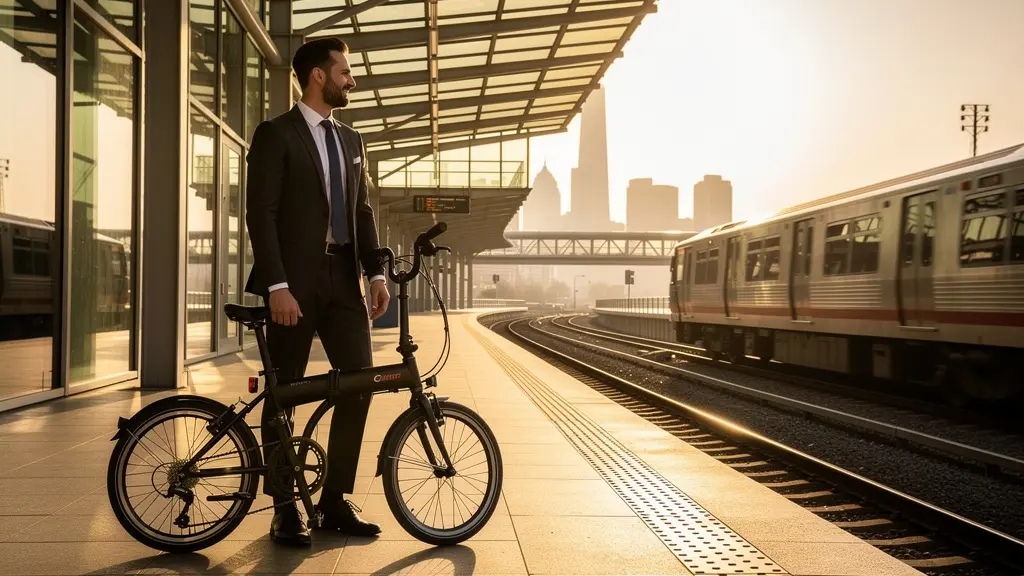
The key to a successful train-and-e-bike commute isn’t the bike itself, but mastering the operational logistics of the transition points.
- Folding bikes often bypass rush-hour bans by being legally classified as ‘luggage’, not ‘vehicles’.
- Efficiency is a choreographed process: folding before you arrive, having payment ready, and using ‘trolley mode’ to board.
- The biggest risks are not on the road but at the station: theft is high and prosecution rates are extremely low.
Recommendation: Treat your journey as a supply chain. Calculate your “Personal Connection Time,” perform a dry run of your route, and focus on mitigating friction at every handover point.
For the suburban commuter, the daily drive into the city center is a familiar battle against congestion, rising fuel costs, and wasted time. The promise of an e-bike is freedom, but the reality of a 15-mile journey is often too daunting. The logical solution appears to be a multimodal commute: drive or bike to the nearest train station, ride the rails, and complete the “last mile” on two wheels. This hybrid approach seems perfect on paper.
Many guides focus on the obvious: buy a lightweight folding e-bike and check transit rules. While true, this advice barely scratches the surface. It overlooks the critical points of “intermodal friction”—the moments of fumbling with a 20kg bike on a crowded platform, the awkward shuffle onto a bus, or the gnawing anxiety of leaving a valuable asset locked to a public rack. These small frictions accumulate, turning a supposedly seamless journey into a stressful ordeal.
But what if the solution wasn’t just about the gear, but about the process? The true secret to a fluid commute lies in treating it not as a series of separate trips, but as a single, integrated logistical system. The focus must shift from the bike to the choreography of the transitions. It’s about optimizing the hand-offs between cycling, walking, and riding public transport.
This guide provides the operational framework to master that system. We will dissect the logistical challenges at each stage—from navigating regulations and boarding efficiently to mitigating security risks and syncing your timing—to transform your commute from a source of friction into a model of personal efficiency.
To help you navigate these logistical hurdles, this article breaks down the key challenges and provides pragmatic, actionable solutions. You’ll find a clear path to optimizing every stage of your multimodal journey.
Summary: A Logistical Guide to a Seamless Commute
- Why Some Train Lines Ban Full-Sized E-Bikes During Rush Hour
- How to Board a Bus with a 20kg E-Bike Without Delaying Traffic
- Folding vs Detachable: Best Option for Crowded Subways?
- The Risk of Overnight Parking at Train Stations Without Lockers
- Syncing Your Ride: How to Buffer Time for Platform Changes
- Electric Skateboard vs Unicycle: Which Fits in a Backpack?
- Brompton Electric vs Full Size: The Intermodal Trade-off
- Survival Guide: Navigating Complex Intersections on an E-Bike
Why Some Train Lines Ban Full-Sized E-Bikes During Rush Hour
The first logistical hurdle for any aspiring multimodal commuter is the rulebook. It can be frustrating to see a “No Bikes” sign during peak hours, especially when the train car appears to have space. The reasoning, however, is rooted in safety and passenger flow. Transit operators prohibit standard bikes during rush hour not just because of the space they occupy, but because they can obstruct entries and exits during crowded boarding, creating a safety hazard. As a case study from the Washington DC Metro shows, this is a common policy designed to ensure unobstructed passenger movement during the busiest times, typically between 7-10 AM and 4-7 PM.
This is where the folding e-bike offers a critical logistical advantage. The key is its legal classification. Many transit systems, like New York’s MTA, have specific rules that reclassify a bike as ‘luggage’ once it is fully folded. This simple change in status means it is no longer subject to vehicle restrictions. As long as the folded unit is of a reasonable size and weight (often under 100 pounds), it bypasses all peak-hour bans. This isn’t just a convenience; it’s a fundamental change in how your equipment is perceived by the system, granting you access when others are denied.
However, this “luggage” status comes with responsibilities. Operators are increasingly requiring that e-bike batteries be UL-certified for fire safety, and they still enforce limits on how many bikes (even folded) can be in a single train car, usually two to four. The strategy, therefore, is not to find a loophole but to operate within this different set of rules. Your folding bike isn’t a bike during rush hour; it’s a large suitcase you happen to be carrying.
How to Board a Bus with a 20kg E-Bike Without Delaying Traffic
Successfully boarding a bus or train with a 20kg (44 lbs) e-bike is not an act of strength; it’s an act of choreography. The goal is to minimize “intermodal friction”—the time and awkwardness of the transition that can frustrate you and delay other passengers. The secret is to perform the entire conversion process before you even reach the vehicle. This is the 15-second bus boarding choreography, and it begins 50 meters from the bus stop.
As you approach the stop, you should already be walking and folding the bike. By the time the bus arrives, the bike should be a compact, secure package. This means having pre-attached velcro straps to secure loose parts like lights or bags. Your payment method should be in an easily accessible pocket, not buried in a bag that’s now part of the folded bike. Making eye contact with the driver while you complete the fold signals your intention and prepares them for your boarding process. This proactive communication is a small but crucial step in smoothing the interaction.
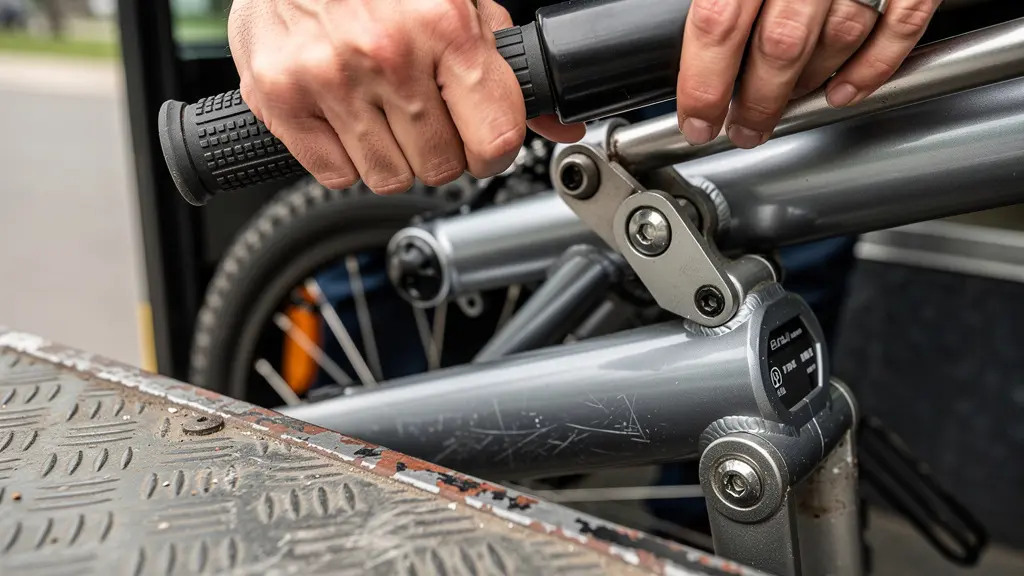
Once folded, avoid the deadlift. Most quality folding bikes have a “trolley mode,” allowing you to roll the bike on its own wheels. This is infinitely more efficient and less strenuous than carrying it. You can then roll it onto the bus, positioning it securely between your legs or against a partition. The process reverses for disembarking: move toward the exit one stop early and prepare the bike for a quick unfold once you are clear of the doors. Mastering this sequence turns a potentially stressful event into a smooth, repeatable, and considerate action.
Folding vs Detachable: Best Option for Crowded Subways?
When navigating the tight confines of a crowded subway, not all compact solutions are created equal. The choice between a folding e-bike and a “detachable” one (where wheels and frame come apart) presents a critical logistical trade-off. While both aim to reduce size, their real-world application during a busy commute is vastly different. A detachable bike, while potentially lighter in its individual pieces, introduces complexity and the risk of lost or damaged parts right on the platform.
The core difference lies in transformation time and the final form. A true folding bike becomes a single, cohesive unit in 15-30 seconds. A detachable bike can take 2-5 minutes to disassemble and reassemble, a stressful eternity during a short platform transfer. Furthermore, the folded bike typically protects its most vulnerable and greasy parts, like the chain and derailleur, by tucking them inward. Detachable bikes leave these components exposed, risking grease stains on clothes and damage from bumps.
This distinction is best illustrated by a direct comparison.
| Factor | Folding E-Bike | Detachable E-Bike |
|---|---|---|
| Transformation Time | 15-30 seconds | 2-5 minutes |
| Folded Form | Single compact unit (25″x19″x30″) | 2-3 separate pieces |
| Drivetrain Protection | Chain enclosed when folded | Chain/derailleur exposed |
| Carrying Weight | 35-60 lbs as one piece | Distributed across multiple parts |
| Platform Reassembly | Unfold and go | Complex reassembly under pressure |
| Storage Footprint | Fits under desk/seat | Requires space for all components |
The real-world impact of these differences is significant. As Toronto commuter Jason reports, the single-unit fold of his bike is a key enabler of his stress-free journey: “My commute from Newmarket to University of Toronto was cut from 2 hours to 1.5 hours… I can fold in seconds, board any train without restrictions, and unfold at Union Station… The single-unit fold means I never worry about dropping parts or getting grease on my clothes.” For the time-pressed commuter in a crowded environment, the folding bike’s self-contained, rapidly deployable design offers superior logistical efficiency.
The Risk of Overnight Parking at Train Stations Without Lockers
One of the most significant and often underestimated risks in a multimodal commute is theft. Leaving an expensive e-bike locked at a train station—especially overnight—is a high-stakes gamble. The security infrastructure at many stations is simply not equipped to handle the rising value of modern bicycles. CCTV offers a weak deterrent, and as the case of Cambridge North Station in the UK demonstrates, even modern stations can become theft hotspots if they are isolated and unmanned. Thieves can effectively “hide in plain sight” when a station is deserted.
The statistics are grim and underscore the scale of the problem. According to recent data from the UK, of the 4,139 bikes reported stolen from train stations in 2024, only 22 suspects were charged. This represents a prosecution rate of just 0.5%, meaning bike theft is a low-risk, high-reward crime. Relying on law enforcement to recover your stolen asset is, statistically speaking, a losing proposition. This reality forces a strategic shift: the commuter’s focus must move from recovery to absolute prevention.
This means implementing a multi-layered security protocol. First, check your insurance policy; many will void coverage for any bike left in a public space overnight. Before ever leaving the bike, you must document everything with photos, including serial numbers on the frame and major components. When parking, always remove the most valuable and easily resold parts: the battery and the display unit. Using two different types of locks (e.g., a U-lock and a heavy chain) forces a thief to carry multiple tools, increasing the time and effort required. Finally, registering your bike with a service like BikeIndex can aid in recovery, but it should be considered a last resort. The only truly secure bike is the one that goes indoors with you.
Syncing Your Ride: How to Buffer Time for Platform Changes
The most stressful part of a train journey is often the connection. A two-minute platform change can feel like an impossible sprint when you’re also managing a folded e-bike. The key to a calm and successful transfer is to quantify and plan for this transition time. You need to calculate your Personal Connection Time (PCT), a personalized buffer that accounts for every step of the process.
The formula is simple: Folding/Unfolding Time + Station Navigation Time + Contingency Buffer = PCT. A realistic estimate might be 30 seconds to fold, 3 minutes to navigate the station (finding elevators or ramps), and a 2-minute contingency for unexpected crowds or delays. This gives you a PCT of 5.5 minutes. This is the absolute minimum time you should allow for any connection. The goal is to make the folding process automatic. Practice daily for a week until you can fold or unfold your bike in under 15 seconds. This muscle memory is invaluable under pressure.
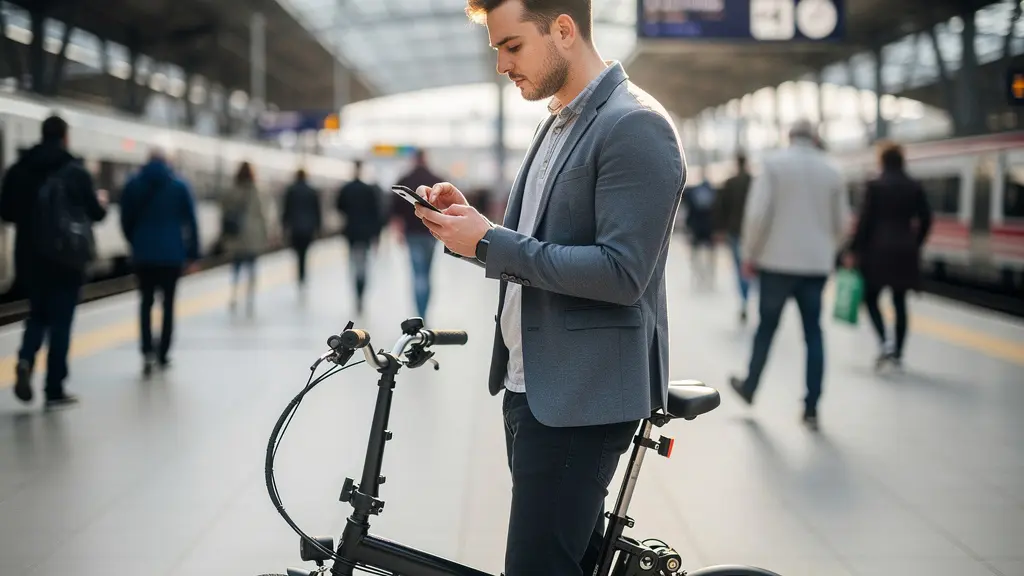
Technology and preparation are your allies in minimizing navigation time. Before you ever leave home, scout the station virtually using Google Street View to identify the shortest routes, elevators, and potential bottlenecks. Use transit apps like Trainline that provide real-time platform numbers so you know where you’re going before the train even stops. The most powerful preparation tool, however, is a “dry run.” Complete your entire commute on a weekend, without any time pressure. This allows you to test your PCT, find the best routes, and build the confidence needed for a stress-free weekday journey.
Action Plan: Auditing Your Multimodal Route
- Identify Transition Points: List every single point where you switch modes (e.g., car to bike, bike to train platform, station exit to city street).
- Measure Baseline Times: Time each transition during a low-pressure dry run. How long does it actually take to fold, walk to the platform, and board?
- Analyze Friction Points: For each transition, identify the biggest source of delay or stress. Is it a lack of elevators? Crowded doorways? A poorly designed bike rack?
- Develop Mitigation Strategies: Brainstorm a specific solution for each friction point. (e.g., “Use the elevator at the far end of the platform,” “Fold the bike 100m before the station entrance”).
- Calculate Final PCT: Based on your mitigated times, establish a reliable Personal Connection Time (PCT) and build it into your schedule as a non-negotiable buffer.
Electric Skateboard vs Unicycle: Which Fits in a Backpack?
For the ultimate in portability, some commuters look beyond folding bikes to even smaller “last-mile” solutions like electric skateboards and electric unicycles (EUCs). While both offer powered transport, their logistical fit for a multimodal commute differs dramatically, especially concerning the question of backpack compatibility and social acceptance. An electric skateboard is, for the most part, a discreet option. Most models are under 30 inches long and can easily be strapped to or placed inside a large backpack, effectively disappearing when you board a train.
An electric unicycle presents a different set of challenges. Despite its single wheel, an EUC is surprisingly heavy and bulky, with typical weights of 35-60 lbs making it far too large for any backpack. It must be carried by its handle, and its wheel, often dirty from the street, is always exposed. As one urban mobility analysis notes, this creates a distinct social friction.
A skateboard in a bag is discreet. An EUC, even when carried, is a large, heavy, and often dirt-covered object that draws attention and can be clumsy in a crowd.
– Urban mobility analysis, Leoguarbikes comprehensive folding e-bike review
The trade-off extends to performance and usability. The EUC’s large wheel is far superior at handling cracks and curbs, but it comes with a steep learning curve, often requiring weeks of practice. A skateboard is less capable on rough surfaces but is intuitive to ride and allows for a simple “jump-off” in an emergency. The final decision rests on a key logistical question: is your priority on-vehicle performance (EUC) or off-vehicle discretion and portability (skateboard)?
| Factor | Electric Skateboard | Electric Unicycle (EUC) |
|---|---|---|
| Learning Curve | 2-4 hours to basic proficiency | 2-4 weeks daily practice |
| Typical Weight | 15-25 lbs | 35-60 lbs |
| Backpack Compatible | Most models under 30″ | No – requires carrying by handle |
| Station Floor Performance | Excellent on smooth surfaces | Good but bulky in crowds |
| Curb/Crack Handling | Poor (small wheels) | Excellent (large wheel) |
| Emergency Dismount | Simple jump-off | Requires practiced technique |
| Social Acceptance | Discreet when carried | Draws attention, often dirty |
Key Takeaways
- Success in multimodal commuting is a matter of logistical choreography, not just equipment choice.
- Folding bikes gain a crucial advantage by being legally classified as ‘luggage’, bypassing most peak-hour restrictions.
- Theft at stations is the single biggest risk, with near-zero prosecution rates making prevention, not recovery, the only viable strategy.
Brompton Electric vs Full Size: The Intermodal Trade-off
The ultimate expression of the folding e-bike philosophy is often found in premium brands like Brompton. The question for the pragmatic commuter is whether the significant price premium is justified by the logistical benefits. A Brompton Electric’s core advantage is its legendary fold. Its 3-part mechanism creates a package roughly two feet square in under 20 seconds, a feat of engineering that has tangible benefits in the real world. This compact form allows it to be stored in luggage racks, under desks, or carried indoors, effectively eliminating the risk of theft.
A case study of the Brompton Electric C-Line highlights its capability. With a robust 12-speed system and a 300Wh battery, it handles inclines and provides reliable urban range, proving it’s not just a convenience but a capable vehicle. The main barrier is its £3,500+ price tag, compared to a decent full-size commuter e-bike at around £1,500. A simple Total Cost of Ownership (TCO) analysis, however, complicates the picture.
While the initial purchase price of the full-size bike is lower, its reliance on public parking introduces ongoing costs and significant risks that the Brompton avoids entirely.
| Cost Factor | Brompton Electric (£3,500) | Full-Size E-Bike (£1,500) |
|---|---|---|
| Initial Purchase | £3,500 | £1,500 |
| Station Parking (£25/year) | £0 (carried indoors) | £75 |
| Theft Insurance | £0 (always supervised) | £360 (£10/month) |
| Emergency Transport (10x/year) | £0 (folds for any transport) | £300 (taxis when bike restricted) |
| Maintenance (outdoor exposure) | £150 | £450 |
| 3-Year Total | £3,650 | £2,685 |
| Theft Risk | Minimal | High (45% stolen from stations) |
It’s important to view this TCO analysis with a critical eye; the £0 costs for the Brompton represent a best-case scenario. However, the table highlights a crucial strategic point: you are not just paying more for a bike, you are paying to eliminate an entire category of risk and recurring cost. The true trade-off is not just financial; it’s a choice between a lower upfront cost with higher ongoing risk versus a higher upfront cost with near-total peace of mind and operational flexibility.
Survival Guide: Navigating Complex Intersections on an E-Bike
The final logistical challenge of your commute is the transition from the controlled environment of the station back into the unpredictable flow of city traffic. This moment is fraught with risk, as drivers are notoriously poor at judging the speed of e-bikes. An e-bike is faster and more silent than a conventional bicycle, making it essential for the rider to be proactively defensive. Your goal is to re-enter traffic safely and assertively, and this requires a strict protocol.
The STOP-SCAN-SIGNAL-START protocol is a non-negotiable survival strategy for exiting a station area. It forces a deliberate pause to assess a complex situation before committing.
- STOP: Come to a complete stop before your wheels enter the traffic flow. Never roll out passively.
- SCAN: Take a full 3 seconds to scan everything: check blind spots for turning vehicles, look for opening car doors (“door zones”), and identify merging traffic.
- SIGNAL: Clearly signal your intention. Use hand signals and ensure your lights are on, even during the day, to maximize visibility.
- START: Use moderate acceleration to move decisively into your lane. Timidity can be dangerous. Taking a central lane position at 15-20 mph helps prevent drivers from attempting a dangerous “right hook” pass.
This protocol emphasizes a core principle of e-bike safety. As research points out, you must actively force other road users to acknowledge your presence.
An e-bike moves faster and more silently than a regular bike. Emphasize the critical need to actively seek and confirm eye contact with drivers at intersections, as they may misjudge your speed.
– E-bike safety research, Urban E-bike Navigation Study
Use your motor not for top speed, but for tactical bursts to clear intersections quickly and efficiently. Before you even stop, pre-select a low gear so you have immediate power available for a swift start. Your life may depend on the 2-second advantage this provides. Mastering this exit is the final piece of the seamless commute puzzle.
By treating your commute as a complete logistical system—from navigating rules and choreographing transitions to mitigating security risks and managing intersections—you can transform a potentially stressful journey into a highly efficient, reliable, and even enjoyable experience. The initial investment in planning and practice pays daily dividends in time saved and stress eliminated.