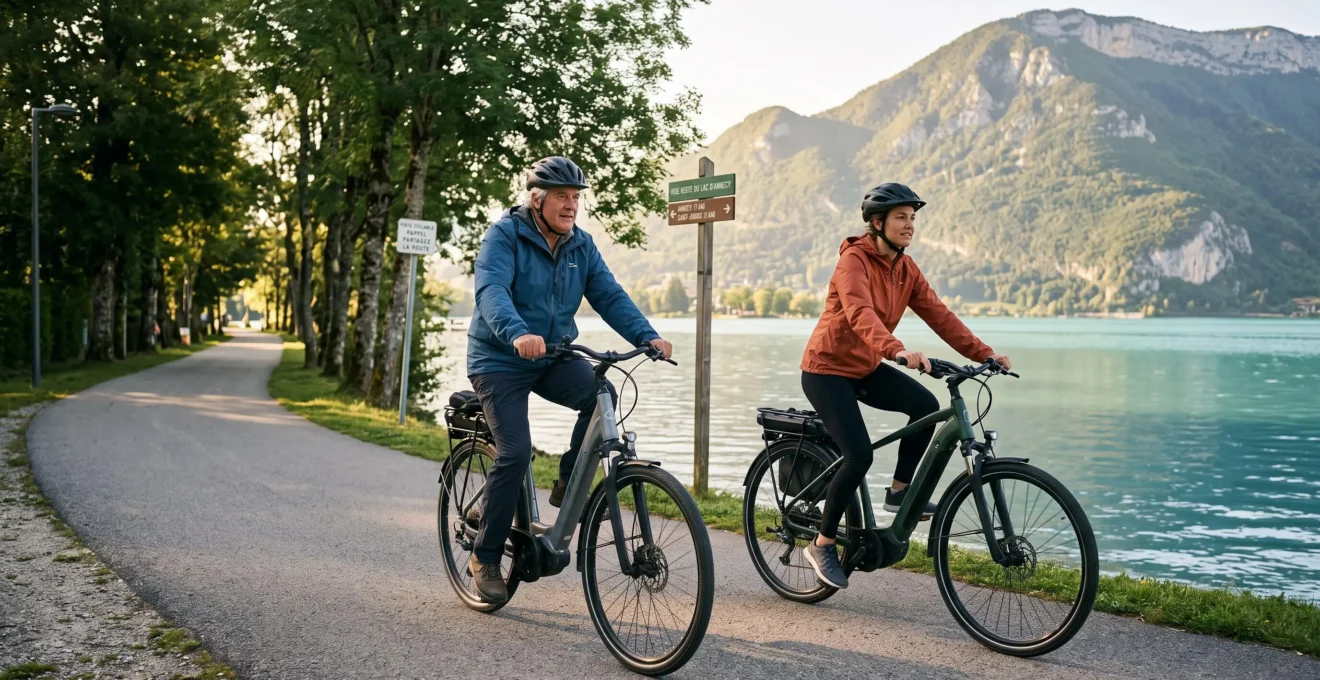
The gap between expectation and reality centres on timing. Rental operators consistently report that tourists booking half-day e-bike windows (4 hours) discover mid-route that they’ve allocated barely enough time for pedaling, let alone the stops that justify the trip. This guide decodes the actual time requirements, identifies the critical preparation steps most skip, and provides a route breakdown that turns the loop from an intimidating question mark into a structured, confidence-building day.
Your Lake Annecy e-bike game plan in 90 seconds
- Book full-day rental (6-8h minimum) 2-3 days ahead
- Depart 8:30-9:00 AM clockwise from Annecy
- Budget 5-7 hours total including stops
- Talloires = strategic lunch break window
- Keep eco mode first half to guarantee battery through return
- Download offline maps before departure
Why does this particular route demand more preparation than typical lake loops? The answer lies in the gap between perceived simplicity and actual logistics. At first glance, a lake circuit sounds like a half-day commitment—the kind of ride you book on impulse the morning-of. The reality involves variables most tourists discover mid-route: village stop timing, battery depletion patterns, lunch service windows in Talloires, and the cumulative effect of elevation spread across seemingly flat terrain.
The sections below decode each variable systematically, transforming the loop from an intimidating question mark into a structured, confidence-building day you’ll execute without second-guessing your rental duration or route direction.
What you’ll discover in this guide
- What makes Annecy’s loop irresistible for e-bike riders?
- Preparation checklist: beyond just showing up with a rental
- Your clockwise route decoded: villages, swim spots and photo moments
- Four critical mistakes that derail full-day lake rides (and how to sidestep them)
What makes Annecy’s loop irresistible for e-bike riders?
The Lake Annecy circuit occupies a rare sweet spot in European cycling: challenging enough to feel like an achievement, gentle enough to remain accessible without months of training, and scenic enough that non-cyclists willingly commit to a full day in the saddle. Aggregated Komoot community data places cumulative climbing between 240 and 250 metres across the complete loop, with no single sustained climb exceeding 5% gradient. E-bikes erase the fitness barrier entirely, flattening the power demands into a consistent, sustainable effort that prioritizes scenery absorption over survival.
1.5 million
visitors annually
The voie verte now welcomes over 1.5 million cyclists and pedestrians each year according to the official Lake Annecy destination webzine, validating its status as France’s most popular lakeside cycling greenway
The infrastructure advantage separates Annecy from generic lake loops where « cycling route » translates to « share narrow roads with impatient drivers. » Official SILA data confirms that the lakeside greenway network now encompasses 43.8 kilometres of dedicated cycling infrastructure, with the western shore voie verte running on a converted railway corridor—completely traffic-free, paved to touring standard. E-bikes unlock the flexibility to stop without penalty—you pause for photos or swimming, then accelerate back to touring speed within three pedal strokes.
Preparation checklist: beyond just showing up with a rental
The most consequential decision happens days before you touch a handlebar: rental duration selection. The typical scenario—tourists check maps, calculate average speed, and book a 4-hour half-day rental. The mathematics appear sound until reality intervenes: bike fitting at pickup, photo stops, swimming, lunch, village navigation. Suddenly the generous window has evaporated with distance still remaining.
Securing adequate time starts with booking a full-day bike rental in Annecy with Mobilboard well ahead—ideally 2 to 3 days advance reservation during peak season (June through September). Full-day rentals typically span 6 to 8 hours, providing the cushion needed for a relaxed touring pace.
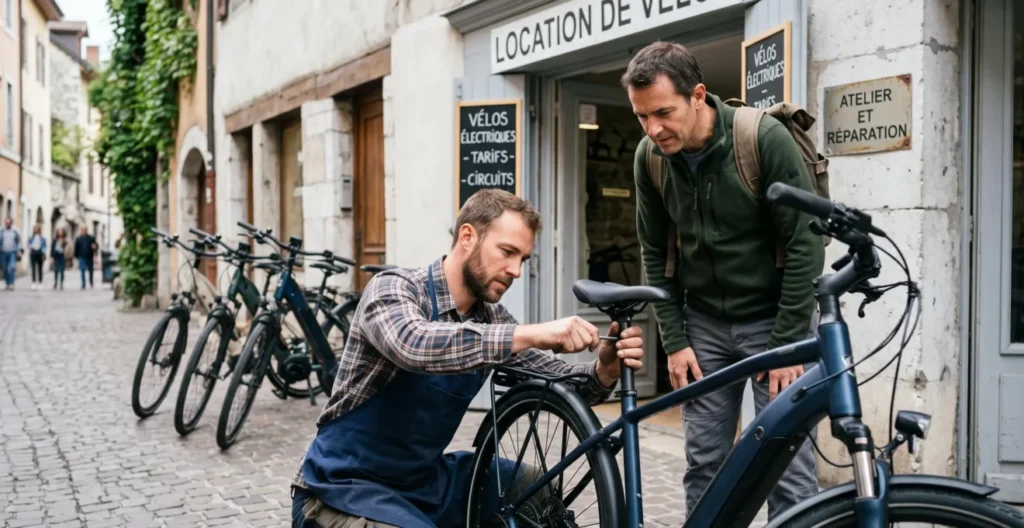
Your pre-departure checklist
- Book full-day e-bike rental 2-3 days ahead
- Download offline route map (Komoot or Strava)
- Pack swim gear for Talloires
- Bring 1.5L water plus energy snacks
Your clockwise route decoded: villages, swim spots and photo moments
Direction matters. Clockwise routing (Annecy → Sevrier → Talloires → Doussard → return via western shore) optimizes multiple variables: morning sun illuminating the eastern shore, arrival at Talloires during lunch service hours, and tackling the faster western shore when afternoon fatigue sets in. Route planning apps like Komoot and Strava offer detailed turn-by-turn navigation with offline map functionality and elevation profile accuracy—download your preferred platform’s Lake Annecy route the night before departure.
-
E-bike pickup and adjustments -
Annecy to Talloires via Sevrier -
Lunch break in Talloires -
Talloires to Doussard -
Doussard to Annecy return
Morning segment: Annecy to Talloires (0-22km, 2-2.5 hours)
The first kilometres leaving Annecy follow lakeside promenades shared with pedestrians—expect a relaxed pace weaving through morning joggers. The route opens up once you join the dedicated voie verte. Sevrier offers the first swimming beach with changing facilities and exceptional water clarity. The segment to Talloires threads through Saint-Jorioz on gentle terrain, riding separated bike paths with short village road sections.
Midday pivot: Talloires lunch stop and southern lakeshore (22-31km, 1.5-2 hours)
Talloires functions as the natural midday pivot. Arrive before 12:30 PM to secure lakeside terrace seating without queuing. Budget 60-75 minutes—this pause transforms a bike ride into a day-long experience rather than a fitness slog.
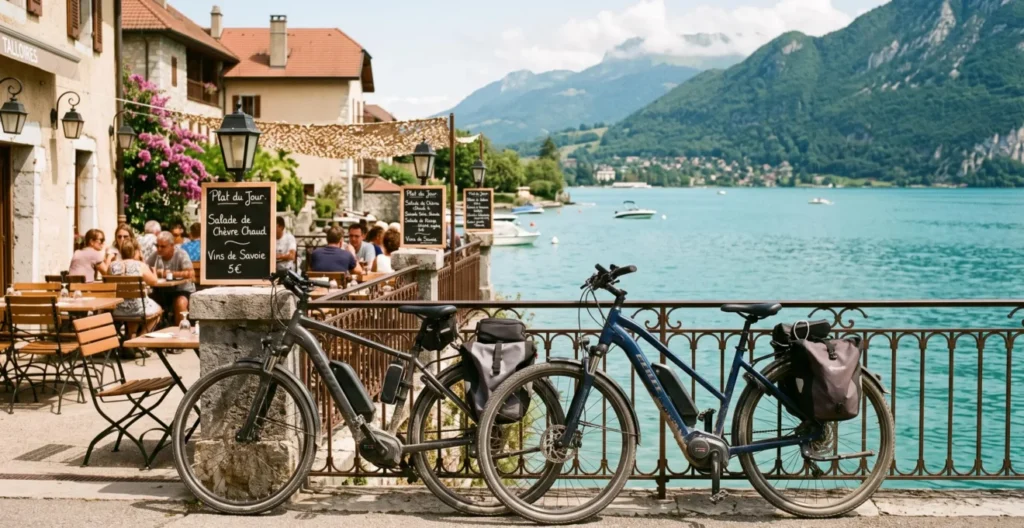
The Talloires-to-Doussard leg follows the eastern shore on narrower pathways mixing bike lanes with village streets. Doussard marks the southern tip, offering the final water stop before the return leg.
Afternoon return: Doussard to Annecy western shore (31-40km, 1.5 hours)
The western shore voie verte delivers the fastest, flattest segment. You’re riding the converted railway corridor—dead straight for long stretches, zero car interaction, consistently smooth pavement. The e-bike’s assistance means you’ll maintain steady speed without straining, covering the final distance efficiently. Battery management becomes relevant only if you’ve been riding in sport or turbo mode all day. Riders who conserved assist early will arrive with comfortable battery remaining.
Four critical mistakes that derail full-day lake rides (and how to sidestep them)
The single most frequent mistake is departure time procrastination. Leaving Annecy late compresses the entire timeline—you arrive at Talloires when restaurants close lunch service, reach Doussard during peak heat, and finish in a rushed sprint. An early departure solves this: cooler temperatures, proper lunch timing, generous buffer for unplanned stops.
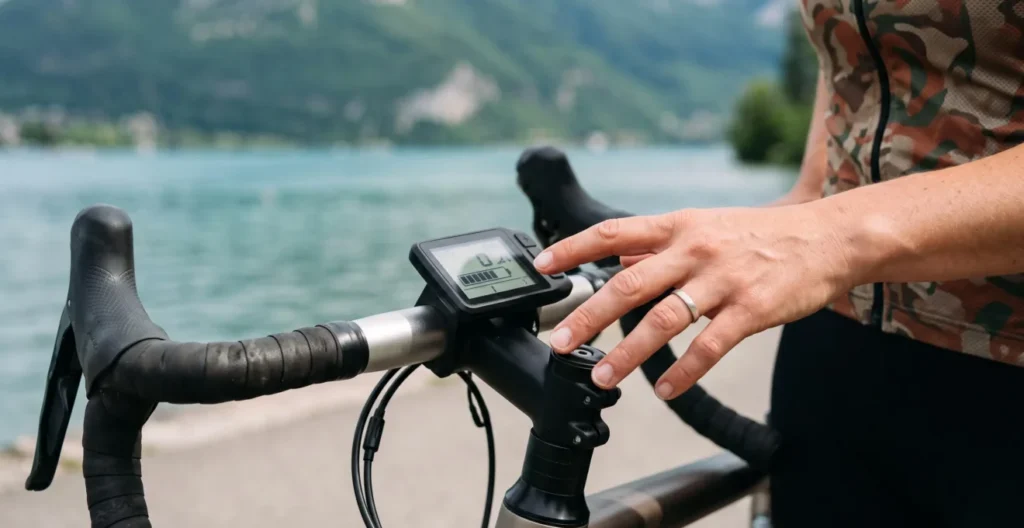
Battery mismanagement stems from misunderstanding assist modes. Sport and turbo modes consume battery at 2-3 times the rate of eco settings. Riders who default to high assist from the start often discover at lunch they’ve consumed excessive battery covering just half the distance. The correction is simple: keep eco mode for the first half, reserve higher assist exclusively for headwinds or climbs.
Battery reality check: Modern e-bikes offer 60-80km range on eco mode, exceeding the loop distance. The mistake is running sport mode for flat terrain, then discovering 70% battery consumed at halfway. Check percentage regularly—if below 60% at Talloires, dial back assist immediately.
Inadequate food and water planning creates unnecessary stops or bonking scenarios. Carrying water and energy snacks means you stop when you want to enjoy a village, not because you’re desperately thirsty or depleted.
Pace misjudgment manifests as treating the loop like a race. Riders who hammer early segments arrive fatigued, face climbs with depleted energy, and suffer through final kilometres. The e-bike removes the need for heroic efforts. Dial in a conversational pace from the start—you should maintain full sentences without gasping. Speed comes from the motor, not anaerobic suffering. Multi-day e-bike touring requires similar preparation frameworks extended across longer timeframes and higher gear volume. Your next step is straightforward: secure your full-day e-bike reservation 2-3 days ahead, download offline maps the night before, and set an alarm for 8:30 AM pickup. The alpine scenery, turquoise water, and medieval villages will handle themselves—your job is building the schedule framework that allows those moments to unfold without time pressure.
Is the full loop realistic for someone who doesn’t cycle regularly?
Yes with an e-bike, borderline exhausting on a traditional bike. The pedal assist makes the distance accessible to most fitness levels—you’re still pedaling, but the motor smooths effort on inclines and against wind. If you can walk 10km comfortably, you can complete this loop on an e-bike.
Which direction is better—clockwise or counter-clockwise?
Clockwise (Annecy → Sevrier → Talloires → Doussard → Annecy) is recommended for morning departures. You’ll have sun behind you for the first half, arrive in Talloires at lunch service hours, and finish the faster western shore when most tired. Counter-clockwise works better for late starts but reverses lunch timing.
Can I complete the loop in a half-day rental (4 hours)?
Technically possible if you skip all stops and maintain high speed, but you’ll miss the entire point. Rental operators report most half-day customers request upgrades mid-route because they underestimated stop time. Book the full day from the start.