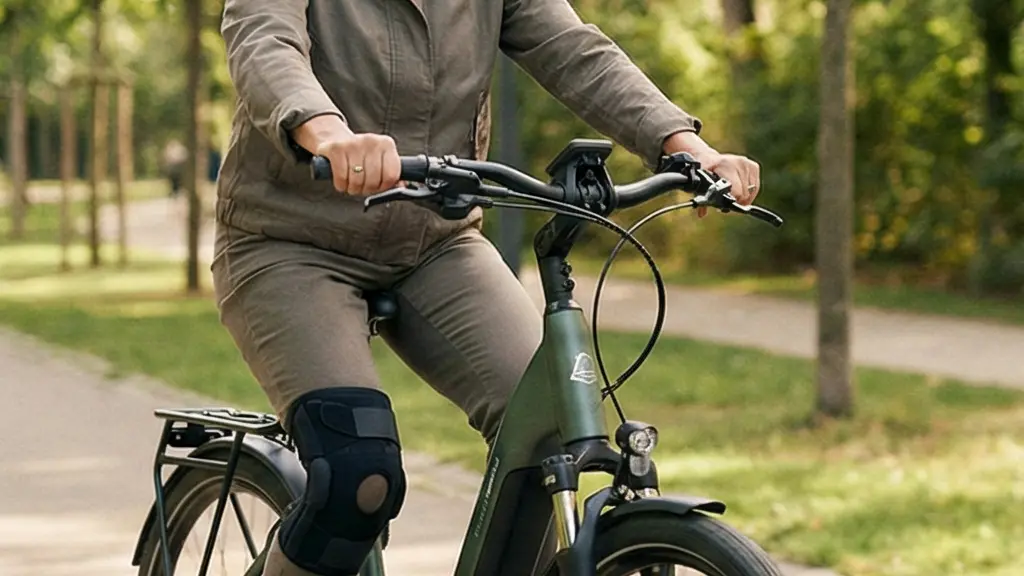
For patients with osteoarthritis, the primary barrier to exercise is not a lack of cardiovascular endurance, but the mechanical pain caused by joint impact.
- Walking generates high compressive forces on the knee, whereas cycling is non-weight-bearing.
- E-bikes allow for torque management, significantly reducing the shear force on damaged cartilage.
Recommendation: Adopt a “high cadence, low torque” riding style using a step-through e-bike to maintain synovial fluid circulation without aggravating joint degradation.
For many patients I see with osteoarthritis (OA), the advice to “stay active” feels like a paradox. You are told that movement is medicine for your joints, yet every step sends a sharp reminder of the cartilage degradation in your knees. The catch-22 is brutal: inactivity leads to stiffness and atrophy, while traditional weight-bearing exercises like walking often exacerbate inflammation.
Common wisdom suggests walking or swimming as the only viable options. However, walking puts a load of up to three times your body weight on the knee joint with every stride. While swimming is excellent, it lacks the convenience for daily mobility. This brings us to a therapeutic tool that is often misunderstood in the medical community: the electric bicycle. It is not “cheating”; it is a precision instrument for load management.
The distinction lies in biomechanics. Unlike a traditional bicycle where the rider must generate 100% of the force to overcome inertia—placing immense stress on the patellofemoral joint—an e-bike allows us to decouple movement from strain. By understanding the physics of torque and cadence, we can utilize the e-bike to circulate synovial fluid and strengthen the quadriceps without the destructive compressive forces of walking.
In this clinical analysis, we will explore the biomechanical arguments for e-biking over walking for OA patients, focusing on torque reduction, proper fit, and safety protocols.
The following analysis breaks down the specific physiological and mechanical factors involved in safe rehabilitation riding.
Table of Contents: Orthopedic Analysis of E-Biking
- Why High Cadence Reduces Knee Torque Significantly
- How Handlebar Height Affects Lower Back Strain
- Stationary Bike vs E-Bike: Which Is Better for Mental Outlook?
- The Risk of Too Much Assist Causing Muscle Atrophy
- Flat Pedals vs Clipless: Reducing Torsion on Injured Knees
- How to Mount a Bike Safely with Limited Hip Mobility
- Cadence Efficiency: Letting the Motor Spin for Max Torque
- Step-Through Frames: Why Accessibility Matters for Riders Over 60
Why High Cadence Reduces Knee Torque Significantly
In orthopedic rehabilitation, our goal is to minimize the force across the joint surface while maximizing the range of motion. On a bicycle, “torque” is the rotational force you apply to the pedals. High torque at low speeds—mashing the pedals in a hard gear—generates excessive compressive force behind the kneecap (patella).
To protect the arthritic knee, we must prioritize cadence (revolutions per minute) over resistance. Spinning the pedals faster in an easier gear requires less muscular force per stroke, thereby reducing the load on the articular cartilage. This is where the electric motor becomes a medical asset: it assists in maintaining momentum, allowing the patient to spin freely without needing to apply high pressure to crest a hill or accelerate.
Recent clinical data supports this approach. A peer-reviewed conference study in cyclists with knee osteoarthritis reports that cadence and power have significant main effects on knee-loading parameters, validating that higher spin rates directly correlate to lower joint stress. By maintaining a cadence between 70 and 90 RPM, you effectively pump synovial fluid—the joint’s natural lubricant—through the knee capsule with minimal wear.
Consequently, the e-bike should be ridden in a mode that encourages spinning, rather than used as a moped.
How Handlebar Height Affects Lower Back Strain
The kinetic chain of the human body means that knee health cannot be isolated from hip and spinal alignment. A common error among seniors is prioritizing an upright position so extreme that it compromises the leverage of the gluteal muscles, forcing the quadriceps (and by extension, the knees) to do all the work.
Conversely, a position that is too aggressive closes the hip angle, leading to impingement and lower back strain. The ideal handlebar height for an OA patient allows for a neutral spine—preserving the natural lumbar curve—while keeping the hip angle open enough to allow full extension without rocking the pelvis. Small adjustments in geometry have measurable clinical impacts.
Research reinforces the sensitivity of this interface. An open-access Scientific Reports study on bike-fit geometry found that even a rearward saddle position of just +10% setback significantly shifts lower-limb extension and comfort levels. For the arthritic rider, professional fitting is not a luxury; it is a prerequisite to ensure that the load is distributed to the skeletal structure rather than the connective tissues.
Correct posture facilitates the engagement of the posterior chain, alleviating pressure on the anterior knee.
Stationary Bike vs E-Bike: Which Is Better for Mental Outlook?
While the biomechanics of a stationary bike and an e-bike are similar, the pain experience is subjective and modulated by the brain. Chronic pain conditions like osteoarthritis often lead to “kinesiophobia”—the fear of movement. In a clinical setting, staring at a wall while pedaling can heighten hypervigilance regarding knee sensations.
The e-bike introduces “distraction therapy.” The sensory input of wind, changing scenery, and navigation occupies the brain’s processing power, which can effectively gate pain signals. This phenomenon is critical for adherence to a rehabilitation protocol. If the exercise is perceived as pleasurable rather than clinical, compliance rates improve drastically.

As illustrated above, the outdoor environment provides a sense of autonomy often lost with reduced mobility. The psychological benefit of “going somewhere” stimulates dopamine release, which acts as a natural analgesic. However, this must be balanced with safety; the environment must be controlled to prevent sudden stops that could jar the joint.
Ultimately, the best exercise is the one the patient is willing to repeat consistently.
The Risk of Too Much Assist Causing Muscle Atrophy
There is a fine line between joint protection and muscle atrophy. If the electric assist is set too high (often called “Turbo” mode), the rider may engage in “ghost pedaling,” where the legs move without encountering resistance. While this protects the cartilage, it fails to stimulate the hypertrophy required to stabilize the joint.
The quadriceps muscle acts as the primary shock absorber for the knee. Weak quadriceps are a leading predictor of OA progression. Therefore, the e-bike must be used to provide *just enough* assistance to eliminate pain, but *not enough* to eliminate effort. This is the “Goldilocks zone” of rehabilitation.
We must monitor the physiological demand carefully. A 2025 paper evaluating e-biking intensity in older adults reported that electrical assistance can reduce VO2 by approximately 57% and heart rate by 31% compared to traditional cycling. While beneficial for cardiac patients, for knee rehab, we must ensure the resistance (METs) remains sufficient to trigger muscle maintenance.
The goal is to use the motor to smooth out the peaks of exertion, not to flatten the entire ride.
Flat Pedals vs Clipless: Reducing Torsion on Injured Knees
The interface between the foot and the pedal is the source of many repetitive strain injuries. “Clipless” pedals (which lock the shoe to the pedal) offer efficiency but restrict the rotational freedom of the tibia (shin bone). For a knee with damaged cartilage, forcing the tibia into a fixed plane during 5,000 revolutions an hour creates damaging torsional shear forces.
I strongly recommend high-quality flat pedals for OA patients. They allow the foot to naturally rotate and find its path of least resistance throughout the pedal stroke. This micro-adjustment capability is crucial because the “neutral” position of the knee often changes as fatigue sets in during a ride.
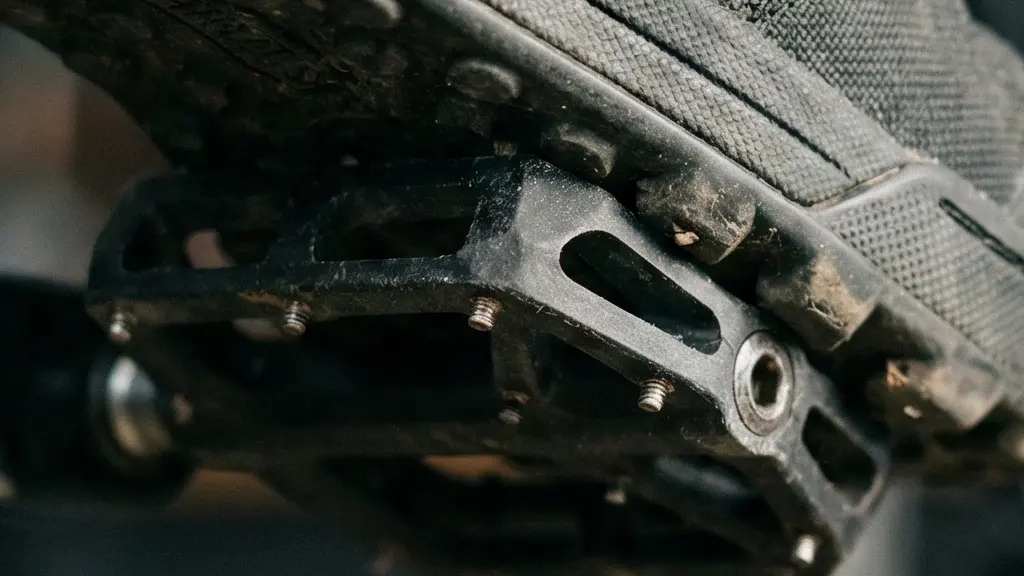
Furthermore, foot placement matters. As shown in the image, placing the mid-foot over the pedal spindle (rather than the ball of the foot) increases stability and reduces the lever arm on the calf, further lowering compressive forces. A physiotherapy-led bike-fitting study in cyclists with knee pain reported that interventions focusing on alignment and fit improved worst knee pain scores by over 2.5 points on a 10-point scale.
Freedom of movement at the foot translates directly to reduced torsion at the knee.
How to Mount a Bike Safely with Limited Hip Mobility
Paradoxically, the most dangerous moment for an arthritic cyclist is not riding, but getting on and off the machine. Limited hip abduction (moving the leg sideways) and reduced single-leg stability make the transition phase a high-risk activity for falls. A fall directly onto an arthritic hip or knee can be catastrophic.
Standard bicycle geometry requires swinging a leg over a high saddle, a movement that creates a high moment of force on the standing leg’s hip joint. CDC fall-prevention data underline why stable mounting and dismounting matters: over 14 million older adults report falling each year, often during transitional movements. Minimizing this risk requires a specific protocol.
Safe Mounting Protocol for Reduced Mobility
- Practice mounting and dismounting in a low-stakes area (empty parking lot, court, or playground) before riding on streets.
- Choose a bike configuration that reduces the need to swing your leg high; a step-through frame can be easier to get on and off for people with limited flexibility or hip problems.
- Rehearse the full sequence: on/off the bike, steady braking, coasting, and controlled stops—until it feels automatic.
- Start with short rides in an easy gear and ramp up gradually while listening to your body.
Stability before mobility is the guiding principle of orthopedic safety.
Cadence Efficiency: Letting the Motor Spin for Max Torque
Electric motors function most efficiently at higher RPMs, much like the human knee. When you pedal slowly in a hard gear, the motor struggles (generating heat) and your knees struggle (generating pressure). When you shift down and spin faster, you allow the motor to operate in its optimal torque range, where it can provide the most support.
This technical synergy is vital for OA patients. By keeping the cadence high, you essentially “outsource” the high-torque requirement of acceleration to the motor. You are providing the motion (kinematics), while the motor provides the force (kinetics). This separation allows for joint articulation without the damaging load.
However, this requires cardiovascular adaptation. A 2024 BMJ Open Respiratory Research study on cadence during CPET reports that higher cadences increase ventilatory demand even if peak oxygen consumption stays similar. Patients must be prepared for a slightly higher breathing rate, which is a healthy sign of aerobic engagement, distinct from the harmful mechanical pain of grinding.
Let the motor handle the heavy lifting while your legs handle the circulation.
Key Takeaways
- E-biking reduces joint compressive forces significantly compared to walking.
- A cadence of 70-90 RPM utilizes the motor to protect cartilage from high torque.
- Step-through frames and flat pedals are medical necessities, not aesthetic choices.
Step-Through Frames: Why Accessibility Matters for Riders Over 60
The “step-through” frame design, historically marketed as a “ladies’ bike,” is in reality the superior orthopedic choice for any rider with joint pathology. By eliminating the top tube, we remove the need for hip abduction and flexion during mounting. This preserves the rider’s balance and center of gravity.
As the popularity of e-bikes surges, we are seeing a concurrent rise in injuries, often linked to loss of control during slow-speed maneuvers. As e-bike use grows, injury data highlight the importance of designs that reduce avoidable falls—Harvard Health notes that emergency injuries related to these devices have risen sharply. A step-through frame mitigates the most common mechanism of injury: tripping over the frame when stopping abruptly.
For the senior rider, equipment selection is a component of the prescription. A low center of gravity and easy egress are as important as the dosage of an anti-inflammatory medication.
If you are considering integrating an e-bike into your osteoarthritis management plan, schedule a functional evaluation with a physical therapist to determine your specific range-of-motion limits before purchasing.