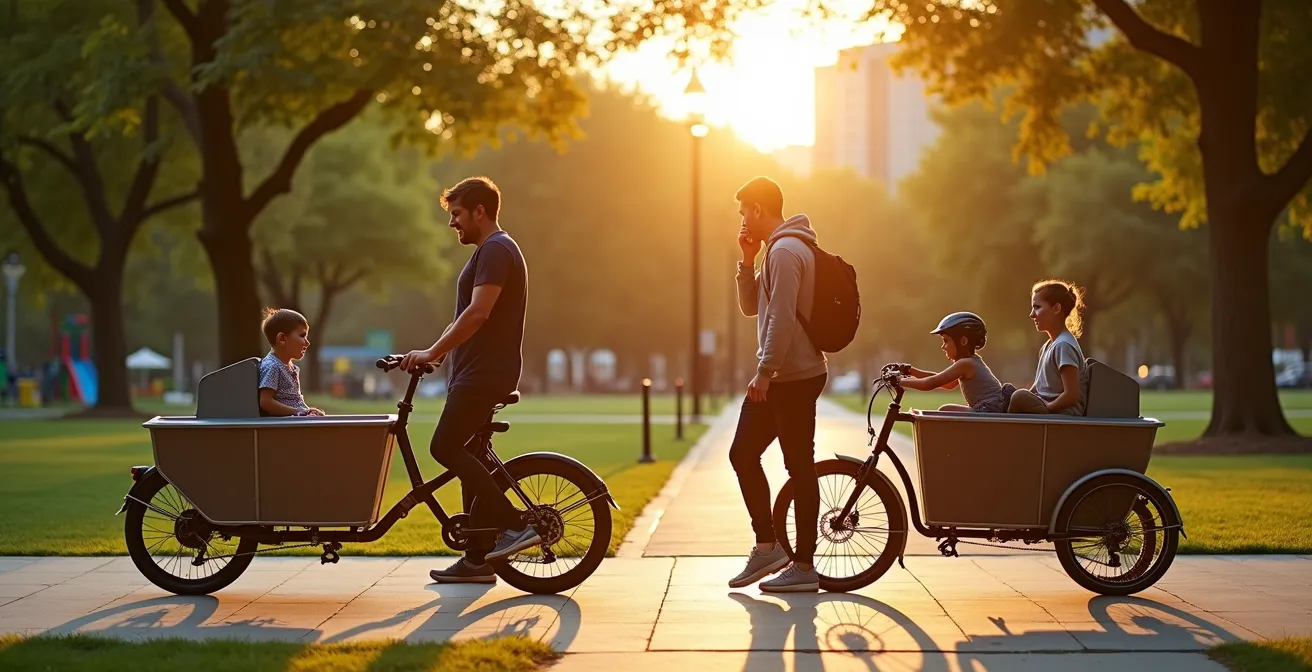
Choosing a cargo bike to replace your car goes far beyond the spec sheet; it’s about understanding the hidden physics of handling a heavy, precious load in the real world.
- Front-loaders (“bakfiets”) offer superior stability when stopped and a lower center of gravity, but their linkage steering has a counter-intuitive learning curve.
- Long-tails feel more like a traditional bike but have a higher center of gravity, which demands more care when loading and unloading wiggling children.
Recommendation: Prioritize test-riding both types with weight in them. The “better” bike is the one whose handling dynamics give you the most confidence for your specific daily routes and challenges.
The morning scramble. The school run traffic. The fight for a parking spot at the grocery store. If you’re a parent, this probably sounds familiar. We were there, too, feeling like our family logistics were dictated by our second car. The dream of swapping the car key for a helmet and gliding past traffic with the kids giggling in the front felt like a distant fantasy. But making that leap from car to cargo bike is a huge decision, and the brochures don’t tell you the whole story.
Most guides will give you simple pro-con lists: front-loaders have more space, long-tails are easier to store. They’ll tell you to get a powerful motor. While true, this is surface-level advice. It misses the fundamental, day-to-day realities of piloting a 60-plus-pound machine carrying the most precious cargo in the world. As a family who has logged thousands of miles on these bikes, we learned that the most important factors aren’t on the feature list.
The real choice isn’t about the brand or the color. It’s about understanding the hidden physics and daily compromises. It’s about the subtle difference in steering that makes one bike feel twitchy and another stable. It’s about the critical importance of torque when you’re starting on a hill with a full load of groceries and two tired kids. It’s about the non-negotiable safety features that you only appreciate when you desperately need them.
This guide is different. We’re going to pull back the curtain on the things you only learn after months of ownership. We’ll explore the nuances of steering, the truth about motor power, and the overlooked components that can make or break your cargo bike experience. By the end, you won’t just have a feature list; you’ll have the practical wisdom to choose the bike that truly fits your family’s life.
To help you navigate this important decision, we’ve broken down the key real-world considerations you need to understand. This article covers everything from mastering the unique feel of different steering systems to planning for the practicalities of storing a bike that’s a substitute for a car.
Summary: A Parent’s Guide to Choosing the Right Family Cargo Bike
- Why Linkage Steering Feels Twitchy at First (And How to Adapt)
- How to Install ISOFIX Seats on Compatible Cargo Boxes
- Bosch Cargo Line vs Standard Motors: Is the Torque Upgrade Necessary?
- The Risk of Kickstand Failure on Heavily Loaded Bikes
- Rain Canopies: Keeping Kids Dry Without Creating a Wind Sail
- Why High Torque is Crucial for Cargo Bikes at Traffic Lights
- Modular Frames: Buying a Bike That Grows with Your Family
- Living with a 60lb E-Bike: Transport and Storage Solutions
Why Linkage Steering Feels Twitchy at First (And How to Adapt)
The first time you ride a front-loader, or “bakfiets,” it feels… weird. The bike seems to wander, and you feel like you’re overcorrecting every tiny wobble. This isn’t you; it’s physics. Unlike a normal bike where the handlebars connect directly to the front wheel, these bikes use a series of rods and pivots called a steering linkage. This indirect connection can feel less precise and, as some DIY builders have found, a weak or flexible linkage can even cause dangerous wobbles at speed. The key is understanding that you’re not just turning the handlebars; you’re guiding a pivot point far in front of you.
The secret to mastering it is to relax and trust the bike. Your brain needs time to build new pathways for this different style of steering. Instead of looking down at the wheel, look far ahead down the road where you want to go. Make small, frequent adjustments rather than big, jerky movements. It feels counter-intuitive, but with a little practice, especially on gentle downhills where the bike feels more stable, the “twitchiness” disappears and is replaced by a smooth, confident glide. It’s a learned skill, just like learning to ride a bike in the first place.
Your Action Plan: Mastering Bakfiets Steering
- Look Ahead, Not Down: Focus your eyes on the road 15-20 feet ahead. Your body will naturally guide the bike where you’re looking. Avoid watching the front wheel.
- Practice Slow-Speed Balance: Find an empty parking lot and try to ride at a walking pace without wobbling. This builds the fine motor control needed for tight spaces.
- Use Small, Frequent Corrections: Steer with gentle inputs from the top of the bars, near the stem. Think of it as nudging the bike back on course, not forcing it.
- Build Confidence on Downhills: Use a gentle, straight downhill to get a feel for the bike’s inherent stability at speed. This helps your brain trust the machine.
- Be Patient: It takes time for your brain to adapt. What feels like over-compensating at first will become natural as new neurological pathways are formed.
How to Install ISOFIX Seats on Compatible Cargo Boxes
Once you’ve got the steering down, the next priority is your precious cargo. While many bikes come with simple wooden benches and harnesses, the gold standard for safely transporting infants and toddlers is using their actual car seat. This is where ISOFIX compatibility comes in. Some premium front-loader cargo bikes offer specially designed adapters that allow you to securely click an ISOFIX-compatible car seat base directly into the bike’s cargo box. This provides a level of tested, standardized safety that a simple bench cannot match.
Installation is typically straightforward but requires precision. It often involves bolting an adapter bracket to the floor of the cargo box. While many parents can do this themselves, we strongly recommend having it done by a professional bike mechanic. They can ensure it’s installed to the manufacturer’s specifications, giving you complete peace of mind. Remember, even with the best installation, other safety factors are at play. For instance, independent safety testing by ADAC shows that on some models, the handlebars can collide with a child’s helmet on tight turns, so always check for adequate clearance.
For parents trying to decide on the best way to carry their kids, the options can be overwhelming. The right choice depends heavily on your child’s age and the type of bike you have.
| Method | Age Range | Safety Features | Installation |
|---|---|---|---|
| ISOFIX Adapters | 0-4 years | Car seat standards | Professional recommended |
| Baby Shells (Melia/Weber) | 0-18 months | Full enclosure | Direct mounting |
| Standard Bench Seats | 2-8 years | 3-point harness | Factory installed |
| Hooptie Rails | 5+ years | Side protection | Aftermarket available |
Bosch Cargo Line vs Standard Motors: Is the Torque Upgrade Necessary?
When you’re looking at e-cargo bikes, you’ll see a lot of talk about motors. The most common question we get is: “Do I really need the expensive ‘Cargo Line’ motor?” The simple answer is yes, and it’s not about top speed. It’s all about torque. Torque is the rotational force that gets you moving from a complete stop. Imagine being at a red light, at the bottom of a hill, with two kids and a week’s worth of groceries. This is where a standard motor will struggle, but a high-torque motor like the Bosch Cargo Line shines.
This specialized motor is engineered to deliver maximum power at very low speeds, or low cadence. It gives you the grunt needed to overcome inertia and get the fully loaded, 300+ pound system moving smoothly and safely. Without it, you’d find yourself wobbling dangerously as you strain to get going. Real-world testing demonstrates that 85 Nm of torque from Bosch’s Cargo Line motor is more than enough, successfully hauling four kids (two on the bike, two in a trailer) up to the bike’s 20 mph assisted speed limit. It’s an investment in safety and confidence, not just power.
Case Study: 10,000 Miles as a Car Replacement
To understand the real-world impact, look at one Seattle family who documented their experience. Over three years, they logged an incredible 10,000 miles on their Tern GSD cargo bike, equipped with a Bosch cargo motor. Using it for daily school runs and grocery shopping, they averaged over 3,300 miles per year. This saved them an estimated 150 gallons of gas, but the biggest benefit they noted was that the powerful electric assist made them choose the bike over the car, even on days when they were tired. It transformed the bike from a novelty into a reliable daily driver.
The Risk of Kickstand Failure on Heavily Loaded Bikes
Here is a piece of equipment that is rarely discussed but is absolutely critical to your family’s safety: the kickstand. On a normal bike, it’s a convenience. On a cargo bike, it’s a structural safety component. You are relying on it to hold up to 100 pounds of bike plus over 100 pounds of children and gear, often while you have your back turned to unload groceries. A kickstand failure can be catastrophic.
Many front-loaders use a wide, two-legged center stand for stability, which is generally very robust. However, the design and mounting points matter immensely. As the ADAC test team noted in their cargo bike review, some popular models have been criticized for this exact component. They state:
One point of criticism from those who tested the Urban Arrow Family was the unstable bipod stand of the e-cargo bike.
– ADAC Test Team, ADAC Single-Track Cargo Bikes Test
Look for bikes with a very wide stance, four-point ground contact, and robust, oversized mounting hardware. Some premium models even offer handlebar-mounted levers to deploy the stand, so you never have to take your hands off the bike while parking. Before every ride, give it a quick visual inspection. Check for cracks in the welds or mounting points and ensure the bolts are tight. This is your first line of defense against a preventable accident.
Rain Canopies: Keeping Kids Dry Without Creating a Wind Sail
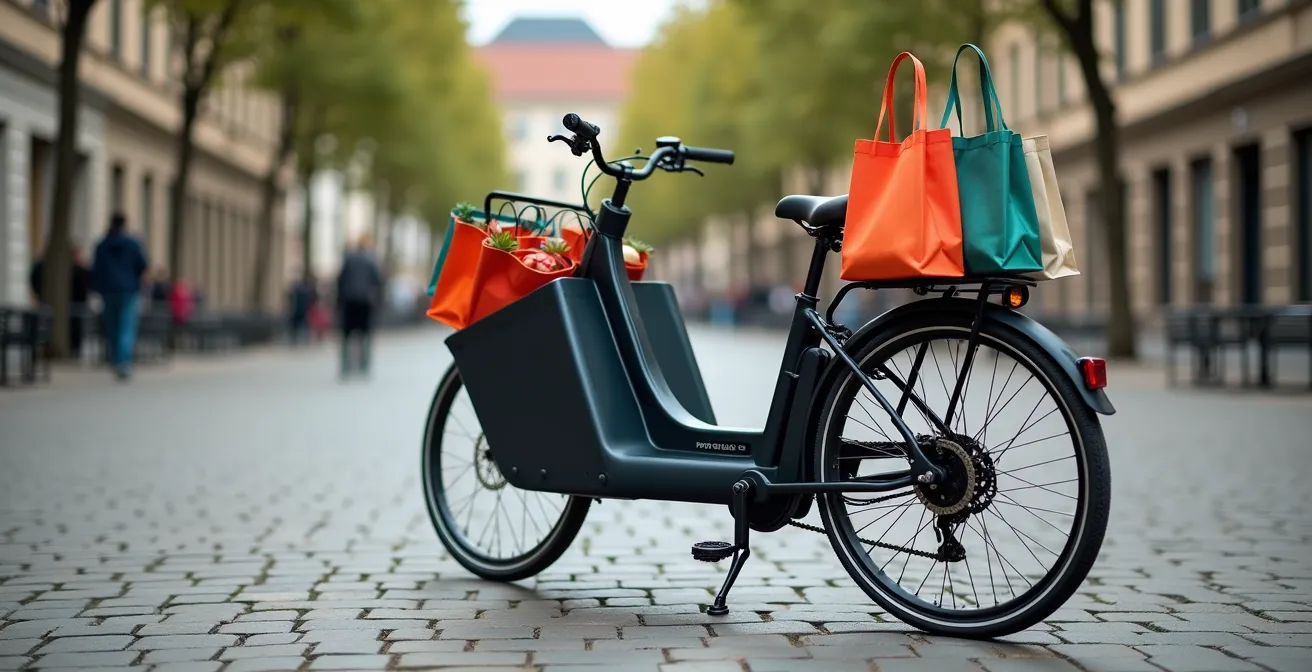
Living the car-free life means being prepared for all weather. A rain canopy seems like a simple solution to keep the kids dry and happy on a drizzly day. However, a poorly designed canopy can introduce a whole new set of problems. The first is safety. The canopy must be tall enough to comfortably accommodate your children while they are wearing helmets. It sounds obvious, but it’s a detail some manufacturers get wrong. For example, safety testing revealed that on some models, children’s helmets protrude well above the cabin height, which is a serious safety concern.
The second issue is aerodynamics. A large, boxy canopy, especially on a front-loader, acts like a giant sail in a crosswind. On a gusty day, this can make the bike incredibly difficult to control, pushing you sideways into the lane. Look for canopies with a more sloped, aerodynamic design. Many have zippered windows or vents that can be opened to reduce the “sail effect” and improve ventilation on warmer, wet days. A good canopy should provide protection without compromising the handling and stability of the bike. It’s an integrated part of the bike’s system, not just a clip-on accessory.
Why High Torque is Crucial for Cargo Bikes at Traffic Lights
We’ve talked about torque for climbing hills, but its most important role in a city is getting you moving safely from a dead stop. Every traffic light, every stop sign, every time you yield to a pedestrian, you have to get all that mass rolling again. With a cargo bike, this isn’t just a matter of convenience; it’s a matter of stability and safety. The most unstable moment on any bike is the transition from stationary to moving. You’re at your most wobbly right as you push off.
A high-torque motor minimizes this period of instability. It provides immediate, powerful assistance that gets you up to a stable rolling speed in a second or two, instead of a long, wobbly struggle. This allows you to clear intersections quickly and predictably, making you a more confident and visible part of traffic. When you’re loaded with up to 440 lb (200 kg) of kids and cargo, having a motor that can generate that initial burst of power is non-negotiable. It’s the difference between feeling in control and feeling like a hazard every time the light turns green.
This instant power gives you the confidence to take your lane and act like a vehicle, because you can keep up with the initial flow of traffic. It’s a feature that directly translates into a safer, less stressful ride for the whole family. When you’re test-riding bikes, don’t just ride around an empty lot. Find a safe place to practice stopping and starting, ideally on a slight incline, to truly feel the difference a high-torque motor makes.
Key Takeaways
- The fundamental choice between a long-tail and a front-loader is a trade-off between the familiar handling of a long-tail and the superior stationary stability of a front-loader’s low center of gravity.
- High torque is more important than high speed. A specialized “cargo” motor provides the crucial low-speed power needed to safely start from a standstill with a heavy load.
- Overlooked components like the kickstand and rain canopy are critical safety systems. Evaluate them based on structural integrity and aerodynamic stability, not just convenience.
Modular Frames: Buying a Bike That Grows with Your Family
A cargo bike is a significant investment, often costing as much as a used car. So, you want it to last. The best cargo bikes are the ones that can adapt as your family’s needs change. This is the beauty of a modular frame system, most commonly found on long-tail bikes. These bikes are designed to be a platform that you can build upon and reconfigure over the years. What starts as a hauler for a baby in an infant seat can transform into a two-kid taxi, and eventually, a solo grocery-getter with massive panniers.
Look for brands that offer a wide ecosystem of accessories. This includes things like “hooptie” rails that create a secure cage for younger kids, deck pads for older kids to ride on, and footpegs and grab bars for tween passengers. This modularity ensures your investment pays off for a decade or more. As the team at Rascal Rides points out, you don’t always need the biggest bike to get this flexibility:
The Xtracycle Hopper is a more compact, affordable ‘mid-tail’ cargo bike at 24″ x 80″ that’s way more manageable than full-size longtails while still fitting one child seat plus one additional passenger.
– Rascal Rides Review Team, 10 Best Family Cargo Bikes Review
Thinking about the long-term use of your bike is key. A bike that can evolve from carrying a toddler to carrying a teenager’s sports equipment is a bike that will truly replace your car for years to come.
| Family Stage | Configuration | Accessories Needed | Age Range |
|---|---|---|---|
| Baby Stage | Baby seat + groceries | Infant carrier adapter | 0-18 months |
| Toddler Stage | Two child seats | Hooptie rails, cushions | 1-4 years |
| School Age | Open deck riding | Foot pegs, grab bars | 5-8 years |
| Tween Stage | Single passenger + cargo | Cushion seat, panniers | 9-12 years |
Living with a 60lb E-Bike: Transport and Storage Solutions
So, you’ve found the perfect bike. You’ve mastered the steering, and it’s kitted out for the family. Now for the last, and often most overlooked, question: where do you put it? This isn’t a bike you can just casually hang on a hook in the garage. The reality is that modern cargo e-bikes typically weigh between 88 to 97 lb (40-44 kg) before you add any kids or gear. This weight presents a real logistical challenge for storage and transport.
If you live in a house with a garage, you’re in good shape. But if you’re in an apartment or have to deal with stairs, you need a plan. Look for your bike’s “walk-assist” mode, which uses the motor to help you push the heavy bike up ramps or hills. For vertical storage to save floor space, you’ll need a weight-rated system specifically designed for heavy e-bikes, like those from Steadyrack, and you must mount it directly into wall studs. Don’t even think about using standard bike hooks.
Transporting the bike by car is another challenge. Most standard car bike racks are not rated for the weight or the long wheelbase of a cargo bike. You’ll need to invest in a heavy-duty, platform-style hitch rack, like the Hollywood Racks Sport Rider for Cargo Bikes, which is one of the few on the market designed for the job. These practical considerations are a huge part of living with a cargo bike. Thinking about them before you buy will save you a lot of headaches later on.
Now that you’re armed with this real-world knowledge, the next logical step is to feel these differences for yourself. Book test rides for both a long-tail and a front-loader, and make sure to ride them with weight equivalent to your kids to truly understand which handling style gives you the most confidence.