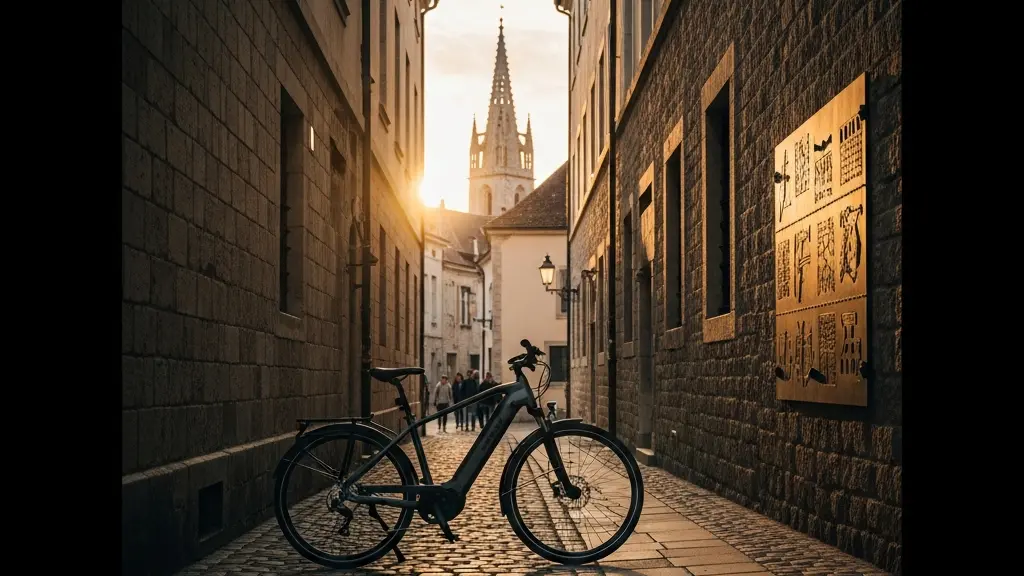
The e-bike is the ultimate “skeleton key” for European heritage, bridging the gap between distant parking lots and pedestrian-only ancient cores.
- Heritage sites ban cars but often welcome silent, non-polluting e-bikes on their periphery.
- Strategic planning allows you to link “castle-to-castle” routes impossible on foot or by bus.
Recommendation: Prioritize perimeter parking with high-security locks and time your arrivals for the “Golden Hour” to experience landmarks without the crowds.
There is a specific heartbreak known only to the modern traveler in Europe: spotting the spires of a medieval hilltop town, only to be diverted by a ZTL (Zone Traffico Limitato) sign to a parking lot three kilometers away. You want to immerse yourself in the history, but the logistics of modern transport often keep you at arm’s length. For years, the choice has been binary: walk until your feet ache or sit on a tour bus that glides past the details.
Most guides will tell you to “wear comfortable shoes” or “shuttle in,” accepting the friction as the price of admission. They treat the car-free zone as a barrier. But what if we view it as a filter? The rise of electric biking has created a loophole in the preservation logic of the Old World. It is silent, efficient, and respectful of ancient stones.
However, simply renting an e-bike isn’t enough; you need a strategy. Accessing these fragile ecosystems requires understanding the unwritten rules of historical preservation, the “Golden Hour” permeation technique, and the art of the silent approach. This isn’t just about easier pedaling; it’s about unlocking a layer of European history that remains invisible to the motorist and inaccessible to the exhausted pedestrian.
To master this art of historical access, we must explore the specific logistics that turn a ride into a journey through time.
Table of Contents: A Guide to Unlocking Heritage
- Why Some Heritage Sites Ban E-Bikes (And How to Park Nearby)
- Creating a “Castle-to-Castle” Itinerary with Charging Stops
- Guided Tour vs Self-Guided Rental: Which Offers Better Insight?
- The Risk of Leaving Rentals Unattended at Tourist Hotspots
- Golden Hour Riding: Beating the Tour Buses to Landmarks
- Heatmaps vs Official Trails: Finding the Quietest Routes
- Hotels vs Campgrounds: Charging Logistics for E-Bikers
- E-Bike Trekking Essentials: Packing for a 3-Day Self-Supported Trip
Why Some Heritage Sites Ban E-Bikes (And How to Park Nearby)
The cobblestones of Europe were laid for hooves and sandals, not for the torque of modern electric motors. Preservation societies are increasingly wary of the vibration and speed associated with powered cycles in fragile pedestrian zones. This restriction is not an act of hostility, but of conservation. In fact, 90% of Bordeaux’s streets now have speed limits of 30 kph or less, reflecting a continent-wide shift toward slowing down traffic to protect both stone and silence.
The savvy slow traveler does not fight these bans but leverages the “permeable periphery.” Most historic centers operate like a fortress with concentric rings. While the inner sanctum is pedestrian-only, the ring immediately surrounding it is often accessible to bicycles but closed to cars. This is your strategic advantage. By parking in this “grey zone,” you reduce a 40-minute walk from the car park to a 2-minute stroll to the cathedral.
Security here is paramount. Historic perimeters are often bustling transition zones. To secure your bike effectively, follow this protocol:
- Identify Boundaries: Use local apps to pinpoint exactly where the riding ban begins.
- Perimeter Parking: Locate racks within 200m of the zone; these are often monitored by CCTV from nearby shops.
- Underground Cages: Many modern car parks beneath old towns offer dedicated, caged bike storage.
- Dismount Zones: Always walk your bike the last 50 meters to blend in with pedestrian flow.
- Battery Removal: Taking the battery with you makes the bike significantly less attractive to thieves.
Once you have secured access to the periphery, the next challenge is connecting these historical dots into a coherent journey.
Creating a “Castle-to-Castle” Itinerary with Charging Stops
The true magic of the e-bike lies in its ability to condense geography. In the past, visiting two hilltop castles in a single day was a logistical marathon involving bus schedules or exhausting hikes. With electric assistance, the valley between them becomes a pleasant interlude rather than an obstacle. You can weave a narrative thread between sites that are historically linked but geographically separated.
However, this “castle-to-castle” approach requires a new kind of fuel management. You are no longer looking for gas stations, but for voltage. The key is to synchronize your cultural absorption with your battery’s needs. A leisurely lunch in a medieval square or a two-hour museum visit is the perfect window to top up your range.
Understanding the relationship between your specific battery system and your cultural itinerary is crucial for a stress-free trip. The table below outlines how to match your charging stops with your sightseeing.
This comparison helps align your cultural pauses with technical necessities, as seen in data on e-bike charging logistics.
| Battery System | 0-80% Charge Time | Typical Museum Visit | Match Quality |
|---|---|---|---|
| Bosch PowerTube 625 | 2.5 hours | Castle tour (2-3 hrs) | Excellent |
| Shimano STEPS 630Wh | 2.0 hours | Art museum (1.5-2 hrs) | Good |
| Yamaha 500Wh | 1.5 hours | Quick cathedral visit | Fair |
With your route planned, the question remains: should you navigate these paths alone, or rely on a local expert?
Guided Tour vs Self-Guided Rental: Which Offers Better Insight?
The debate between freedom and context is eternal in travel. A self-guided rental offers the liberty to linger over a sunset or chase a whim down an unmarked lane. For the historian at heart, this autonomy is intoxicating. You are the explorer, not the passenger. However, the density of European history means that invisible stories are layered beneath every cobblestone, often missed by the untrained eye.
Guided e-bike tours have evolved. They are no longer just about keeping the group together; they are curated narrative experiences. A good guide acts as a curator, using the e-bike to physically move you through the timeline of the city. They know which alleyway leads to the hidden Roman cistern and which bakery has used the same yeast for a century. They provide the software (knowledge) to the hardware (the bike) you are riding.
The value of this human connection cannot be overstated. As one traveler noted regarding their experience:
I absolutely loved, loved, loved it. The whole experience. Cycling and walking in a remote and undiscovered part of the country with no tourists…the guides and hosts and their enthusiasm, passion, knowledge and care
– Jim G, The Slow Cyclist Customer Review
Independence brings responsibility, particularly when it comes to the security of your high-value equipment.
The Risk of Leaving Rentals Unattended at Tourist Hotspots
An e-bike is not just a bicycle; in the eyes of a thief, it is a high-value asset, often worth thousands of euros, left lightly secured in a public space. Tourist hotspots are hunting grounds. The relaxed atmosphere of a vacation can lull you into a false sense of security, but the statistics are sobering. In fact, e-bicycles are 3 times more likely to be stolen than traditional bikes, a figure that demands a proactive defense strategy.
The most effective deterrent is visual complexity. A thief looks for the path of least resistance. If your bike looks difficult to strip or move, they will move on to the next one. This means using heavy-duty locks that are visibly robust, but more importantly, removing the heart of the machine: the battery. Without the power source, the bike is heavy, awkward, and significantly less valuable for resale.
To understand the mechanics of this deterrent, observe the precision required in securing the power source.
The image below illustrates the tactile engagement required to secure your investment.
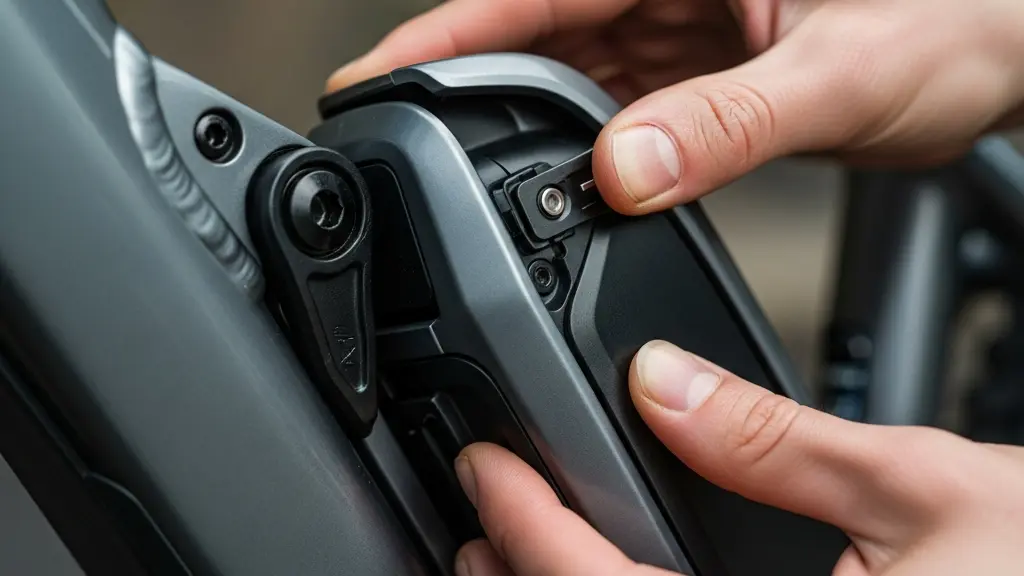
As this detail shows, the removal mechanism is a precise interaction. By taking the battery with you, you effectively render the bike incomplete and unappealing to opportunists.
Once your bike is secure, you can focus on timing your exploration for the most magical moments of the day.
Golden Hour Riding: Beating the Tour Buses to Landmarks
There is a specific window of time that transforms European landmarks from chaotic tourist traps into spiritual experiences. The “Golden Hour,” usually the hour before sunset, is when the light softens to amber and, crucially, when the large tour buses begin their retreat to hotels. For the pedestrian, this time is often spent waiting for dinner. For the e-biker, it is the prime tactical opportunity.
With an e-bike, you can zip out of the city center to a panoramic viewpoint or a distant ruin in minutes, arriving just as the silence settles. You are not fighting for space on the pavement; you are gliding through a cooling landscape. The electric motor hums quietly, allowing you to approach wildlife or enter quiet zones without the intrusion of a combustion engine.
Case Study: Rome’s Reverse Tourism Strategy
In Rome, the Appian Way offers a stark example of this dynamic. During the day, it can be crowded and hot. However, the 10-mile car-free section becomes a sanctuary in the evening. As tour buses return to the city center, e-bikers venture out to explore ancient mausoleums and catacombs bathed in the golden evening light, reclaiming a connection to antiquity that the midday crowds destroy.
Finding these perfect routes requires looking beyond the standard tourist map.
Heatmaps vs Official Trails: Finding the Quietest Routes
Official cycling maps are bureaucratic documents; they tell you where you are allowed to ride, often funneling you onto busy shared paths or dull commuter arteries. To find the “slow” in slow travel, you need to know where the locals go to escape. This is where digital heatmaps become your secret weapon. They aggregate the data of thousands of riders to reveal the “desire lines” of a city—the shortcuts, the scenic loops, and the quiet backstreets that don’t appear on paper pamphlets.
A heatmap might reveal a faint line cutting through a vineyard that connects two villages, avoiding the main road entirely. It might show that the local club riders favor a specific ridge line for its sunset views. By interpreting this data, you stop following a generic itinerary and start riding like a resident who knows the terrain.
The table below compares the utility of standard maps versus data-driven apps for the heritage explorer.
Choosing the right tool changes your experience, as shown in this comparison of navigation aids.
| App Feature | Official Maps | Heatmap Apps | Best For |
|---|---|---|---|
| Historic paths shown | Limited | Extensive | Hidden ruins |
| Traffic patterns | Not shown | Real-time data | Avoiding crowds |
| Desire lines visible | No | Yes | Secret spots |
| Offline availability | Yes | Premium only | Remote areas |
Navigating the wild is one thing; navigating the infrastructure of accommodation is another challenge entirely.
Hotels vs Campgrounds: Charging Logistics for E-Bikers
The romance of staying in a converted 16th-century monastery often collides with the reality of 21st-century power needs. Historic hotels were not designed with e-mobility in mind. You may find that your room is on the third floor with no elevator, or that fire regulations strictly prohibit charging heavy lithium-ion batteries in guest rooms. This can leave you stranded with a dead bike and a heavy schedule.
Campgrounds often offer easier access to outdoor outlets, but they lack the central location. The solution is a proactive “power audit” before you even book. You must ask the right questions to ensure your steed is fed and secure while you sleep. Assuming electricity is available is a rookie mistake that can derail a trip.
Pre-Arrival Hotel Power Audit
- Policy Verification: Call ahead to confirm the specific policy on e-bike batteries; many hotels now ban in-room charging due to fire risk.
- Infrastructure Check: Ask specifically if there is a “fire-safe charging locker” or a dedicated bike room with functioning wall outlets.
- Power Capacity: Confirm the amperage available in garage areas to ensure it can handle your charger’s draw without tripping breakers.
- Security Confirmation: Request written confirmation (email) of secure overnight storage arrangements to avoid “courtyard” parking.
- Hardware Backup: Pack a surge protector rated for your charger’s wattage to protect your equipment from unstable old wiring.
With logistics settled, the final piece of the puzzle is equipping yourself to look the part.
Key Takeaways
- Park on the periphery to access pedestrian-only zones effortlessly.
- Use heatmaps to find the silent routes locals cherish.
- Always audit your hotel’s charging policy before booking.
E-Bike Trekking Essentials: Packing for a 3-Day Self-Supported Trip
The goal of slow travel is to blend in, to be an observer rather than a spectacle. Nothing screams “tourist” louder than neon Lycra in a baroque cathedral. The modern e-bike trekker needs a wardrobe and kit that transition seamlessly from the saddle to the sommelier’s table. This is the art of “dual-purpose packing.”
You need gear that performs technically—wicking sweat, resisting rain—but reads socially as casual wear. Merino wool is the gold standard here, offering odor resistance and a matte finish that looks like high-quality streetwear. Your luggage should also be a chameleon; panniers that convert instantly into backpacks allow you to park your bike and walk into a museum without fumbling with clips and straps.
As experts in the field suggest, the right gear is about access as much as comfort:
Prioritizing merino wool and ‘urban’ cycling gear allows entry into cathedrals and fine dining without looking like a Lycra-clad athlete
– Art of Bicycle Trips Guide, Slow Travel Vietnam to Siem Reap Route
Ultimately, your packing list dictates your freedom. By choosing equipment that respects the aesthetics of the places you visit, you show respect for the culture itself.
The open road and the silent streets await. Don’t just book a rental; plan an expedition into the layers of history that only an e-bike can reveal. Start your planning today by selecting your first “castle-to-castle” route.
Frequently Asked Questions about E-Biking Historic Centers
What time should I start my golden hour ride to avoid crowds?
Begin your ride at 5 PM when tour buses start returning to hotels. This gives you 2-3 hours of optimal light and minimal crowds at major landmarks.
Can e-bikes handle low-light conditions safely?
Modern e-bikes come equipped with powerful LED lights suitable for dusk riding. The added weight provides stability for photography stops in no-tripod zones.
Which viewpoints are only accessible by e-bike during golden hour?
Remote panoramic lookouts 5-10km from city centers become safely accessible with e-bike lights, while walking would be risky after dark.