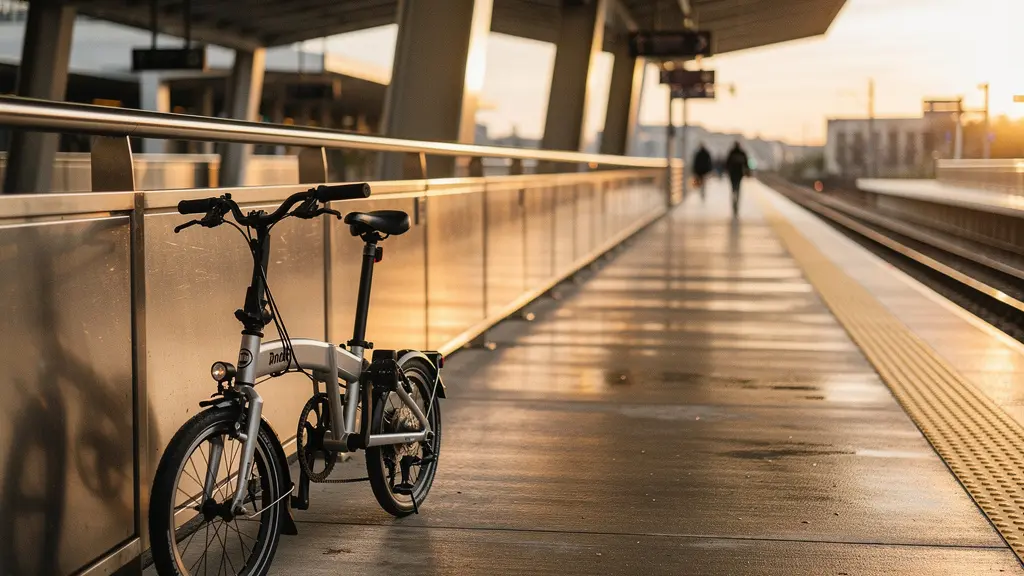
The viability of your commute hangs on the security of the transition, not the speed of the ride.
- Public racks function as security theater; only enclosed lockers or taking the bike with you offer genuine protection.
- Infrastructure failures like elevator outages or rush-hour bans turn full-sized e-bikes into liabilities.
Recommendation: Audit your route for “friction points” and prioritize folding frames or verify secure locker availability before committing to a pass.
You arrive at the platform, helmet under your arm, checking the schedule. But the low-level anxiety hums in the background: is the bike you just locked up still going to be there in nine hours? For the intermodal commuter, the journey isn’t the problem; the pause is. We are often sold a vision of seamless integration between cycling and rail, yet the reality is often a jagged disconnect of incompatible infrastructure and high-risk storage.
Standard advice usually revolves around buying a heavier lock or parking under a streetlamp. These are band-aids on a broken limb. We need to look at station environments not just as parking spots, but as high-friction transition zones where architectural neglect meets opportunistic crime. The gap between the saddle and the train seat is where the system fails most commuters.
To secure your commute, we must dismantle the illusion of safety provided by standard station designs and reconstruct a strategy based on “modal hardening.” We need to shift from hoping for the best to architecting a commute that eliminates the vulnerability of the stationary bike entirely.
The following analysis dissects the specific failure points of station infrastructure and provides the blueprints for a truly secure intermodal routine.
For a structured overview of these critical security protocols and infrastructure assessments, refer to the table of contents below.
Table of Contents: Intermodal Security Analysis
- Bike Lockers vs Racks: Is the Monthly Fee Worth It?
- How to Take E-Bikes on Ferries and Water Taxis
- Brompton Electric vs Full Size: The Intermodal Trade-off
- The Risk of Elevator Outages at Train Stations with Heavy Bikes
- The 5-Minute Buffer: Transitioning from Platform to Pedals
- Why Some Train Lines Ban Full-Sized E-Bikes During Rush Hour
- Folding Locks vs D-Locks: Convenience vs Maximum Security
- How to Combine Trains and Folding E-Bikes for a Seamless Commute
Bike Lockers vs Racks: Is the Monthly Fee Worth It?
When analyzing station security, we must distinguish between “visual deterrence” and “physical isolation.” Standard outdoor racks offer the former; they rely on the thief’s fear of being seen. However, station environments are often transient spaces where bystanders ignore suspicious activity. This renders the standard rack fundamentally flawed for long-duration parking.
The data supports a pessimistic view of open-air storage. A 2023 survey revealed that 95% of bikes stolen from outdoor racks were locked at the time. The lock itself is rarely the failure point; the failure lies in the unlimited time and access afforded to the thief. In contrast, bike lockers or controlled-access cages remove the bike from the visual field entirely. If a thief doesn’t know what is inside the box, the risk-reward calculation skews against them.
Paying a monthly fee for a locker is not purchasing storage; it is purchasing an insurance policy against infrastructure design failure. While the cost may seem like an added tax on your commute, it pales in comparison to the replacement cost of an e-bike and the disruption of a stolen mode of transport. For the serious commuter, the “free” rack is the most expensive option available.
Station Security Audit Checklist: Assessing Your Risk
- Line of Sight: Verify if the rack is visible from the ticket booth or manned security post.
- Anchor Integrity: Shake the rack itself to check for loose bolts or pre-cut bars.
- Lighting Quality: Inspect the area at night; shadows are a thief’s workspace.
- Traffic Flow: High foot traffic is good; isolated corners are fatal flaws.
- Access Control: Confirm if “secure” cages have anti-tailgating mechanisms.
Ultimately, if your station does not offer enclosed lockers, the architectural verdict is clear: the station is not a parking facility, it is a risk exposure zone.
How to Take E-Bikes on Ferries and Water Taxis
Maritime transit introduces a variable often overlooked in terrestrial commuting: the regulatory volatility surrounding lithium-ion batteries. Ferry operators operate under strict maritime safety laws, which view your e-bike not as a vehicle, but as a hazardous material carrier. The salt air and motion are physical challenges, but the legal framework is the true barrier.
Recent guidelines have tightened significantly. European operators, leading the regulatory charge, are increasingly enforcing caps where electric vehicle battery charge is limited to 40% SoC before boarding is permitted. This effectively slashes your usable range upon arrival. Commuters relying on ferries must architect their charging schedule to arrive at the dock with a depleted battery, necessitating charging infrastructure at the destination—a logistical hurdle that breaks many commute plans.
Furthermore, the physical environment of a ferry deck is hostile to electronics. As illustrated below, the combination of saltwater spray and exposed electrical contacts creates a rapid corrosion vector that land-based bikes rarely face.

The image above highlights the microscopic threat of crystallization on motor housings. Protective measures are non-negotiable here; dielectric grease on contacts and a heavy-duty cover are as essential as your ticket.
Ignore the maritime context at your own peril; a refused boarding due to a high state of charge leaves you stranded at the water’s edge with no recourse.
Brompton Electric vs Full Size: The Intermodal Trade-off
The debate between a folding e-bike and a full-sized commuter is not about ride quality; it is about “modal privilege.” A folding bike is luggage; a full-sized bike is a vehicle. In the eyes of transit authorities, luggage travels free and anywhere, while vehicles are restricted, taxed, and often banned. This distinction defines the reliability of your commute.
The following table breaks down the critical specifications that dictate intermodal compatibility. Note the disparity in train compatibility and the physical demand of navigating station architecture.
As the comparison below demonstrates, the trade-off is stark. An analysis of key intermodal specifications reveals the operational gap between the two form factors.
| Specification | Brompton Electric C-Line | Full-Size Commuter E-Bike (Typical) |
|---|---|---|
| Total Weight | ~17 kg (38 lbs) with battery | ~23–27 kg (50–60 lbs) |
| Weight Without Battery | ~14.5 kg (32 lbs) | ~20–24 kg (44–53 lbs) |
| Wheel Diameter | 16 inches | 26–28 inches |
| Folded Dimensions | ~64 × 58 × 27 cm | N/A (non-folding) |
| Motor | 250W front hub | 250–750W mid-drive or rear hub |
| Battery Capacity | 300 Wh | 400–750 Wh |
| Estimated Range | 30–70 km | 50–120 km |
| Fold/Unfold Time | ~20 seconds (practiced) | N/A |
| Train Compatibility | Treated as luggage (anytime) | Restricted; often banned at rush hour |
| Carrying Up Stairs | Manageable but requires two hands + battery bag | Very difficult; often requires elevator |
Opting for a full-sized bike means you are betting that the station elevators are working and that the train isn’t too crowded. The Brompton, or any quality folder, acts as a bypass key for these systemic bottlenecks. You sacrifice wheel diameter for the certainty of arrival.
The choice is ultimately between a better ride on the road or a guaranteed spot on the train.
The Risk of Elevator Outages at Train Stations with Heavy Bikes
Modern e-bikes are heavy, often exceeding 25kg. Station architecture, particularly in older systems, relies heavily on a single point of failure for accessibility: the elevator. When an elevator is out of service—a frequent occurrence in underfunded transit networks—a full-sized e-bike transforms from an asset into an immovable anchor.
The vulnerability is twofold. First, the physical exertion required to haul a heavy bike up two flights of stairs is significant and dangerous. Second, leaving the bike locked at street level due to an outage exposes it to maximum theft risk. Statistics from campuses serve as a microcosm for this transit risk; reports indicate that stolen e-bikes and e-scooters accounted for 44% of reported incidents, highlighting how targeted these vehicles are when left unattended.
The visual below captures the harsh reality of this infrastructure failure. There is no grace in dragging heavy machinery down concrete steps.
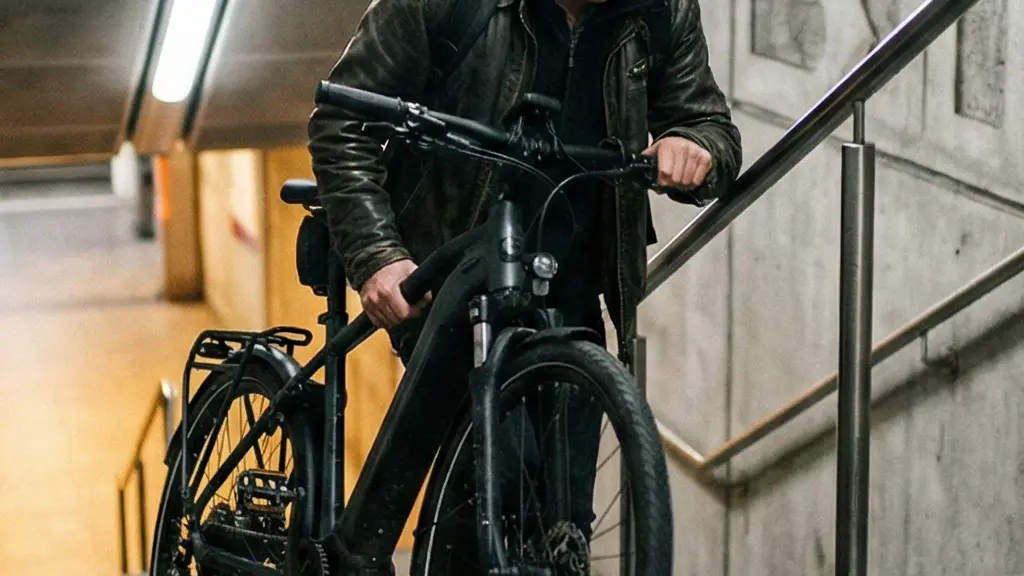
This scenario represents a critical failure of the intermodal chain. If your commute relies on a functioning elevator, your reliability rate is capped by the maintenance schedule of the transit authority.
Always have a contingency plan: know where the nearest secure street-level parking is, or ensure your bike has a “walk mode” to assist on ramps.
The 5-Minute Buffer: Transitioning from Platform to Pedals
The most dangerous moment for your bike isn’t necessarily when it’s parked, but when you are rushing to catch a train. We call this the “transition friction.” When a commuter is late, security protocols are the first to be abandoned. A lock is not fully engaged, a battery is left on the frame, or a bike is parked in a “temporary” spot that becomes a theft magnet.
A realistic analysis of the platform-to-pedal transition shows it takes 4 to 6 minutes to properly secure a bike or prepare it for boarding. This includes removing accessories, folding the frame, or navigating the turnstiles. If your schedule allows only two minutes for this transfer, you are statistically increasing your vulnerability profile. The cost of theft is high, not just financially but operationally: 47% of bike theft victims reported that the theft significantly affected their ability to get to work.
Building a “5-minute buffer” into your schedule is a security measure. It allows for the deliberate execution of locking mechanics and the calm navigation of station crowds. Speed is the enemy of security.
Treat the transition as a distinct leg of the journey, with its own allocated time slot, rather than an instantaneous event.
Why Some Train Lines Ban Full-Sized E-Bikes During Rush Hour
The “Rush Hour Ban” is a blunt instrument used by transit authorities to manage capacity. During peak times, floor space is the most valuable commodity on a train. A full-sized e-bike occupies the standing room of approximately three passengers. From a utilitarian perspective, the bike loses the space allocation war.
Regulations are tightening as e-bike popularity surges. For instance, Amtrak has updated its policies to require that certified models must produce less than 750W and meet specific safety standards. But beyond safety certifications, the sheer geometry of non-folding frames clashes with the density of rush hour crowds. This creates a “blackout window” usually between 7-9 AM and 4-7 PM where your intermodal commute becomes legally impossible with a full-sized bike.
This exclusion forces commuters into a binary choice: arrive extremely early/late, or switch to a folding model. The ban is structural; without dedicated bike cars—rare in many regions—the full-size bike will always be a second-class citizen on the rails.
Check the fine print of your local operator; “bikes allowed” often carries a “subject to conductor discretion” asterisk that can leave you stranded.
Folding Locks vs D-Locks: Convenience vs Maximum Security
In the world of bike security, convenience is inversely proportional to protection. Folding locks have gained popularity for their compact form factor, easily mounting to a frame without the rattle of a U-lock (D-lock). However, in a high-risk station environment, structural rigidity is paramount.
The U-lock remains the gold standard for a reason. Its rigid shackle requires two cuts to defeat if designed correctly (locking at both ends), whereas folding locks have multiple pivot points that are susceptible to drilling or nut-splitting attacks. Data reinforces this hierarchy: only 20% of stolen bikes were secured with a U-lock, indicating that thieves actively select softer targets secured with cables or weaker folding mechanisms.
The image below juxtaposes these two philosophies. The folding lock bends to fit the user’s life; the D-lock forces the thief to break theirs trying to defeat it.
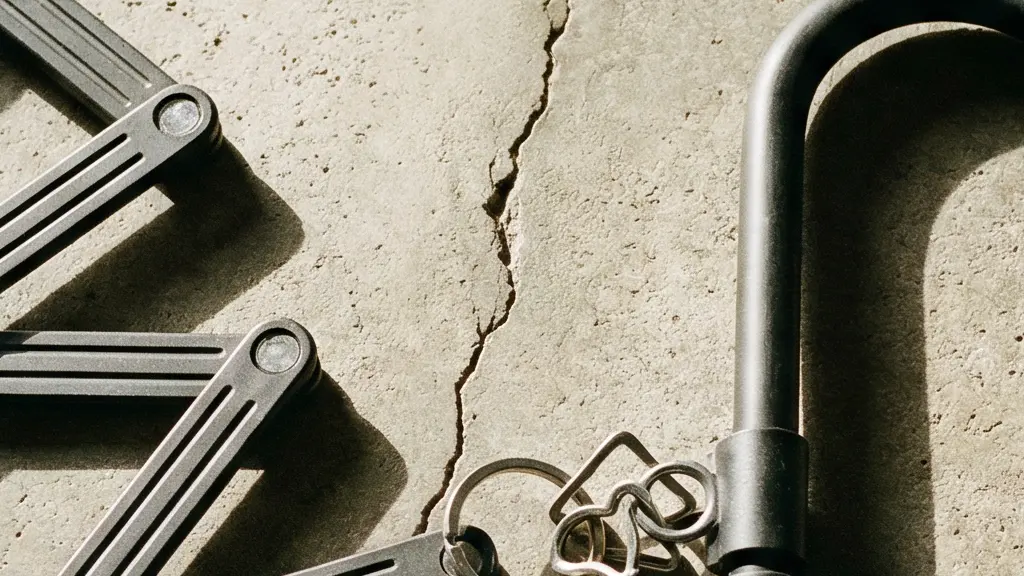
For station parking, where the bike remains unattended for hours, the D-lock is the mandatory choice. The folding lock is acceptable for a coffee stop, but not for the workday duration.
Never compromise on the primary lock; use a heavy D-lock for the frame and rear wheel, and perhaps a lighter lock for the front wheel, but never rely on a folding lock alone for station parking.
Key Takeaways
- Station racks are high-risk zones; secure lockers are the only reliable parking.
- Elevators are single points of failure; ensure you can carry your bike if needed.
- Folding e-bikes bypass rush hour bans and theft risk by staying with you.
How to Combine Trains and Folding E-Bikes for a Seamless Commute
The folding e-bike represents the architectural resolution to the intermodal conflict. By effectively vanishing the vehicle into a piece of luggage, you eliminate the dependencies on station racks, elevators, and rush-hour permissions. The bike stays with you, removing the “weak link” of unattended parking entirely.
This approach transforms the commute from a chain of vulnerabilities into a continuous, controlled flow. The “first and last mile” are covered by the motor, and the high-speed middle segment is covered by the train, with no friction at the interchange points. You are no longer a cyclist begging for space; you are a passenger with a carry-on.
Evaluate your route today. If your anxiety spikes at the station rack, the solution isn’t a better lock—it’s a folding frame that never leaves your side.
Frequently Asked Questions about Station Parking Security
Is bike insurance worth it for station commuters?
Absolutely. Most home insurance policies cover bikes poorly or not at all away from home. Specialized bike insurance that covers theft at transit stations (often requiring specific lock ratings) is essential for peace of mind.
Can I leave my e-bike battery on the bike?
Never. The battery is the most expensive single component and easily stolen. Taking it with you not only prevents battery theft but also makes the bike less attractive to thieves looking for a quick ride-away.
Are GPS trackers effective for recovery?
They are useful for recovery but not prevention. Police often cannot act on GPS data alone due to warrant restrictions for private buildings. Use them as a backup, not a primary defense.