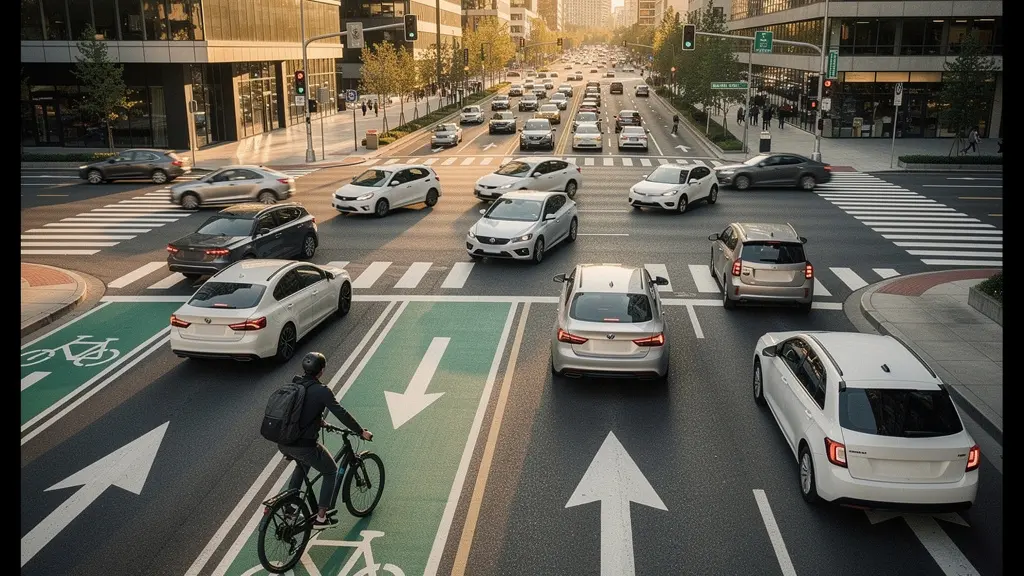
In summary:
- Stop being a passive victim of traffic; learn to proactively control your space and predict driver behavior.
- The safest route is often not the fastest. Prioritize reducing your mental stress (cognitive load) over shaving minutes off your ride.
- Your position in the lane is your primary tool for communication and safety. Use it assertively to make yourself seen and respected.
- Match the speed and flow of traffic where possible. An e-bike’s power is a tool for integration, not just for speed.
Riding into the city center from the suburbs can feel like entering a whole new world. The quiet streets you’re used to give way to a chaotic dance of cars, buses, and pedestrians. That complex five-way intersection ahead isn’t just intimidating; it feels downright dangerous. The usual advice—”wear a helmet,” “be visible”—sounds hollow when a bus is in your blind spot and three lanes of traffic are merging around you. You feel like a guest, an obstacle, just trying to survive until the next bike lane appears.
Here’s the deal: that mindset is the real danger. As an experienced courier, I learned that survival isn’t about being passive and hoping drivers see you. It’s about taking control. It’s about understanding the physics of the street, predicting driver psychology before they even signal, and using your e-bike not just as transport, but as a strategic tool. It’s time to stop thinking like a vulnerable cyclist and start thinking like a traffic navigator who owns their space.
This guide isn’t about the basics. It’s about the street-smart tactics that keep you safe when the infrastructure fails. We’ll break down how to assess risk, how to position yourself to command respect, and how to use your e-bike’s power to flow with traffic, not fight against it. You’re not a guest on their road; you’re a legitimate part of the transport system. Let’s get you riding like it.
This article breaks down the essential street-smart strategies you need to master urban riding. Below is a summary of the key scenarios we will cover, providing you with a clear roadmap to becoming a more confident and safer city cyclist.
Summary: A Street-Smart Guide to Urban E-Bike Navigation
- Why The “Fastest” Route Is Rarely the Safest for Cyclists
- How to Claim the Lane When Bike Paths Disappear
- Protected Lanes vs Shared Roads: Real Safety Differences
- The Risk of Riding in the “Door Zone” of Parked Cars
- Green Waves: Adjusting Speed to Hit Every Light
- Class 1 or Class 3:Is Your E-Bike Really Green? Calculating the Carbon Offset vs Cars
- How to Lane Split Safely Where Legal
- Angle Grinder Resistant Locks: Are They Worth the Weight and Cost?
Why The “Fastest” Route Is Rarely the Safest for Cyclists
Your GPS will almost always suggest the most direct path, a route optimized for a car that can merge at 40 mph. For you on an e-bike, that “fastest” route is often a one-way ticket to a state of high alert. Every complex intersection, every lane merge, every surprise bus stop adds to your cognitive load. This is the amount of mental energy you’re spending just to process your surroundings and not get hit. When your cognitive load is maxed out, you make mistakes. You miss the car turning without a signal. You don’t see the pothole. The spike in accidents is no coincidence; recent federal data reveals that 46% of all e-bike injuries from 2017-2022 happened in 2022 alone, as more people are riding in these complex environments.
The street-smart move is to choose your route based on minimizing mental stress, not distance. A route that adds five minutes but uses quieter streets with simpler intersections is infinitely safer. It keeps your cognitive load low, leaving you with the mental bandwidth to anticipate real, immediate hazards. Before you ride, don’t just look at the map for the shortest line; look for the simplest one. Your brain is your most important piece of safety gear—don’t overload it.
Action Plan: Your Cognitive Load Assessment
- Step 1: Count intersection complexity points (traffic lights, turning lanes, merges)
- Step 2: Evaluate visibility factors (blind spots, parked cars, bus stops)
- Step 3: Calculate cognitive demand score (complex intersections = 5 points, simple = 1 point)
- Step 4: Compare total mental load against route distance (aim for <20 points per mile)
- Step 5: Choose routes prioritizing mental clarity over minimal distance
How to Claim the Lane When Bike Paths Disappear
This is the moment that terrifies most new urban riders: the protected bike lane simply ends, dumping you into a shared lane with cars that are faster and bigger than you. Your instinct is to hug the curb, to make yourself as small as possible. This is the single most dangerous thing you can do. Riding on the far edge of the road makes you invisible, invites drivers to squeeze past you with inches to spare, and puts you squarely in the path of potholes and debris.
It’s time to learn how to claim the lane. This isn’t being aggressive; it’s being assertive and predictable. You need to position yourself in the center of the lane, making it physically impossible for a car to pass you without changing lanes completely. You become a vehicle they have to acknowledge, not an obstacle they can ignore. This technique, sometimes called “taking the lane,” requires what pros call the “CCC Method”: Confidence, Commitment, and Communication. You must ride with a steady pace, signal your intentions clearly and early, and make eye contact with drivers in their mirrors. You’re not asking for permission; you’re communicating your next move.
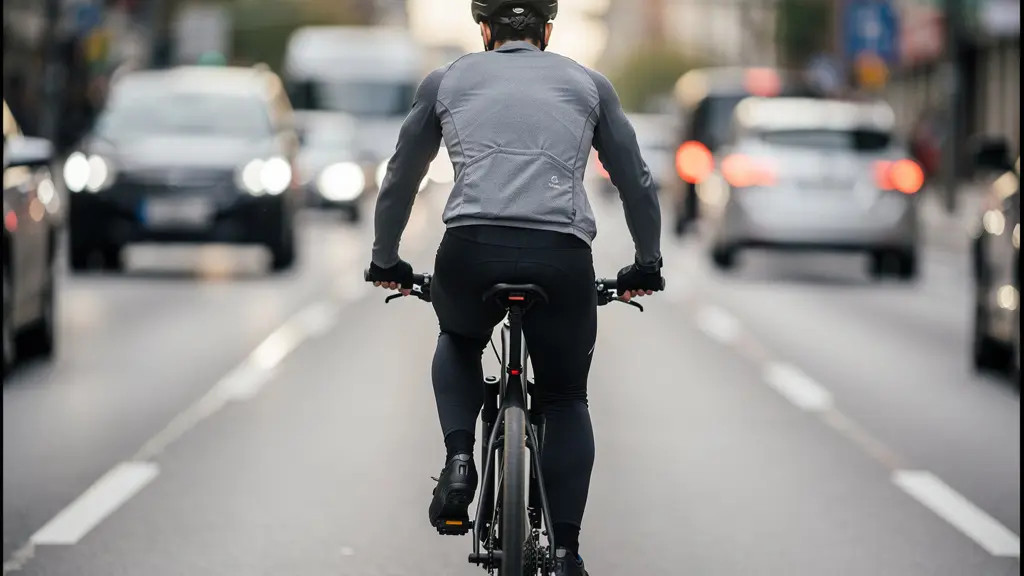
Mastering this feels like a superpower. You stop being a victim of the traffic flow and start directing it around you. Your e-bike’s motor is your best friend here, allowing you to get up to speed quickly (15-20 mph) so you are not significantly slower than city traffic. This assertive positioning dramatically increases your visibility and safety, turning a moment of panic into an act of control.
Protected Lanes vs Shared Roads: Real Safety Differences
Everyone assumes a protected, separated bike lane is a cyclist’s paradise. And for cruising mid-block, it absolutely is. You’re safe from traffic, relaxed, and enjoying the ride. The problem is, bike lanes aren’t continuous. They start and, more importantly, they end, usually at intersections—the most dangerous part of any urban ride. This is the great paradox of bike infrastructure: the very thing designed to protect you can create new, unexpected dangers.
Drivers on a main road get used to the bike lane being a separate entity. They are simply not looking for you when they make a right turn across the bike path (the infamous “right hook”). They don’t expect a cyclist to emerge from the “safe” lane and enter the intersection at 18 mph. The table below breaks down this counter-intuitive reality. While mid-block safety is high in a protected lane, the conflict points at intersections and transitions can be even more dangerous than a well-integrated shared road.
| Risk Factor | Protected Lane | Shared Road |
|---|---|---|
| Mid-block safety | High (physical separation) | Moderate (visibility dependent) |
| Intersection conflicts | Higher (right hooks, left crosses) | Lower (integrated flow) |
| Transition points | Critical danger zones | Continuous integration |
| Driver awareness | Lower at intersections | Consistent throughout |
The key takeaway isn’t that protected lanes are bad. It’s that they create a false sense of security. When you are in a protected lane, your guard should go *up* as you approach an intersection, not down. You must be hyper-aware of turning traffic and be prepared to take the main lane to make yourself visible before the intersection. True safety comes from awareness, not just concrete barriers.
The Risk of Riding in the “Door Zone” of Parked Cars
Riding next to a line of parked cars feels safer than being in the main flow of traffic, but it hides a sudden and brutal danger: the “door zone.” This is the three-to-four-foot area next to a parked car where a suddenly opened door can send you flying into traffic. A driver checking their phone, a passenger grabbing their bag—they aren’t looking for you. For them, it’s a minor mistake; for you, it’s a catastrophic accident. In fact, public health research shows that motor vehicles are involved in 35.4% of e-bike injuries, and dooring incidents are a significant part of that.
The only way to manage this risk is to stay out of the door zone entirely. This means riding a minimum of four feet away from parked cars. Yes, this will often mean you are taking up more of the traffic lane. That’s the point. It forces cars behind you to slow down and wait or change lanes to pass, exactly as they should. It feels bold, but it’s the safest way. You need to develop a proactive scanning protocol, constantly looking for signs of life in parked cars: brake lights turning off, silhouettes visible through tinted windows, or even the faint click of a door latch. Your hearing and vision are your primary defense systems here.
At lower speeds (under 15 mph), your priority is braking. At higher speeds, a swerve might be safer, but only if the lane next to you is clear. This is a split-second decision that you need to be prepared for. Never let your guard down when riding alongside parked cars. Assume every door is about to open.
Green Waves: Adjusting Speed to Hit Every Light
One of the biggest advantages of an e-bike in the city is the ability to control your speed with precision. You can use this to your advantage to ride the “green wave”—the sequence of traffic lights timed to allow a group of vehicles to pass through multiple intersections without stopping. For cars, this is usually set around 25-30 mph. For cyclists in many cities, the sweet spot is around 15-18 mph. Learning to surf this wave is a pro-level move that is both incredibly efficient and much safer.
Riding the green wave means you are not accelerating from a dead stop at every light, where you’re most vulnerable. You’re flowing with a predictable pack of traffic, making you a more visible and integrated part of the street. It requires you to look far ahead, observing the timing of lights two or three cycles in advance. You’ll use your e-bike’s assist levels strategically: maybe a little boost to catch the wave, then dropping to eco mode to maintain speed and conserve battery between signals. It turns your ride into a smooth, rhythmic dance with the city’s pulse instead of a jarring series of stops and starts.
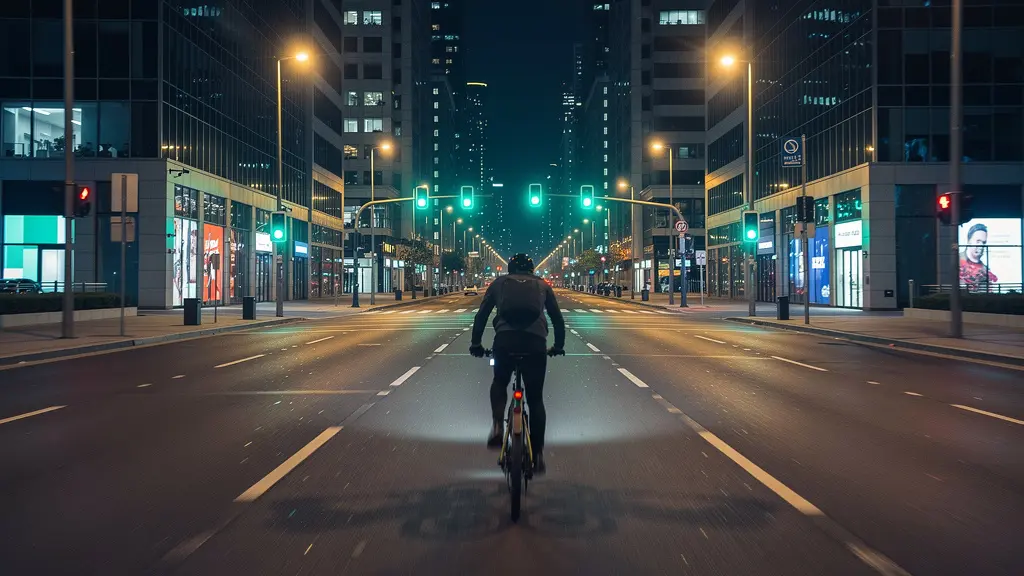
This isn’t about racing. It’s about smart, efficient riding. You’ll apply a ‘Scan-and-Go’ protocol: as you approach a green light, you’re already scanning the cross-traffic and preparing for the next light. By adjusting your speed just a little, you can avoid the frustration and danger of red lights, arriving at your destination less stressed and often just as quickly as if you had sprinted the whole way.
Class 1 or Class 3:Is Your E-Bike Really Green? Calculating the Carbon Offset vs Cars
The conversation around e-bikes often gets stuck on being “green.” But when you’re navigating a complex intersection, there’s a much more immediate question: is your bike’s power level appropriate for the environment? A Class 1 e-bike assists you up to 20 mph. A Class 3 can push you to 28 mph. That extra 8 mph might sound great, but it can be the difference between safely navigating a situation and becoming a statistic. Speed magnifies every risk. It shortens reaction times, increases stopping distances, and turns minor tumbles into major accidents.
Don’t fall into the “faster is better” trap. The real “green” choice is the one that allows you to stay alive and keep riding. In most dense urban cores, the speed of traffic flows between 15 and 25 mph. A Class 1 e-bike, or a Class 3 ridden responsibly, is perfectly capable of integrating with that flow. Pushing a Class 3 to its limits on a crowded street is asking for trouble. The data is terrifyingly clear: national injury data reveals that head trauma from e-bike accidents increased 49-fold nationally between 2017 and 2022. That’s not a typo. Forty-nine times.
This isn’t to say Class 3 e-bikes are bad. They are incredible tools for replacing car trips, especially for longer suburban commutes. But in the tight quarters of a city center, that extra power must be treated with extreme respect. The smartest choice is to use only the power you need to match the flow and keep yourself safe, not the maximum power the bike can deliver. Your goal is safe integration, not a new personal speed record.
How to Lane Split Safely Where Legal
In some places, it’s legal for cyclists to “filter” or “lane split,” moving between lanes of stopped or slow-moving traffic. This is an advanced technique, and you should be 100% sure of your local laws before even attempting it. When done correctly, it can save you significant time and get you to the front of the traffic line at a red light, making you more visible. When done incorrectly, it’s one of the fastest ways to get into an accident.
If you choose to filter, you must follow a strict safety protocol. This is not a time for speed. Your speed differential should be no more than 10 mph compared to the traffic you’re passing—and only filter if that traffic is moving at less than 5 mph or is completely stopped. Your hands should be covering your brakes at all times. You must be constantly scanning for opening doors, cars suddenly changing lanes without signaling, and pedestrians stepping out between cars.
The biggest rule of filtering is this: never, ever filter alongside large trucks or buses. Their blind spots are enormous—they are called “no-zones” for a reason. They cannot see you, and if they decide to turn or change lanes, you will have nowhere to go. Always make eye contact with drivers in their side mirrors before you pass their front axle. A quick nod or wave confirms they’ve seen you. Filtering is a high-risk, high-reward maneuver. It demands your full, undivided attention.
Key Takeaways
- Prioritize Your Mental Safety: The best route is the one that causes the least stress, not the one that’s the shortest distance.
- Control Your Lane, Control Your Fate: Your position on the road is your strongest safety tool. Be assertive and predictable.
- Speed is for Integration, Not Ego: Use your e-bike’s power to match the flow of traffic, not to race through it.
Angle Grinder Resistant Locks: Are They Worth the Weight and Cost?
Your e-bike is a significant investment, so securing it is a top priority. This leads many riders to the heaviest, toughest locks on the market—angle grinder resistant U-locks and chains. They offer incredible security, but they come with a serious trade-off that directly impacts everything we’ve just discussed: weight. A top-tier lock can weigh 8-10 pounds. That’s like strapping a bowling ball to your bike frame.
This extra weight has a real, noticeable effect on your bike’s handling. It raises the center of gravity and can make the bike feel sluggish or top-heavy, especially at low speeds or when making sharp turns to avoid a hazard. The agility you need to navigate a complex intersection can be compromised by the very thing you bought to protect your bike. It’s a classic security vs. agility trade-off, and you need to be honest about your specific needs.
Are you leaving your bike unattended for hours in a high-theft area? Then the weight might be a necessary evil. But if you’re primarily using the lock for quick stops at a café or locking it in a secure garage, a lighter, standard U-lock might be a much smarter choice. It provides good security while preserving the nimble handling you need to stay safe on the road. Don’t let the fear of theft compromise your ability to ride safely. Choose the lock that fits your actual risk level, not just the one that’s hardest to cut.
Ultimately, becoming a confident urban cyclist is about making a series of smart, conscious choices—from the route you take, to the way you position yourself in traffic, to the gear you carry. Start by applying these principles to your own riding, and you’ll transform from an intimidated suburbanite into a street-smart navigator who truly owns the road.