
Treating your lithium battery like a chemical reservoir rather than a fuel tank is the key to extending its life from 2 to 5 years.
- Heat and full saturation (100% charge) are the primary catalysts for irreversible cathode oxidation.
- Micro-cycles and partial charging (stopping at 80%) drastically reduce internal voltage stress.
Recommendation: Shift your routine to the “80/20 Rule”—charge to 80% for daily use and never leave the battery plugged in overnight.
Most e-bike owners view their $800 battery pack as a simple fuel tank: fill it up until it stops, run it until it’s empty, and repeat. This mechanical analogy is expensive. Unlike a gas tank, a lithium-ion cell is a volatile chemical environment where ions physically move between cathode and anode. Every time you force that last electron in to reach 100%, you aren’t just “topping it off”; you are stressing the chemical structure to its breaking point.
The standard advice—”don’t overcharge”—is often repeated but rarely explained. We are told to unplug, but not why the molecular bonds break down under high voltage or how temperature acts as a catalyst for degradation. Whether it’s the myth of the “memory effect” or the confusion surrounding fast chargers, misinformation is rampant.
To make your power pack last five years instead of two, we must look at the electrochemistry. It is not about magic; it is about managing heat, voltage, and time. By understanding the physical stress exerted on the ions during charging and storage, we can adopt a protocol that preserves the cell’s capacity. This article will dissect the molecular mechanics of battery aging and provide a scientifically backed roadmap to maximize your investment.
text
The following analysis breaks down the chemical realities of lithium-ion maintenance, moving from cycle definitions to storage protocols.
Table of Contents: The Chemistry of Charging
- What Counts as a “Full Cycle”? (It’s Not Just Plugging It In)
- How Heat Destroys Lithium Cells Permanently
- Fast Charger vs Standard: Does Speed Kill the Battery?
- The Danger of Charging Unattended Overnight
- Basement vs Garage: Where to Store Batteries in Winter
- Charging to 80%: The Secret to Doubling Battery Lifespan
- Why Recycling Lithium Batteries Is Still a Logistical Nightmare
- Wh vs Ah: How to Read E-Bike Battery Specs Like a Pro
What Counts as a “Full Cycle”? (It’s Not Just Plugging It In)
One of the most persistent misunderstandings in battery chemistry is the definition of a “cycle.” A charge cycle is not defined by the act of plugging the charger into the wall; it is defined by the cumulative throughput of energy equivalent to the battery’s total capacity. If you discharge your battery by 20% and recharge it, you have not used a full cycle. You have used one-fifth of a cycle. This distinction is vital because lithium-ion chemistry favors shallow discharge cycles over deep ones.
When you drain a battery to 0% and recharge it to 100%, you force the ions to traverse the full physical distance between the cathode and anode, causing maximum mechanical stress on the host material. This is known as Depth of Discharge (DoD). Shallow discharges reduce this structural strain. In fact, research from Battery University shows that batteries discharged to only 50% can achieve over 3,000-5,000 cycles versus 300-500 cycles at 100% DoD. By avoiding deep discharges, you effectively multiply the total energy throughput the battery can handle over its lifetime.
The chemistry dictates that the middle range of the battery’s capacity—typically between 30% and 80%—is the “equilibrium” zone where internal resistance and voltage stress are lowest. Operating within this band prevents the formation of parasitic reactions that occur at the extreme ends of the state of charge. Therefore, “top-up” charging after a short ride is not harmful; in fact, it is chemically preferable to waiting for a full depletion.
However, even perfect cycling habits can be undone if the operating environment is uncontrolled.
How Heat Destroys Lithium Cells Permanently
Heat is the silent assassin of electrochemical storage. While cold weather temporarily slows down ion movement (reducing range), high temperatures permanently alter the chemical structure of the cell. Inside the battery, the electrolyte acts as the medium for ion transport. When temperatures rise, this electrolyte begins to decompose, forming a solid electrolyte interface (SEI) layer that thickens over time. This thickened layer acts like a barrier, permanently increasing internal resistance.
This degradation is not linear; it is exponential. The impact of temperature is often underestimated by owners who leave batteries in hot cars or garages. Data indicates that for every 10°C rise above 35°C, cycle life drops by 25%. This permanent loss of capacity occurs regardless of whether the battery is being used or sitting idle. The heat accelerates the oxidation of the cathode, a process that strips the battery of its ability to hold a charge.
To visualize this invisible threat, consider the structural integrity of the cells under thermal stress.
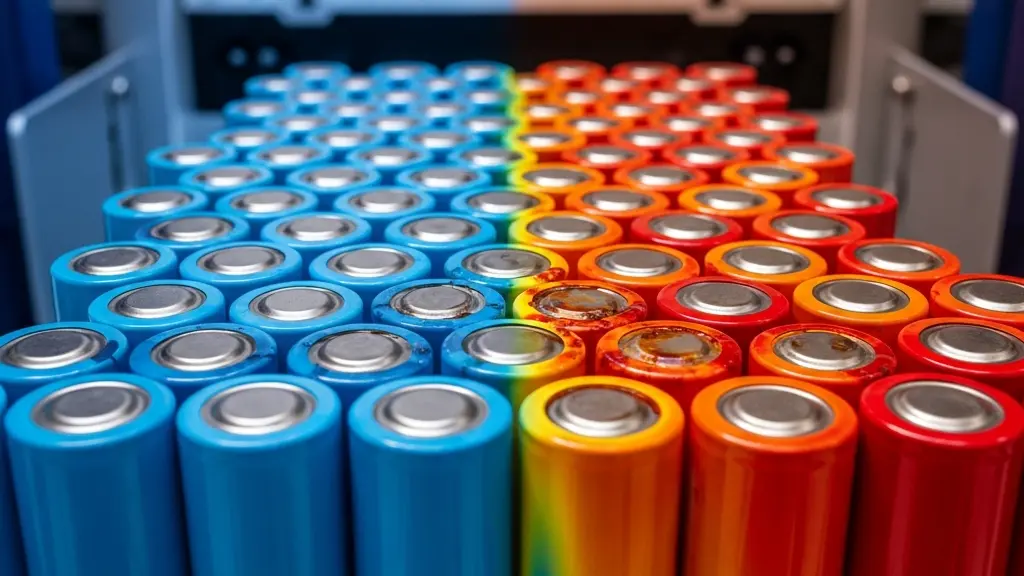
As the image above illustrates, heat creates uneven stress distributions across the cell pack. The damaged areas represent irreversible chemical changes. Once the electrolyte decomposes, no amount of careful charging can restore the lost capacity. Keeping the battery cool is, chemically speaking, as important as keeping it charged.
This internal heat is frequently generated by the charging process itself, specifically when high amperage is applied.
Fast Charger vs Standard: Does Speed Kill the Battery?
The allure of fast charging is undeniable: getting back on the road in half the time seems like a pure benefit. However, from an electrochemical perspective, forcing energy into a cell quickly generates significant friction. When you push current into a battery at a high rate (high C-rate), the lithium ions must intercalate (embed) themselves into the anode rapidly. If they arrive faster than the anode can absorb them, they pile up on the surface, leading to metallic lithium plating. This not only reduces capacity but can create dendrites—sharp spikes that may short-circuit the cell.
As noted by EcoFlow Energy Experts in the “Electric Bike Power Solutions Guide 2024”:
Fast chargers reduce charging time by half but may shorten battery longevity over the long term
– EcoFlow Energy Experts, Electric Bike Power Solutions Guide 2024
The trade-off between convenience and longevity is chemically quantifiable. The faster the energy transfer, the higher the internal resistance and heat generation. The table below illustrates the correlation between charging speed and expected cycle life, demonstrating clearly that patience preserves chemistry.
We can see this impact in the following comparison, where an analysis regarding charging speeds highlights the thermal cost of speed.
| Charger Type | Charge Time (500Wh) | Expected Cycles | Temperature Rise |
|---|---|---|---|
| Standard 2A | 5-6 hours | 800-1000 | 5-10°C |
| Fast 4A | 2.5-3 hours | 500-700 | 15-25°C |
| Ultra-fast 8A | 1-1.5 hours | 300-500 | 30-40°C |
Unless you have an emergency need for range, using a standard 2A charger is the most effective way to minimize thermal stress during the refueling process.
This leads to the most common bad habit among e-bike owners: the overnight charge.
The Danger of Charging Unattended Overnight
Leaving a battery plugged in overnight is often justified by the battery management system (BMS) ability to cut off power. While the BMS does prevent catastrophic overcharging, it cannot prevent the chemical stress of saturation. When a lithium-ion battery sits at 100% charge, the voltage is at its peak (typically 4.2V per cell). At this voltage, the electrolyte oxidizes much faster than at lower voltages. It is akin to keeping a rubber band stretched to its absolute limit for hours; eventually, the elasticity degrades.
Prof. Jeff Dahn, a renowned battery researcher, highlights this exact issue in the “E-Bike Battery Guide”:
Time spent at high charge ~100% charge is bad i.e., if you leave your charger plugged in overnight, expect ~500 cycles instead of 800+ cycles
– Prof. Jeff Dahn, E-Bike Battery Guide – Electric Bike Forums
Furthermore, “trickle charging”—where the charger tops off the battery every time it drops slightly below 100%—subjects the cells to mini-cycles at high voltage, compounding the degradation. The goal should always be to disconnect the power source as soon as the charge is sufficient. Implementing a strict routine can mitigate this risk significantly.
Safe Overnight Charging Protocols: Steps to Protect Chemistry
- Set a timer: Calculate hours needed and set a plug timer to cut power at 80-90%
- Smart integration: Use smart plugs with automatic shutoff features to prevent trickle charging
- Timing shift: Charge in the evening and unplug before bed, rather than while sleeping
- Storage voltage: Store battery at 40-60% if not using for extended periods
- Calibration: Perform BMS calibration with full charge only monthly
Once the charging habits are corrected, the next variable to control is the environment in which the battery waits for its next use.
Basement vs Garage: Where to Store Batteries in Winter
Long-term storage presents a different set of electrochemical challenges compared to daily cycling. During winter months or periods of inactivity, the battery must contend with self-discharge and ambient temperature. Storing a battery in a freezing garage is less damaging than a hot one, but extreme cold can cause the electrolyte to become viscous and, if charged while frozen, can instantly plate lithium metal, destroying the cell. Conversely, a heated basement might keep the chemistry active, increasing the rate of self-discharge.
The ideal storage environment is cool and dry, typically between 10°C and 20°C (50°F – 68°F). A consistent environment prevents the expansion and contraction of materials that can lead to mechanical fatigue of the internal seals. The visual difference in these environments often mirrors the invisible chemical safety of the cells.

As depicted, the controlled environment of a basement (away from heat sources) usually offers better stability than the fluctuating temperatures of an uninsulated garage. To confirm the impact of these conditions, we look at longitudinal data on capacity loss.
Study: Temperature effects on battery storage
Battery lifespan is typically 8 to 15 years, after which 20 to 30% of the original capacity is lost. The rate of capacity loss is influenced by factors like cycling frequency, temperature, and depth of discharge. Less intensive cycling with shallower discharge leads to a longer lifespan
This confirms that capacity loss is not strictly a function of time, but of the conditions endured during that time.
That decision is determining the maximum charge level for daily use.
Charging to 80%: The Secret to Doubling Battery Lifespan
If there is one “magic bullet” for battery longevity, it is the 80% rule. Lithium-ion batteries do not like being full, and they do not like being empty. They are most stable at 50%. By capping your charge at 80%, you avoid the highest voltage range where the most severe chemical stress occurs. This simple adjustment keeps the cell voltage below the threshold where electrolyte oxidation accelerates rapidly.
The benefits of this practice are not marginal; they are transformative for the asset’s value. In fact, electric bike battery care research confirms that you can double the lifecycle of your battery by only charging it to 80%. This means a battery rated for 500 cycles could effectively deliver useful service for 1,000 cycles or more, simply by sacrificing the top 20% of capacity that is rarely used for average commutes anyway.
PVY E-Bike Engineers explain the mechanism behind this stress reduction:
The chemical structure inside the battery is under the most stress at high states of charge. When you charge to 100% and leave the battery plugged in, the cells are held at their peak voltage. This high voltage accelerates unwanted chemical reactions
– PVY E-Bike Engineers, The 80/20 Rule: Battery Chemistry Guide
For the average user, the reduced range is negligible compared to the massive gain in longevity. It is a strategic trade-off: sacrifice a few miles today to gain years of use tomorrow.
Eventually, however, every battery reaches the end of its chemical life, leading to the complex issue of disposal.
Why Recycling Lithium Batteries Is Still a Logistical Nightmare
When a battery degrades beyond usable capacity (usually below 70%), it becomes a hazardous waste product. The recycling process for lithium-ion packs is not as simple as melting down aluminum cans. These packs contain a complex mix of cobalt, nickel, manganese, and lithium, all bound together with flammable electrolytes and glues. Separating these materials requires sophisticated hydrometallurgical or pyrometallurgical processes that are energy-intensive and expensive.
Because of these complexities and a lack of standardized design across manufacturers, recycling rates remain alarmingly low. Indeed, current battery recycling statistics reveal that only 25% of lithium-ion batteries were recycled in 2023, expected to rise to 30% by 2024. This low rate is a supply chain failure, as the raw materials inside dead batteries are crucial for building new ones. The industry is currently in a race to improve these numbers to prevent a toxic environmental crisis.
Initiatives are emerging to close this loop. For example, a new program powered by Call2Recycle has already recycled more than 36,000 pounds of batteries, coordinating disposal for 52 e-bike brands. These programs are essential because the reusability of raw materials is the only sustainable future for electric mobility.
To avoid premature disposal, one must start by purchasing the right battery for their needs, which requires deciphering technical specifications.
Key Takeaways
- Voltage stress at 100% charge is the primary cause of electrolyte oxidation.
- Heat acts as a catalyst for irreversible chemical degradation.
- Understanding the relationship between Voltage (V) and Amp-hours (Ah) is essential for predicting range and durability.
Wh vs Ah: How to Read E-Bike Battery Specs Like a Pro
Understanding battery specifications is the first line of defense against buying a pack that will chemically fail under your usage requirements. Manufacturers often throw around terms like Volts (V), Amp-hours (Ah), and Watt-hours (Wh), but the most critical metric for total energy is Watt-hours. Wh is calculated by multiplying Voltage by Amp-hours. It represents the size of the “gas tank.” A higher voltage system (e.g., 52V vs 36V) is generally more efficient because it can deliver the same power with less current, resulting in less heat and therefore less chemical stress.
Amp-hours (Ah) represent the capacity flow—how much energy can be drawn for an hour. However, without knowing the voltage, Ah is meaningless for comparing total energy. A 10Ah battery at 48V has significantly more energy (480Wh) than a 10Ah battery at 36V (360Wh). Knowing these distinctions allows you to choose a battery that fits your range needs without requiring deep discharges that shorten lifespan.
Evaluate your current battery specifications today and configure your charging timer to stop at 80% to immediately begin extending your battery’s service life.
text
Frequently Asked Questions about Battery Chemistry & Care
How often should I charge my e-bike battery?
Ideally, charge your battery after every ride to keep it in the 40-80% “sweet spot.” Avoid waiting for it to completely drain, as deep discharge cycles cause more chemical stress than shallow, frequent top-ups.
Is it safe to leave the battery on the charger after the light turns green?
No. Once the light turns green, the battery is at 100% voltage. Leaving it connected can lead to “trickle charging” and prolonged exposure to high voltage, which accelerates electrolyte oxidation and reduces lifespan.
Can I use a different brand of charger for my battery?
This is highly risky. Chargers are calibrated to specific voltage and amperage requirements. Using an incompatible charger can cause overheating, short circuits, or even thermal runaway (fire) if the cutoff voltage does not match the battery’s chemistry.