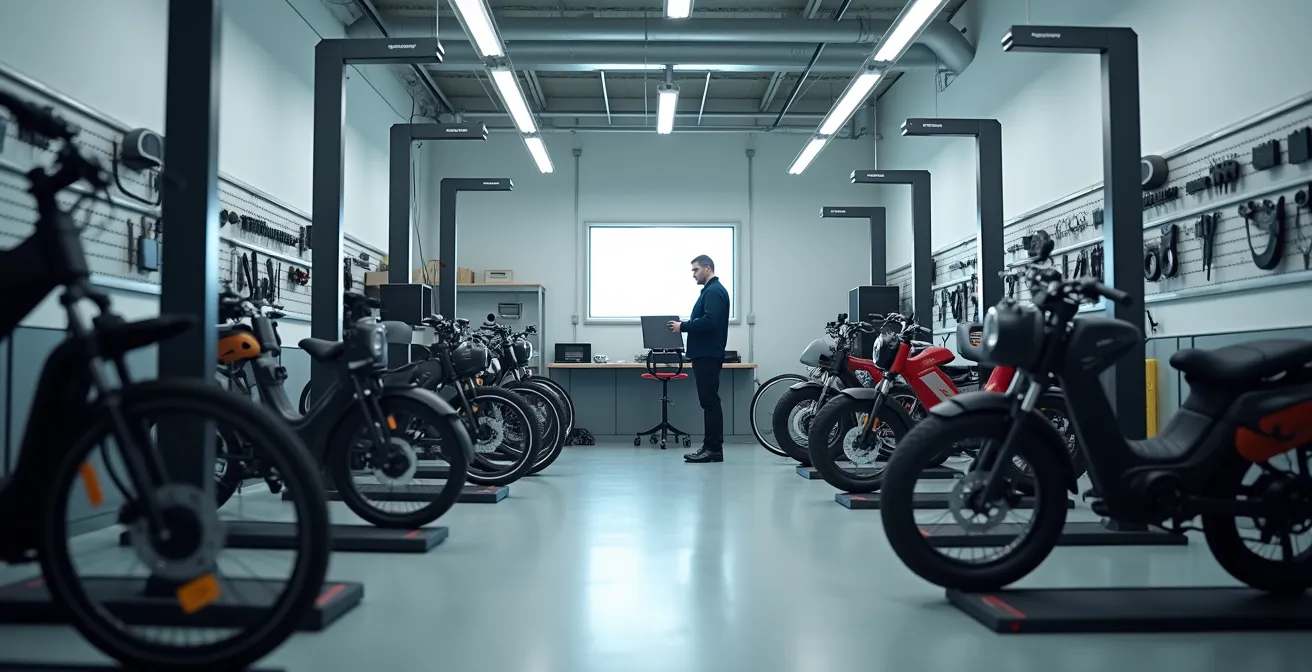
Contrary to belief, the higher price at a bike shop isn’t for the bike itself—it’s for exclusive access to a closed service ecosystem that online sellers are locked out of.
- Certified dealers perform a “digital handshake” with manufacturers to activate your warranty, a step often missed with self-assembly.
- Only dealers possess the proprietary diagnostic tools required to clear complex error codes and perform deep firmware updates on systems like Bosch or Shimano.
Recommendation: View the extra cost not as a markup, but as an investment in the bike’s long-term serviceability, safety, and warranty validity.
As a bike shop owner, I see the question in my customers’ eyes every day. You’ve researched online, you’ve seen the prices, and you’re wondering: why is the exact same e-bike 30% more expensive in my store than from a direct-to-consumer (DTC) website? It’s a fair question, and the temptation to save hundreds of dollars by ordering a bike in a box is completely understandable. The common answers you’ll hear—”better service,” “expert assembly”—feel vague and don’t quite justify such a significant price gap.
The truth is, you’re not just paying for a mechanic to turn a few bolts. You’re paying for access. Premium e-bike systems from brands like Bosch and Shimano are not open platforms. They are sophisticated, closed diagnostic ecosystems. Buying from a certified dealer isn’t a simple transaction; it’s your entry point into this system. Without it, you risk owning a technologically advanced machine that no one can—or will—properly service. The initial savings can quickly be erased by a single, unfixable electronic issue or a voided warranty claim.
This article will break down the specific, tangible value you get from a certified service center. We will move beyond the platitudes and into the technical and legal realities of e-bike ownership. We’ll explore why only dealers can manage certain error codes, how assembly activates your warranty, the risks of service refusal for internet brands, and why the “dealer dongle” holds power your consumer app can’t touch. By the end, you’ll understand that the price difference isn’t a markup; it’s a crucial investment in your bike’s future.
To help you navigate these critical differences, this guide details the essential functions and long-term benefits that only a certified brick-and-mortar shop can provide for your premium e-bike.
Summary: The Hidden Value: Why a Bike Shop E-Bike Is Worth the Extra Cost
- Why Only Dealers Can Reset Error Codes on Premium Systems
- How Dealer Assembly Protects Your Warranty Coverage
- Mobile Mechanics vs Brick-and-Mortar Shops: Pros and Cons
- The Risk of Local Shops Refusing to Work on Internet Brands
- Building Rapport: Why Tipping Your Mechanic Pays Off
- Dealer Dongle vs Consumer App: What Can You Actually Fix?
- How to Find Spares for Discontinued Motor Systems
- Service Intervals: Why E-Bikes Need More Frequent Shop Visits
Why Only Dealers Can Reset Error Codes on Premium Systems
One of the first moments of panic for a new e-bike owner is a cryptic error code flashing on the display. Your instinct is to turn it off and on again, but with premium systems like Bosch or Shimano, the problem is rarely that simple. These are not just bicycles with motors; they are integrated electronic systems where every component communicates. An error code is often just a symptom, and simply clearing it without a diagnosis is like turning off a smoke alarm while the fire still burns. This is where the proprietary diagnostic software, exclusive to certified dealers, becomes essential.
When you bring your bike to a certified shop, the mechanic doesn’t just “clear the code.” They perform a three-step diagnostic process that is impossible to replicate at home:
- First, they connect your bike to the diagnostic tool and access the firmware to identify the exact fault location, not just the surface-level error shown on your display.
- Next, they analyze a complete diagnostic report, including usage history, battery cycles, and temperature logs, to understand the root cause of the fault.
- Finally, all findings and repairs are documented in the system, creating an official service record that is crucial for validating your warranty.
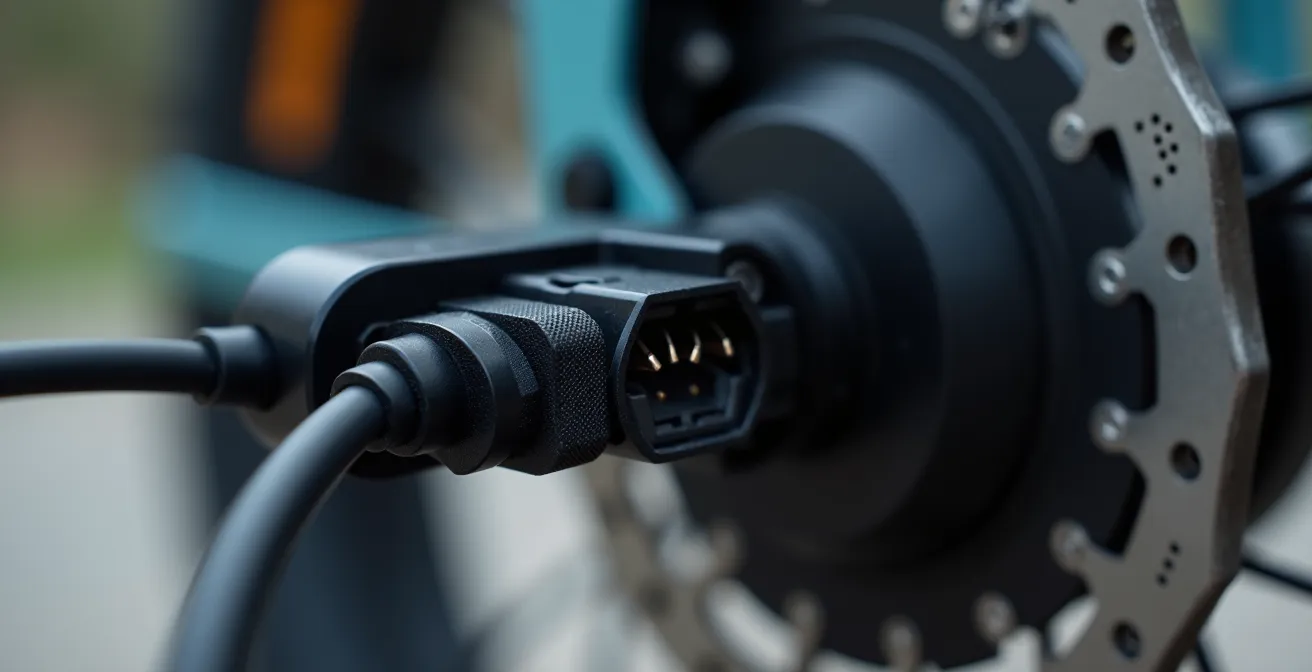
As you can see, the connection is more than just a plug; it’s a gateway to the bike’s entire electronic history and brain. Without this hardware and the licensed software, a persistent error code can render an expensive e-bike unusable. The consumer-facing apps offer basic information, but the power to perform a true diagnostic reset and document it for the manufacturer remains firmly in the hands of the certified dealer. This access alone is a fundamental pillar of the bike’s long-term value and serviceability.
How Dealer Assembly Protects Your Warranty Coverage
Buying an e-bike in a box and assembling it yourself can feel empowering and cost-effective. However, what most online sellers don’t emphasize is that the warranty isn’t just a piece of paper; it’s a contract that is formally activated. For brands like Bosch, this activation is a “digital handshake” performed by the dealer’s diagnostic tool upon assembly. The dealer doesn’t just build your bike; they digitally commission it, registering the frame, motor, and battery serial numbers with the manufacturer’s global database. This act serves as official proof that the bike was assembled to the manufacturer’s standards, transferring the liability for assembly-related issues from you to the shop.
Case Study: The Digital Handshake for Warranty Activation
Bosch eBike Systems provides certified dealers with its DiagnosticTool, which does more than just find errors. During initial assembly, the dealer uses it to configure the eBike and, most importantly, create an official digital service book. This process logs all component serial numbers directly into Bosch’s global system. This digital commissioning is the definitive step that activates the full manufacturer’s warranty. Without this dealer-performed action, a customer may find their warranty is not considered valid during a claim, as there is no official record of professional assembly and system registration.
This distinction between self-assembly and professional commissioning has significant implications for your coverage. The table below, drawing from common warranty terms in the industry, highlights the risks you take on when you assemble the bike yourself.
| Aspect | Self-Assembly | Dealer Assembly |
|---|---|---|
| Warranty Activation | May not be automatically activated | Digital commissioning activates warranty |
| Burden of Proof | Customer must prove proper assembly | Dealer assumes assembly liability |
| Coverage Period | Often limited or conditional | Full manufacturer warranty applies |
| Component Registration | Manual registration required | Automatic serial number registration |
| Initial Calibration | Not performed | Professional firmware update and calibration |
Ultimately, paying for dealer assembly is a form of insurance. You are purchasing a liability shield. If a brake caliper fails because of an incorrectly torqued bolt, the responsibility lies with the shop, and the repair is covered. If you built it yourself, the burden of proof is on you, and manufacturers are quick to deny claims based on “improper assembly.”
Mobile Mechanics vs Brick-and-Mortar Shops: Pros and Cons
The rise of mobile bike mechanics offers a convenient alternative to hauling your e-bike to a shop. For basic maintenance on traditional bikes, they can be a fantastic solution. However, when it comes to the complex electronics of a premium e-bike, the capabilities of a van are fundamentally limited compared to a fully equipped brick-and-mortar service center. As the professionals at one certified service center state, being certified means they can support you with everything from software updates and diagnostics to warranty claims—services that require a stable, dedicated infrastructure.
We are a fully certified Bosch, Shimano Steps, and Fazua eBike Service Center. This means we can support you with your eBike needs for any make or model of bike whether you are looking for Software Updates, Diagnostics Report, Spare Parts, Warranty Claim or simply a Service.
– Celestial Cycles Service Center, Celestial Cycles Electric Bike Service
The core difference lies in the diagnostic ecosystem. A brick-and-mortar shop invests tens of thousands of dollars in diagnostic hardware, dedicated PCs with licensed software, and a vast inventory of parts. A mobile mechanic simply cannot carry this level of equipment. They can handle mechanical issues like a flat tire or brake adjustment, but they are often unable to interface with the e-bike’s core electronics for firmware updates or deep diagnostics.
| Service Aspect | Mobile Mechanics | Brick-and-Mortar Shops |
|---|---|---|
| Convenience | Comes to your location | Requires transport to shop |
| Diagnostic Equipment | Limited portable tools | Full workshop diagnostic systems |
| Parts Inventory | Basic consumables only | Extensive parts warehouse |
| Complex Electronic Repairs | Usually not available | Full electronic diagnostic capability |
| Turnaround Time | Immediate for simple repairs | Same-day for stocked parts |
| Warranty Work Authorization | Rarely authorized | Often manufacturer-certified |
While a mobile mechanic excels at on-the-spot convenience for simple jobs, a certified shop acts as the “hospital” for your e-bike. It’s the only place with the authorization and equipment to perform the electronic “surgeries” required to keep a premium system running properly and under warranty.
The Risk of Local Shops Refusing to Work on Internet Brands
Perhaps the single greatest risk of buying an e-bike from a direct-to-consumer (DTC) brand is that you may end up with an “orphaned bike.” This happens when you have a problem that you can’t fix, and your local bike shops refuse to work on it. This isn’t because they are unfriendly; it’s a business decision based on three factors: liability, parts availability, and lack of experience. Shops face significant liability risks when working on a bike of unknown assembly quality. If something fails after their service, they can be held responsible.
Furthermore, many DTC brands use proprietary components that a local shop simply cannot source through their regular suppliers. If your specific controller or battery fails, and the online brand is unresponsive or out of business, the bike may become irreparable. This is a real-world problem that leaves owners stranded, as documented in forums where riders share their struggles.
Case Study: The Stranded Yamaha Owner
In a discussion on a popular forum about e-bike manufacturer warranties, a Yamaha e-bike owner shared their frustrating experience. Despite Yamaha having a strong, transferable warranty, the owner (the third purchaser) found that no local shop, including those listed on Yamaha’s own website, would touch the bike for warranty work. The original seller, a motorcycle dealer, refused to help. This left the owner with a bike that had a valid warranty on paper but no authorized service center willing to honor it, effectively stranding them with a problem they couldn’t solve.
When you buy a bike with a Bosch, Shimano, or Brose system from a certified dealer, you are buying into a global service network. A shop in Colorado can service a bike bought in Florida because they use the same tools, have access to the same parts database, and operate under the same manufacturer guidelines. With a lesser-known internet brand, you are betting on that single company’s longevity and customer service, a gamble that can leave you with a very expensive piece of garage art.
Building Rapport: Why Tipping Your Mechanic Pays Off
In a world of impersonal online transactions, the relationship you build with your local bike mechanic is a form of currency. It’s a human connection that provides value far beyond the cost of a tune-up. A good mechanic becomes your trusted advisor, your advocate for warranty claims, and your go-to source for honest advice. This relationship is an asset, and like any asset, it’s worth investing in. While not always expected, a tip for exceptional service is a powerful way to show appreciation and solidify that bond.
Loved the efficient, personable service, much less intimidating for a novice rider vs. going into a shop. Every bike and e-bike is different. We tailor our services to meet each individual’s needs – repairs, tunes, assembly, parts & accessories.
– Customer Review, velofix.com
A mechanic who knows you and your bike is more likely to go the extra mile. They might squeeze you in for a last-minute repair before a big trip, give you a heads-up on a coming sale, or spend extra time explaining how to properly maintain your drivetrain. This isn’t about buying special treatment; it’s about fostering a partnership based on mutual respect. A customer who is engaged, respectful, and appreciative is a customer a shop wants to keep happy.
Your action plan: building a valuable relationship with your e-bike mechanic
- Tip appropriately for exceptional service – consider it an investment in priority treatment during peak season.
- Ask for maintenance advice after service – mechanics appreciate customers who want to learn proper care.
- Bring your bike in clean and provide all keys and chargers – this shows respect for their time.
- Schedule regular maintenance appointments – consistent customers get preferential treatment.
- Refer other riders to the shop – mechanics remember and reward customers who bring them business.
This long-term rapport is something an anonymous online seller can never offer. When you have a complex, intermittent electronic issue, you don’t want to be emailing a faceless customer service address; you want to talk to “your mechanic” who knows your bike’s history.
Dealer Dongle vs Consumer App: What Can You Actually Fix?
Modern e-bikes often come with a sleek consumer app, like Bosch’s eBike Flow app, that connects to your bike via Bluetooth. These apps are great for tracking rides, adjusting assist modes, and viewing basic battery health. However, it’s crucial to understand that these apps are designed for the rider experience, not for deep system service. They are a window into the system, but they don’t give you the keys. The real power lies with the Dealer Diagnostic Tool, a combination of hardware (the “dongle”) and licensed PC software that makes the dealer a true service gatekeeper.
Inside the Bosch Diagnostic Software
The professional Bosch eBike Diagnostic Software provides technicians with a level of system access that is completely hidden from the consumer. When connected to the bike, it reveals a clear overview of every component’s status, including detailed parameters like total battery charge cycles, current capacity down to the cell level, maximum battery temperature reached, and a full log of all previous faults. This data is essential for diagnosing complex issues and is a mandatory requirement for processing a warranty claim with the manufacturer.
The consumer app lets you see a surface-level error code, but only the dealer tool can perform a full system firmware flash, recalibrate components after replacement, and access the deep analytics needed for a proper diagnosis. The following table breaks down the stark difference in access levels.
| Function | Consumer App (eBike Flow) | Dealer Diagnostic Tool |
|---|---|---|
| View Error Codes | Basic codes only | Full diagnostic history |
| Clear Error Codes | Not available | Full reset capability |
| Firmware Updates | Minor updates via Bluetooth | Full system firmware flash |
| Component Calibration | Not available | Complete sensor calibration |
| Assist Mode Tuning | Basic adjustments | Deep parameter configuration |
| Battery Analytics | Basic capacity info | Cell-level diagnostics |
| Service Documentation | View service history | Create official service records |
Thinking you can manage your premium e-bike with just the consumer app is like thinking you can manage a modern car’s engine with a gas gauge and a speedometer. You have basic information, but you have no control over the complex computer running the entire system.
How to Find Spares for Discontinued Motor Systems
An e-bike is a long-term investment, and a common fear is what happens when your motor or battery is discontinued. With the rapid pace of technology, will you be able to find replacement parts in five or ten years? This is another area where buying from a dealer connected to a major brand like Bosch provides immense value and peace of mind. These established manufacturers have robust policies for long-term parts availability. For instance, Bosch has a policy that commits to 10 years of spare parts availability after motor discontinuation, ensuring your investment remains serviceable for a decade or more.
When a part is needed for an older system, a certified dealer has multiple avenues to source it that are unavailable to the average consumer:
- Manufacturer’s ‘Classic’ Warehouse: Dealers can directly access the manufacturer’s inventory of parts reserved for legacy systems.
- Dealer Network Search: They can leverage their network to search the inventory of other shops across the country, often finding a new-old-stock part sitting on a shelf elsewhere.
- Official Replacement Programs: For out-of-warranty systems, manufacturers often offer discounted replacement motors or batteries through their dealer network, providing an upgrade path.
- Retrofit Knowledge: Certified technicians are trained on which newer components can be safely adapted to older systems, a task that requires deep product knowledge.
In contrast, if you own a bike from a smaller internet brand that goes out of business, your search for a proprietary battery or controller ends almost immediately. There is no dealer network, no parts warehouse, and no one to call. This commitment to long-term support from major brands is a hidden, but critically important, part of the value you are buying.
Key takeaways
- The price difference for a dealer e-bike is an investment in warranty activation, proprietary software access, and long-term serviceability.
- Only certified dealers can perform the “digital handshake” that validates your warranty and access the deep diagnostic tools needed for complex repairs.
- Buying from direct-to-consumer brands carries the risk of the bike becoming “orphaned” and unserviceable if the company fails or shops refuse to work on it.
Service Intervals: Why E-Bikes Need More Frequent Shop Visits
If you’re used to servicing a regular bicycle, the maintenance needs of an e-bike can be surprising. An e-bike is not simply a bike you don’t have to pedal as hard. The additional weight, speed, and immense torque from the motor place significantly higher stress on all components. Chains, cassettes, and brake pads wear out much faster. This accelerated wear means that the “set it and forget it” approach is a recipe for expensive, catastrophic failures. Regular, e-bike-specific service isn’t an upsell; it’s a necessity to protect your investment.
The True Cost of Deferred E-Bike Maintenance
A cautionary tale from the service center at MAPDEC Cycle Works illustrates this perfectly. A customer brought in an e-bike that had its chain and brakes maintained but had never received proper drive unit service. Upon opening the motor casing, the mechanics found it packed with dirt and rust. Water had infiltrated the system, completely destroying the bearings and the printed circuit board (PCB). The motor was ruined, requiring a replacement costing over £700. A simple, regular check and cleaning of the motor casing seals by a qualified technician could have prevented this total failure.
A certified service center follows a specific schedule designed to catch these issues early. This proactive approach includes checking for firmware updates, running diagnostic scans to spot developing electronic faults, and servicing mechanical parts before they fail under the motor’s extra strain.
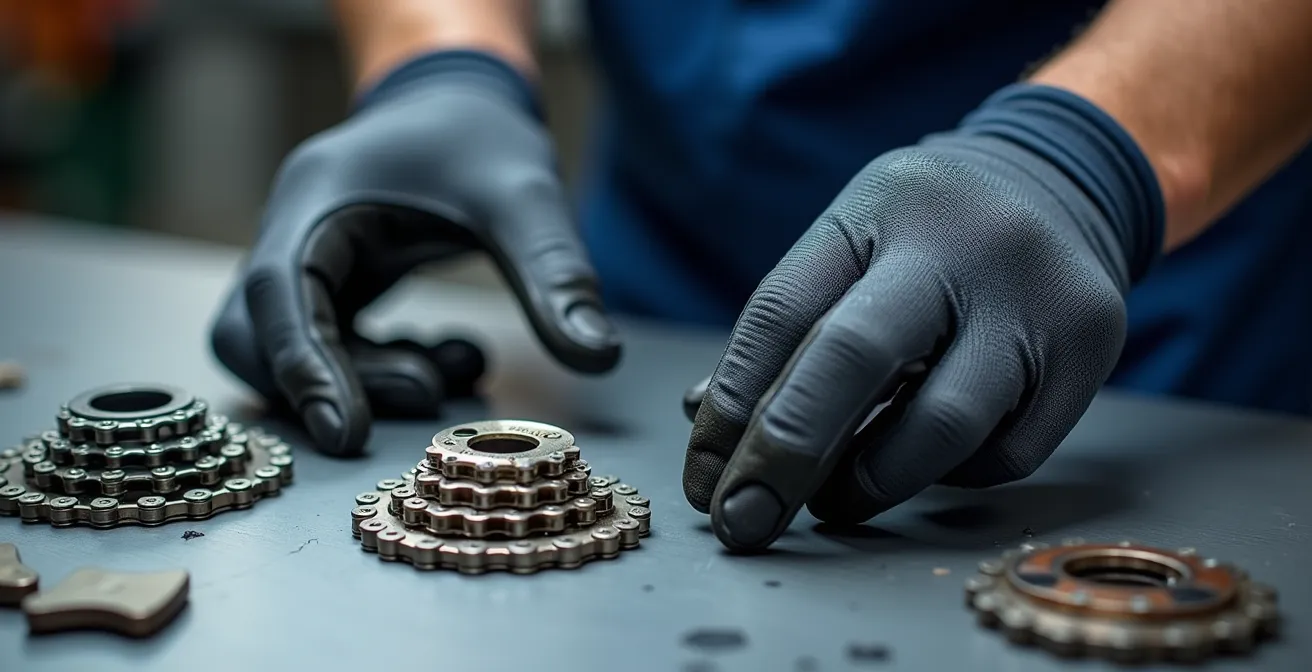
A typical e-bike maintenance schedule is more frequent and more thorough than that for a non-electric bike, including critical electronic checkpoints:
- Initial Inspection: After the first 4 weeks or 186 miles to catch any issues from the initial break-in period.
- Battery Health Check: Every 6 months to monitor capacity and charging patterns, ensuring you maintain a minimum capacity like the 60% retention required by some warranties.
- Drivetrain Service: Every 500-1000 miles to prevent accelerated wear on the chain and cassette.
- Firmware Updates: Checked quarterly to access new features and crucial system improvements.
- Complete Diagnostic Scan: Annually to identify potential electronic issues before they lead to failure.
Ultimately, the higher frequency of service is a direct reflection of the machine’s higher performance and complexity. Proactive maintenance at a certified shop is the most effective way to lower the total cost of ownership and ensure your e-bike is safe and reliable for years to come.
Frequently asked questions about The Hidden Value of Buying from a Certified Bosch/Shimano Service Center
Why do shops refuse to work on bikes they didn’t sell?
Shops face liability risks working on bikes of unknown origin or assembly quality. If something fails after their service, they could be held partially responsible for damages.
What happens when an online-only brand goes out of business?
The bike becomes ‘orphaned’ – without manufacturer support for parts or warranties. Unlike major brands with independent service networks, the bike may become unrepairable.
Can shops get parts for direct-to-consumer brands?
Often not. Many DTC brands use proprietary components that shops cannot source through their regular suppliers, making even simple repairs impossible.