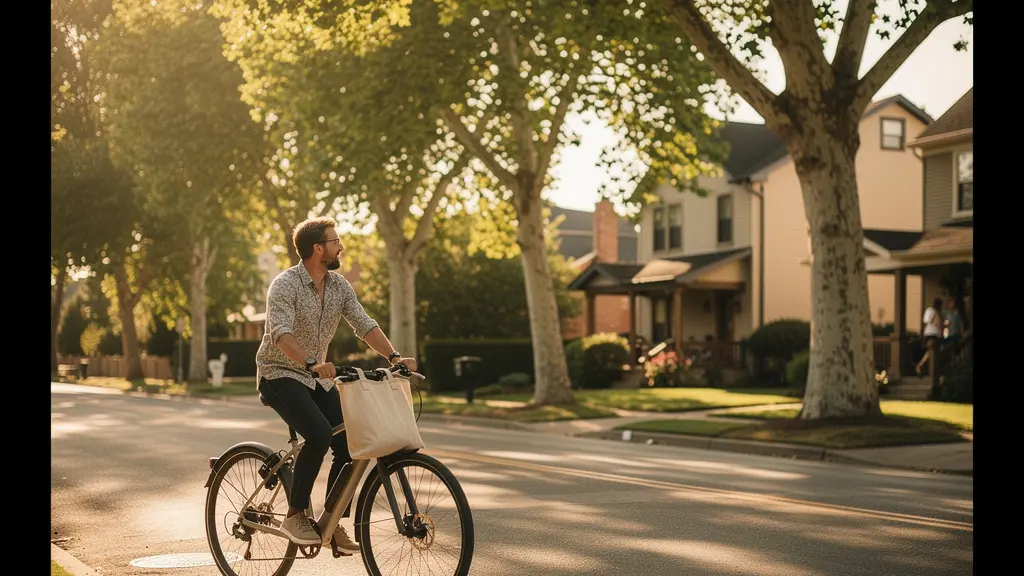
The most revolutionary aspect of urban e-bike adoption isn’t speed or sustainability, but the restoration of acoustic sovereignty and the dissolution of the automotive enclosure that isolates residents.
- Cyclists generate significantly higher monthly economic value for local merchants than drivers, reversing the entropy of car-centric sprawl.
- The transition from enclosed vehicle to open-air cycling induces measurable physiological changes, reducing cortisol and reclaiming mental bandwidth.
Recommendation: Evaluate your current commute not by duration, but by the quality of sensory engagement and social connection it permits.
The modern resident of the sprawling metropolis navigates a paradox of isolation: encased in climate-controlled steel, surrounded by constant motion, yet psychologically atomized from the physical environment and fellow citizens. The car-centric city functions as a machine for producing alienation, where the automotive enclosure severs the sensory connection to street life, replacing it with the low-frequency rumble of combustion and the cortisol spikes of congestion. Conventional wisdom suggests that escaping this condition requires radical lifestyle upheaval—abandoning suburbs for dense downtowns, or adopting ascetic fitness regimes that privilege athleticism over utility.
Yet the “Slow City” movement proposes a different rebellion, one that operates through kinetic humility rather than deprivation. The electric bicycle emerges not merely as a transportation device, but as a tool for dissolving the barriers between self and street, between resident and neighborhood. By lowering the physical threat profile of the vehicle while expanding the accessible radius of the pedestrian, e-bikes enable a form of tactical intimacy—micro-interactions and sensory engagements impossible within the hermetic seal of the automobile. This exploration unfolds through eight interconnected perspectives, examining how the shift to silent, human-scale mobility reconstitutes the urban social fabric and restores neurological equilibrium.
To navigate the following analysis, each section below isolates a distinct dimension of this transformation, from the acoustic ecology of neighborhoods to the neurochemical reality of the daily commute.
Table of Contents: The Architecture of Slow Urbanism
- Why Silent Transport Improves Neighborhood Mental Health
- How Cyclists Spend More at Local Shops Than Drivers
- Car Stress vs Bike Zen: The Psychological Shift
- The Risk of “Soft” Vehicles Menacing Pedestrians in Shared Zones
- Tactical Urbanism: How Temporary Bike Lanes Become Permanent
- How to Identify Motor Whine Before Buying
- Forest Bathing on a Bike: Combining Nature and Motion
- Cortisol Detox: Why the Ride Home is More Important Than the Ride There
Why Silent Transport Improves Neighborhood Mental Health
The acoustic environment of a neighborhood functions as an invisible infrastructure, shaping stress levels with the same materiality as pavement quality or air quality. Research indicates that noise-induced stress increases cortisol concentration even in sleeping persons, activating the hypothalamic-pituitary-adrenal axis and inducing chronic physiological arousal without conscious awareness. The internal combustion engine serves as the primary vector of this acoustic violence, its low-frequency vibrations penetrating walls and disrupting the parasympathetic nervous system’s attempt to restore equilibrium.
Electric bicycles, by contrast, operate at the threshold of auditory perception, producing less than 55 decibels at cruising speed—a level conducive to conversation and cognitive restoration. This silence permits what urban sociologists term sensory sovereignty: the resident’s reclaimed authority over their attentional field. When the streetscape is freed from the roar of engines, the subtle sounds of human activity—footsteps, conversation, the rustle of trees—re-emerge as the dominant acoustic texture, signaling safety and social coherence to the mammalian brain.

As the droplets on a stationary bell await the gentle touch that produces sound, the silent e-bike awaits the rider’s intention without imposing its mechanical signature on the environment. This acoustic gentrification—improving the sensory quality of shared space—creates the conditions for spontaneous social encounters, transforming the street from a conduit for escape into a place of habitation.
How Cyclists Spend More at Local Shops Than Drivers
The economic sociology of mobility reveals a counter-intuitive dynamic: velocity correlates inversely with local commercial vitality. While drivers prioritize destination efficiency, cyclists and pedestrians engage in what the flâneur tradition recognizes as aimless drifting—a mode of urban consumption that favors discovery over efficiency. Transport for London commissioned research demonstrating that people walking, cycling and using public transport spend 40% more each month at local shops than car drivers.
This disparity arises not from wealth differentials but from behavioral geometry. The enclosed driver experiences the street as a corridor; the cyclist experiences it as a façade. Each parked automobile represents not just a storage unit, but a barrier to visual engagement with storefronts. Conversely, the cyclist’s slower pace and unobstructed sightlines enable the recognition of window displays, sidewalk seating, and neighborly gestures that trigger discretionary spending.
Furthermore, the logistical friction of parking—searching, stopping, feeding meters—creates a psychological barrier to spontaneous stops. The cyclist’s ability to pause instantaneously, locking a machine lighter than a shopping cart, lowers the activation energy for micro-transactions. A Portland State University study corroborated this pattern, finding that while drivers spent more per individual trip, cyclists generated higher total monthly value through visit frequency, spending $75.66 versus $68.56 at bars, restaurants and convenience stores.
Car Stress vs Bike Zen: The Psychological Shift
The transition from driver to cyclist constitutes a shift between two distinct phenomenological states: the vigilance of the predator and the receptivity of the pedestrian. Operating a motor vehicle requires sustained sympathetic nervous system activation—monitoring for threats, negotiating velocity differentials, managing the territorial aggression of lane changes. An umbrella review published in the European Journal of Public Health establishes that environmental noise is second only to air pollution as a major factor in disability-adjusted life years lost in Europe, with noise exposure activating the HPA axis and elevating cortisol through sleep deprivation.
The cyclist, paradoxically more vulnerable physically, enters a state of relaxed alertness—a parasympathetic dominance incompatible with the road rage endemic to enclosed transport. The absence of climate control forces engagement with meteorological reality; the lack of audio insulation permits the bird song and human speech that regulate autonomic nervous function. This “bike zen” is not merely subjective wellbeing, but measurable neurochemical change.
Where the car produces isolation through protective excess, the bicycle produces connection through managed vulnerability. The rider becomes visible, accountable, and present—qualities that dissolve the anonymity enabling antisocial behavior in traffic. The commute transforms from a stressor to be endured into a liminal space for cognitive decompression.
The Risk of “Soft” Vehicles Menacing Pedestrians in Shared Zones
The democratization of speed through electrification introduces a paradoxical hazard: the “soft” vehicle that moves silently and accelerates rapidly, creating kinetic energy invisible to the pedestrian’s threat-detection systems. While automobiles announce their danger through engine roar and visual bulk, e-bikes approach at velocities that outpace the evolutionary calibration of human peripheral vision, particularly in shared spaces where the woonerf philosophy erases curbs and signage.

This tension requires the cultivation of kinetic humility—an ethical stance wherein the rider accepts responsibility for the energy they introduce into shared space. The hand resting gently on the brake lever, as shown above, symbolizes a readiness to yield, to dissipate momentum in deference to the more vulnerable. Without this cultural norm, the e-bike risks becoming merely a quieter, more insidious form of the same automotive domination it seeks to replace.
Back then, group rides were slow, respectful, and almost meditative. We weren’t out there trying to prove anything. We were just trying to feel something again.
– Frantic TV documentary filmmaker, Streetsblog USA
The path forward lies not in segregation—infinite lanes for infinite modes—but in the cultivation of mutual awareness. The e-bike rider must embrace the role of the courteous guest in spaces temporarily borrowed from the pedestrian’s domain.
Tactical Urbanism: How Temporary Bike Lanes Become Permanent
Official infrastructure operates on geological time scales, while urban needs evolve seasonally. Tactical urbanism bridges this temporal gap through interim interventions that test solutions before committing concrete. During the COVID-19 pandemic, cities across Europe deployed pop-up cycle lanes that increased cyclist numbers by 11% to 48%, generating billions in projected health benefits. These temporary installations served as prototypes, demonstrating demand through use rather than through predictive modeling.
The most compelling case study of this approach emerged on Cherry Street in Seattle, where anonymous activists installed plastic pylons to demonstrate the feasibility of a protected lane. Rather than prosecuting this tactical intervention, the Seattle Department of Transportation ultimately made the guerrilla-installed lane permanent, recognizing that citizen-led design often captures usage patterns invisible to traffic engineers.
This methodology reflects a broader shift from top-down planning to iterative place-making. By lowering the stakes of experimentation—allowing “failure” to consist merely of removing paint and cones rather than jackhammering asphalt—cities unlock the creative capacity of residents to redesign their own habitat. The temporary becomes permanent not through bureaucratic decree, but through the demonstrated impossibility of returning to previous conditions once the social benefits become visible.
How to Identify Motor Whine Before Buying
Not all electric bicycles contribute equally to the acoustic restoration of the city. The quality of the motor’s sound signature—its “whine” versus its “hum”—determines whether the machine blends into the urban soundscape or becomes a mobile nuisance. Prospective buyers must conduct an acoustic evaluation before purchase, treating noise pollution as a critical selection criterion alongside battery capacity.
Your Acoustic Evaluation Protocol: E-Bike Selection
- Select a silent testing environment: Identify a location where ambient noise registers below 40 dB, such as a park path or dead-end residential road, to isolate the motor’s true acoustic signature without interference from traffic.
- Establish the baseline at zero load: Ride on flat terrain with minimal pedal assistance to hear the motor’s resting character—listen for grinding, clicking, or high-frequency electrical buzzing that indicates poor shielding or gear meshing.
- Stress-test under progressive load: Accelerate hard from a complete stop or climb a moderate hill to evaluate how the motor’s pitch changes under torque; seek a low, reassuring hum rather than a piercing whine that fatigues the ear.
- Evaluate sustained cruise: Maintain a constant velocity of 15-20 mph for several minutes to determine whether the motor produces a persistent, intrusive drone or fades into the background white noise of wind and tires.
- Compare motor architectures: Test both mid-drive systems (which may exhibit gear meshing sounds under load but offer natural pedaling dynamics) and hub motors (generally quieter at cruise but potentially whiny at acceleration) to determine which acoustic profile suits your typical routes.
| Characteristic | Mid-Drive Motor | Hub Motor |
|---|---|---|
| Noise at cruise speed | Low gear hum, generally quiet | Very quiet, near-silent at constant speed |
| Noise under load (hills) | Noticeable gear meshing; can whine at high torque | Slight electrical hum; louder at max assist |
| Noise at acceleration | Moderate; depends on gear selection | Can produce brief high-pitched whine |
| Vibration feedback | Transmitted through cranks and frame | Isolated in wheel; minimal frame vibration |
| Best ‘Slow City’ fit | Hilly terrain; natural pedal feel | Flat urban environments; maximum silence |
Selecting a motor that respects the acoustic commons ensures that your personal mobility does not externalize costs onto the neurological wellbeing of neighbors.
Forest Bathing on a Bike: Combining Nature and Motion
The Japanese practice of shinrin-yoku—forest bathing—traditionally requires stillness, the immersion of the static body in the phytoncide-rich atmosphere of the woodland. E-bikes expand the accessible radius of this practice, transforming nature immersion from a weekend expedition requiring athletic fitness into a daily ritual available to all bodies and ages. Research from the PIAMA study published in Environmental Epidemiology demonstrates that residential exposure to green space within a 3,000-meter radius was associated with measurably lower chronic stress levels in children, measured through flatter diurnal cortisol decline.

The electric assist dissolves the barrier of topography that separates urban residents from urban forests. Hills that would require cardiovascular capacity beyond the reach of the elderly or the physically limited become navigable slopes, democratizing access to the biophilic environments necessary for psychological restoration. Programs like the Can Do Colorado E-Bike Pilot distributed electric bicycles to low-income workers, extending practical cycling range to 5-20 miles and proving that access to nature need not remain a privilege of the affluent or the athletic.
When the machine rests on the forest floor, integrated into the fern and dappled light, it ceases to be a tool of conquest and becomes a bridge—an extension of the foot that permits the urbanite to touch the wild without dominating it.
Key Takeaways
- The silent operation of e-bikes restores acoustic sovereignty to neighborhoods, reducing cortisol and enabling social connection.
- Slow mobility generates higher economic value for local businesses than car-dependent commerce, revitalizing street-level economies.
- Tactical urbanism and careful equipment selection transform the e-bike from a mere vehicle into an instrument of community repair.
Cortisol Detox: Why the Ride Home is More Important Than the Ride There
The morning commute carries the anticipatory stress of arrival—the deadline, the meeting, the performance. The evening return, however, offers a different potential: the transition from the managed self of the workplace to the authentic self of the domestic sphere. This liminal journey functions as a cortisol detox, a neurological shedding of the day’s accumulated stress hormones. Research confirms that road traffic noise activates stress axes even below waking thresholds, meaning the enclosed car commute extends the workday’s physiological burden into domestic space.
The e-bike commute, particularly through green corridors, interrupts this pattern. Bloemsma et al. note that green space improves health by reducing stress, promoting physical activity, and reducing exposure to environmental stressors. The rider arrives home not with elevated blood pressure and tightened jaw, but with cleared lungs and regulated nervous system.
This distinction—between the ride there and the ride home—reveals the true metric of transportation quality. Efficiency measured in miles per hour ignores efficiency measured in psychological restoration per minute. The slow city movement recognizes that the commute is not dead time to be minimized, but transitional space to be cultivated. The e-bike does not merely transport the body between locations; it detoxifies the psyche between social roles.
Evaluate your current evening transit not by its duration, but by the state of mind in which it deposits you at your doorstep. If the journey leaves you energized rather than depleted, connected rather than isolated, you have discovered the true velocity of the slow city.