
Contrary to popular belief, using an e-bike for recovery isn’t about riding passively; it’s about leveraging the motor as a precision tool for active physiological regulation.
- Effective recovery is dictated by maintaining specific physiological zones (Zone 2 Heart Rate, low Rider Power), not just reducing speed.
- The motor’s role is to decouple rider effort from terrain, allowing you to hold a consistent biological output (e.g., 100 watts) whether you’re on a flat or a slight incline.
- Ignoring metrics like Training Stress Score (TSS) leads to accumulated fatigue, negating the recovery benefits of the ride.
Recommendation: Calibrate your metrics, quantify your effort with data, and use a structured plan to transform your e-bike from a simple transport device into your most advanced recovery tool.
For the serious cyclist, recovery is not a passive state of rest; it is an active, biological process. The notion that an e-bike is merely a tool for an “easy day” fundamentally misunderstands its potential. While many athletes simply switch to eco mode and pedal lightly, they are leaving significant physiological gains on the table. This approach relies on subjective feelings, a notoriously unreliable guide when managing the complex interplay of lactate clearance, glycogen replenishment, and central nervous system fatigue.
The common advice to “just spin the legs” is a platitude that ignores the very real work being done by the body. True active recovery is a targeted intervention. It requires precision. The breakthrough for the modern athlete is reframing the e-bike not as a crutch, but as a sophisticated metabolic control device. The motor is not a substitute for effort, but a regulator of it, allowing you to hold a perfect physiological state regardless of external variables like wind or gradient.
But if the goal isn’t just to “ride easy,” what is it? The key is to shift focus from external metrics like speed and distance to internal ones: heart rate, rider power output, and total training stress. This article will deconstruct how to use these data points to transform your e-bike recovery session from a casual spin into a calculated, data-driven protocol. We will explore the critical difference between rider power and motor power, the profound benefits of strict Zone 2 training, and how to quantify your effort to ensure every recovery ride accelerates your adaptation and prepares you for the next hard session.
To navigate this technical landscape, this guide is structured to build your expertise progressively. We’ll start by addressing data inaccuracies and move through metric selection, planning, and the deep physiological principles that govern true recovery.
Summary: Using E-Bike Metrics to Manage Recovery Rides for Cyclists
- Why Your E-Bike Display Overestimates Calories Burned by 40%
- How to Use Turbo Mode for High-Intensity Interval Training (HIIT)
- Heart Rate vs Power: Which Metric Dictates Your Effort?
- The Mistake of Ignoring Fatigue Because “It’s Just an E-Bike”
- Planning a 4-Week Progressive Base Training on an E-Bike
- Why Rider Wattage Matters More Than Motor Wattage for Health
- Why Keeping Your Heart Rate in Zone 2 is Better Than Sprinting
- Active Recovery: Using E-Bikes to Flush Lactate Without Fatigue
Why Your E-Bike Display Overestimates Calories Burned by 40%
The first step in any data-driven protocol is to ensure the data is accurate. Unfortunately, the calorie expenditure figure on most e-bike displays is fundamentally flawed. These systems often use a simplistic algorithm based on motor output, speed, and generic user data, failing to distinguish between the work done by the rider and the work done by the motor. This leads to a significant overestimation, often by as much as 25-40%, rendering the number useless for any serious nutritional planning or effort tracking. A real-world example highlighted a rider on a Specialized Turbo Tero whose 100-mile ride synced to Strava showing only 46 calories, demonstrating the wild inaccuracies that can occur when proprietary e-bike data conflicts with standard calculation models.
This discrepancy isn’t just a minor annoyance; it undermines the entire purpose of a recovery ride. If you believe you are burning more calories, you may overcompensate with nutrition, or worse, believe you are working harder than you are, pushing you out of the intended recovery zone. To build a reliable system, we must look to more direct measures of rider effort. For calorie calculation, power meters demonstrate superior accuracy at around 5% compared to the 10-20% margin of error for heart rate monitors. While a dedicated power meter is the gold standard, a chest strap heart rate monitor provides a far more reliable estimate than any stock e-bike display. The goal is to measure the physiological cost to the rider, not the total energy moving the bike.
To overcome this, you must establish a personal correction factor for your specific setup. This calibration process allows you to translate the flawed display data into a more meaningful metric. It’s a one-time effort that provides the foundation for all future data-driven recovery rides.
Action Plan: Calibrating Your E-Bike’s Calorie Counter
- Establish a Baseline: Ride a fixed, repeatable course (e.g., 5 miles) using both your e-bike’s display and an independent chest strap heart rate monitor (HRM) with a connected app (like Strava or Garmin Connect) to record data simultaneously.
- Collect Data: At the end of the ride, note the total calories burned as reported by the e-bike display and the total calories reported by the HRM-based app.
- Analyze the Discrepancy: Compare the two values. You will likely observe that the e-bike’s display shows a significantly higher number, often 25-40% greater than the HRM’s calculation.
- Calculate Your Correction Factor: Divide the more accurate HRM calorie number by the e-bike display’s calorie number. This will give you a factor (e.g., 250 HRM calories / 400 display calories = 0.625).
- Implement and Integrate: For all future rides, multiply the calorie number shown on your e-bike display by your personal correction factor to get a much more accurate estimate of your actual energy expenditure.
How to Use Turbo Mode for High-Intensity Interval Training (HIIT)
The title of this section contains a deliberate misdirection common among new e-bike users. For an athlete, using Turbo mode for High-Intensity Interval Training (HIIT) on a recovery day is a physiological contradiction. A recovery ride’s purpose is to keep efforts low, promote blood flow, and clear metabolic byproducts without inducing further stress. Engaging in HIIT, even with motor assistance, spikes lactate production and heart rate, directly opposing these goals and turning a recovery session into another training session.
The proper, strategic use of high-assistance modes like “Turbo” or “Boost” during a recovery ride is not to *create* intensity, but to *prevent* it. The primary enemy of a steady, low-effort recovery ride is terrain variation. A short, steep incline can force your heart rate and power output to spike well above your target recovery zones, even for just 30-60 seconds. This is where Turbo mode becomes a precision tool. Its function is to neutralize the hill’s demand, allowing your personal power output and heart rate to remain stable and low.
Think of it as “effort-smoothing.” You should reserve Turbo mode exclusively for these brief moments, such as starting on a steep hill to prevent an initial power surge or cresting a short, sharp rise without elevating your heart rate. The engagement should be short, typically a maximum of 30 seconds, and you should immediately switch back to Eco or a lower assistance level once momentum is established and the terrain flattens. The goal is to use the motor to maintain a flat physiological road, even when the physical road is not.
Heart Rate vs Power: Which Metric Dictates Your Effort?
Once you commit to a data-driven approach, the central question becomes: which metric should be your primary guide? For recovery rides, both heart rate (HR) and power (rider watts) are crucial, but they play different roles. Heart rate is your physiological governor, reflecting the body’s internal response to stress. Power is your mechanical regulator, an instantaneous measure of the work you are performing. Understanding their relationship is key to optimizing recovery.
Heart rate is a lagging indicator; it can take 30-60 seconds to respond to changes in effort. It’s also influenced by external factors like heat, caffeine, stress, and hydration. However, for a steady-state recovery ride, it is the ultimate arbiter of physiological strain. Your goal is to keep it within a specific, low-intensity zone (typically Zone 1 to low Zone 2). On an e-bike, the motor’s great advantage is helping you maintain this stable heart rate, adding just enough assistance to prevent cardiac drift or spikes from terrain changes. For effective recovery, guidelines suggest keeping your heart rate in Zone 1, or at least 15 beats per minute below the top of your Zone 2.
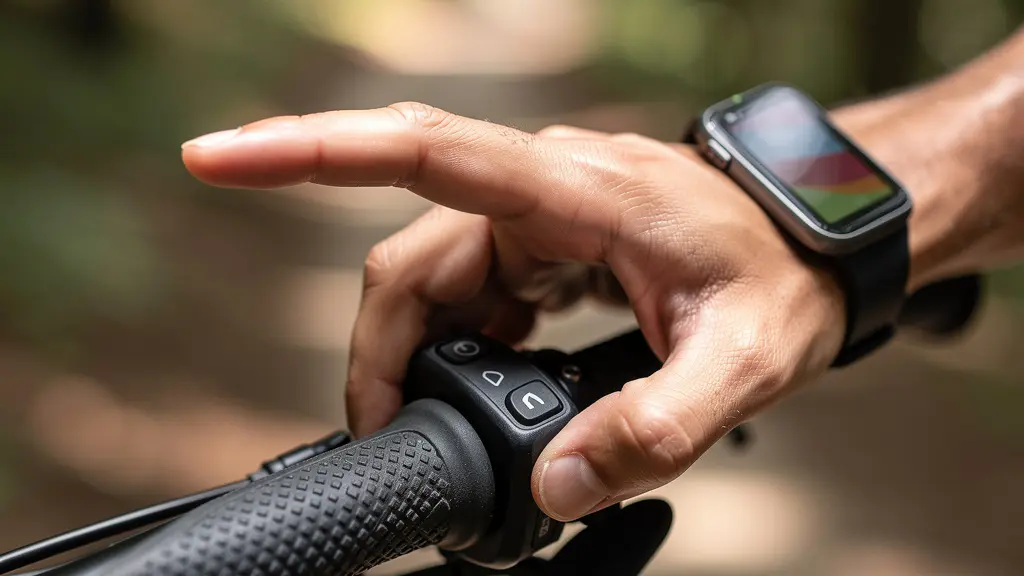
Power, measured in watts, is an immediate and objective measure of your mechanical output. It is not affected by external factors, making it a pure representation of your effort at any given moment. The target for a recovery ride is to keep your rider power consistently low, typically between 30-50% of your Functional Threshold Power (FTP). The e-bike allows you to achieve this by decoupling your power from your speed. You can maintain 100 watts of rider power while going 12 mph on a flat or 12 mph up a slight incline, with the motor filling in the difference. Power is the input you control; heart rate is the resulting physiological cost.
For a recovery ride, heart rate is the ultimate ceiling you must not break, while rider power is the tool you use to stay well below that ceiling. The following table breaks down their distinct roles.
| Metric | Heart Rate | Rider Power |
|---|---|---|
| Primary Role | Physiological Governor | Mechanical Regulator |
| Recovery Zone | Zone 1-2 (60-80% threshold) | 30-50% FTP |
| Response Time | Delayed (30-60 seconds) | Instantaneous |
| E-Bike Advantage | Motor helps maintain stable HR | Can reduce rider watts while maintaining speed |
The Mistake of Ignoring Fatigue Because “It’s Just an E-Bike”
Perhaps the most dangerous mistake an athlete can make is to assume that any ride on an e-bike is inherently a recovery ride. The assistance from the motor can easily mask accumulating fatigue, leading you to believe you’ve had an easy day when, in fact, you’ve added significant stress to your body. This is why subjective feeling is not enough; we must quantify the load. The gold standard for this is the Training Stress Score (TSS).
As the experts at EVOQ.BIKE explain in their professional guide, the principle of adaptation is universal. The training stimulus, whether on an acoustic bike or an e-bike, is what breaks the body down. Recovery is when it rebuilds stronger. Ignoring the stress component of an e-bike ride is ignoring half of the equation.
When we work out or simply ride the bike, we are putting stress on our bodies, measured in Training Stress Score (TSS). However, that ride is not what makes us stronger – the stress breaks the body down, and recovery is when the body rebuilds stronger.
– EVOQ.BIKE, Professional Cycling Recovery Guide
TSS provides a single number that accounts for both the intensity (based on your FTP) and the duration of your ride. It allows you to objectively compare a 45-minute e-bike ride to a 2-hour traditional ride. For a true active recovery session, the goal is to keep the load minimal. According to training guidelines, a TSS of around 15 to 30 represents a gentle 30 to 60-minute recovery ride, which is a fraction of the 100 TSS accumulated from riding at your FTP for one hour. If your “easy” e-bike spin consistently results in a TSS of 50 or 60, you are not recovering; you are accumulating “grey zone” fatigue that will compromise your next key workout.
The e-bike’s motor makes it incredibly easy to drift into these higher TSS zones without noticing. A little too much rider effort, a slightly longer duration, or a few unmanaged hills can quickly turn a 20 TSS ride into a 50 TSS ride. Tracking TSS is non-negotiable for athletes using an e-bike for recovery. It is the objective check that ensures your recovery day is genuinely contributing to positive adaptation, not hidden fatigue.
Planning a 4-Week Progressive Base Training on an E-Bike
A data-driven approach is most effective when applied within a structured, progressive plan. Randomly heading out for “easy spins” lacks the targeted stimulus needed for optimal adaptation. A progressive plan for e-bike recovery rides focuses not on increasing intensity, but on enhancing efficiency. The goal over several weeks is to perform the same physiological work (i.e., maintain the same heart rate and duration) with progressively less assistance from the motor. This demonstrates a true improvement in your aerobic base and recovery capacity. As one professional guide notes, recovery rides are best incorporated once or twice weekly, often immediately after hard days, because they keep the body active and ready for the next session, avoiding the full “shutdown” of a complete rest day.
This 4-week protocol provides a clear framework. The primary metric is time spent in the target heart rate zone (low Zone 2), with secondary metrics like assistance level and battery usage used to track progress. This structure gamifies the process of becoming more efficient.
Here is a sample 4-week progression:
- Week 1 – Calibration: The entire focus is on process. Ride for a set duration (e.g., 60 minutes) and use whatever assistance level is necessary to keep your heart rate locked in low Zone 2. The goal is to accumulate time in zone, learning how the motor helps you smooth out undulations and maintain a steady physiological state. Your primary metric is simply minutes in Zone 2.
- Week 2 – Duration Extension: Maintain the strict heart rate control from Week 1, but increase the duration of each recovery ride by 15-20%. Monitor your aerobic decoupling (the rate at which your heart rate drifts upward at a constant power output). A target of less than 5% decoupling indicates strong aerobic fitness.
- Week 3 – Efficiency Focus: Return to the ride duration of Week 2. Now, the goal is to complete the ride with a lower average assistance level or a lower total battery consumption than in previous weeks, all while maintaining the same target heart rate zone and duration. This proves your body is doing more of the work.
- Week 4 – Optimization: The final challenge is to consolidate your gains. Aim to complete the same routes and durations as Week 3 but with a further 20% reduction in battery usage or by spending more time in a lower assistance mode, all while keeping your heart rate perfectly in the target recovery zone.
Why Rider Wattage Matters More Than Motor Wattage for Health
In the world of e-bikes, marketing often focuses on the power of the motor, measured in watts. However, for an athlete focused on recovery and health, this metric is largely irrelevant. The number that truly matters is rider wattage: the actual power you are producing through the pedals. This is the metric that reflects your physiological work, stimulates adaptation, and burns calories. The motor’s wattage is simply the assistance provided to help you achieve a desired speed or overcome resistance.
Focusing on motor wattage is a distraction. The art of the e-bike recovery ride is to use the motor as a tool to precisely control your *rider wattage*. For a recovery session, you might target a constant 90-110 watts of rider power. On a flat road, you may need minimal assistance (Eco mode) to achieve this at a comfortable speed. As you hit a slight incline, you would increase the assistance level not to go faster, but to keep your personal power output locked at that same 90-110 watts. The motor fills the gap between the power you want to produce and the power the terrain demands.
A powerful concept for tracking this is the Human-to-Electric Power Ratio, which shows the percentage of total power coming from you versus the motor. For an effective recovery ride, this ratio should be high, perhaps 3:1 or 4:1, indicating the rider is doing the vast majority of the work. Even if you don’t have a power meter, you can approximate this principle. By holding a target heart rate and a consistent cadence (e.g., 90 RPM), you are maintaining a relatively stable power output. You then adjust motor assistance only to smooth out terrain and keep that HR/cadence combination steady. If your heart rate drops at the same cadence, it’s a sign the motor is doing too much work, and you should lower the assistance level.
Why Keeping Your Heart Rate in Zone 2 is Better Than Sprinting
For an athlete, the term “recovery” is synonymous with Zone 2. Sprinting or high-intensity efforts have their place in a training plan, but they are the polar opposite of a recovery stimulus. The physiological adaptations triggered by these two types of efforts are fundamentally different, and mixing them up on a recovery day is counterproductive. Sprinting is an anaerobic effort that produces lactate faster than the body can clear it, requiring a subsequent recovery period. In contrast, Zone 2 training occurs below the lactate threshold, actively promoting clearance and enhancing the body’s ability to use fat as a fuel source.
As explained by experts at Peloton, Zone 2 is the ‘fat-burning zone’ perfect for building a deep aerobic base. This steady endurance range, where you can comfortably hold a conversation, is critical for developing mitochondrial density. Mitochondria are the powerhouses of your cells, and a higher density means your body becomes more efficient at producing energy aerobically. High-intensity sprints do little to improve this specific adaptation. The e-bike is the perfect tool for Zone 2 work, as the motor can help you stay in this relatively narrow HR band for extended durations (60-120 minutes) without the muscular fatigue that might occur on a non-assisted bike, especially on varied terrain.

Many athletes neglect Zone 2 because it “feels too easy” and requires longer sessions to be effective. However, its impact on building a robust aerobic engine and enhancing recovery is unparalleled. During a recovery ride, the goal is to spend the maximum amount of time in this zone. The following table highlights the critical differences in physiological effects.
As a comparative analysis from Cycling Weekly shows, the benefits are starkly different.
| Aspect | Zone 2 Training | Sprint/High Intensity |
|---|---|---|
| Lactate Production | Below lactate threshold | Exceeds clearance rate |
| Mitochondrial Density | Increases significantly | Limited improvement |
| Fat Oxidation | Primary fuel source | Minimal fat burning |
| Recovery Impact | Promotes recovery | Requires recovery |
Key Takeaways
- Rider Effort Over All: The key metric for recovery is your personal physiological output (Rider Watts, Heart Rate), not the bike’s speed or the motor’s power.
- Zone 2 is Non-Negotiable: The vast majority of a recovery ride should be spent in Heart Rate Zone 2 to maximize mitochondrial adaptation and lactate clearance without adding stress.
- Quantify, Don’t Guess: Use metrics like Training Stress Score (TSS) to ensure your “easy” ride is truly low-load (15-30 TSS) and contributing to recovery, not hidden fatigue.
Active Recovery: Using E-Bikes to Flush Lactate Without Fatigue
The ultimate goal of an e-bike active recovery ride is to accelerate the body’s natural healing processes, primarily by flushing metabolic byproducts like lactate from the muscles without causing additional micro-trauma. This is achieved through a gentle, low-intensity effort that stimulates blood flow—the so-called “muscle pump” effect. The e-bike is the ideal instrument for this task, as it allows you to maintain a high, smooth cadence with very low muscular torque, which is the perfect combination for promoting circulation without stress.
The timing and structure of this ride are critical. The “golden window” for an active recovery session is typically 12-24 hours after a hard effort. The ride should be between 45-60 minutes, long enough to be effective but not so long as to tax glycogen stores. The intensity must be strictly controlled, keeping your cycling recovery heart rate around 50-60% of your max heart rate or 50-60% of your FTP for a very easy effort. This usually corresponds to high Zone 1 or low Zone 2.
To maximize the muscle pump effect, the focus should be on maintaining a high cadence (90+ RPM). This is where the e-bike shines. You can use the motor’s assistance to keep the resistance or torque extremely low, allowing you to spin your legs quickly and smoothly without generating significant power or muscular strain. A great way to gamify this and ensure you’re not over-relying on the motor is to set a “battery budget” for the ride (e.g., using no more than 200 Wh). This forces you to manage your effort and the bike’s assistance efficiently, keeping you honest throughout the session. By combining these elements—timing, duration, low intensity, and high cadence—you turn the e-bike into a powerful tool for actively accelerating recovery.
By implementing this data-driven, physiological approach, you elevate your e-bike from a recreational vehicle to an indispensable part of your athletic training and recovery arsenal. Begin today by calibrating your metrics and planning your next recovery session not by feel, but by the numbers that truly drive performance.