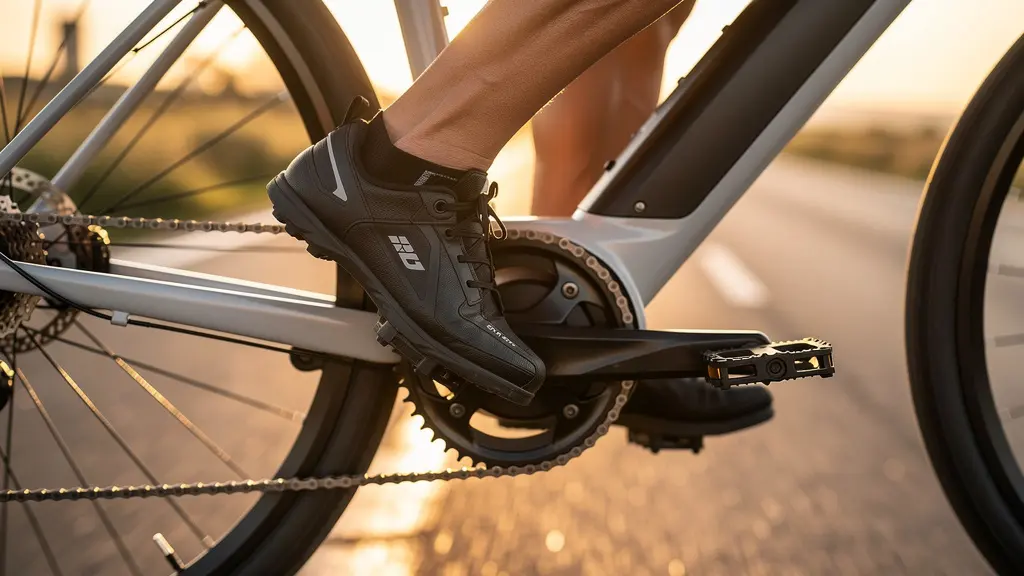
Grinding in a high gear isn’t just inefficient; it’s actively harming your motor and draining your battery by forcing it to operate outside its peak efficiency zone.
- Electric motors have an optimal “sweet spot”—around 75-80 RPM—where they deliver maximum power with minimum energy consumption.
- Low-cadence “grinding” creates a massive amperage spike, drawing huge amounts of current and rapidly depleting your battery.
- Using your gears to maintain a high, consistent cadence allows the motor to spin freely, multiplying torque and dramatically improving range.
Recommendation: Shift gears often to keep your pedal spin rate high and consistent. Learn to think like your motor, transforming it from a struggling workhorse into an efficient partner.
You’ve invested in a powerful electric bike, yet the battery range displayed on the screen feels more like a vague suggestion than a reliable metric. You find yourself nursing the bike home on low power, frustrated that the promised mileage never materializes. Many riders blame the battery or the motor, but the real culprit is often misunderstood. The common advice is to “pedal faster” or “use your gears,” but these are just symptoms of a deeper issue. The problem isn’t your bike’s hardware; it’s the communication between you and the machine.
The core of e-bike efficiency lies in a concept borrowed from internal combustion engines: the optimal RPM range. Your e-bike’s motor is an engine, and like any engine, it has a “sweet spot” where it operates with peak efficiency and power output. For most mid-drive e-bike motors, this magic number hovers around 80 revolutions per minute (RPM). Riding below this cadence, especially mashing on the pedals in a high gear, is like trying to accelerate a car from a standstill in fifth gear. It puts immense strain on the system, causes a huge spike in energy consumption, and wears down components prematurely. Conversely, learning to keep the motor spinning in its happy zone changes everything.
This guide moves beyond generic tips. We will delve into the mechanics of why cadence is king for battery longevity. We will explore the hardware that measures your effort, the risks of poor technique, and how different motor systems respond to your input. By understanding how to work *with* your motor instead of against it, you can unlock its true potential, significantly extend your battery range, and achieve a smoother, more intuitive ride.
This article breaks down the essential technical knowledge every e-bike owner should master. From the sensors that read your pedaling to the motor systems that respond, we will cover the key elements that dictate your bike’s efficiency and range.
Summary: Why a Cadence of 80 RPM Extends Your Battery Range Significantly
- Why Magnet Sensors Fail in Muddy Conditions
- How to Align Spoke Magnets Without Tools on the Roadside
- Cadence vs Torque Sensors: Which Provides the Smoothest Ride?
- The Risk of Starting in High Gear Without Cadence Input
- Calibrating Your Speed Sensor for Accurate Cut-Off Limits
- Why High-End Pedal Assist Feels More Natural Than Hub Motors
- Cadence Efficiency: Letting the Motor Spin for Max Torque
- Mid-Drive vs Hub Motor: Which Is Best for Hilly Commutes?
Why Magnet Sensors Fail in Muddy Conditions
The humble magnet sensor is the simplest form of a cadence sensor, acting as the basic eyes and ears of your pedal-assist system (PAS). It typically consists of a magnet mounted on a wheel spoke and a sensor fixed to the chainstay. Each time the magnet passes the sensor, it completes a circuit, telling the motor controller that you are pedaling. However, its simplicity is also its weakness, especially when faced with challenging trail conditions. Mud, dirt, and water can create a host of problems for this system.
The primary failure point is physical obstruction. A thick layer of mud can increase the gap between the magnet and sensor beyond the required 1-3mm tolerance, preventing a signal from being registered. Even more problematic is the accumulation of fine, metallic particles within the mud. These ferrous particles can cling to the magnet, effectively weakening its magnetic field to the point where the sensor can no longer detect it. This results in an intermittent or complete loss of motor assistance, leaving you without power when you might need it most.
Diagnosing these issues is critical for any rider who ventures off-road. If your motor assist becomes erratic or cuts out entirely after a muddy ride, the magnet sensor should be your first point of inspection. A systematic check can quickly identify and resolve the problem.
- Check for ferrous particle buildup on the magnet: Visually inspect the spoke magnet. If it’s caked in dirt, wipe it clean with a dry cloth. Pay close attention to any fine, dark particles that seem magnetically attached.
- Verify the sensor gap: Ensure the distance between the magnet and the frame-mounted sensor is still within the 1-3mm range, even with mud accumulation on the frame. Gently adjust the sensor or magnet position if necessary.
- Test sensor signal continuity: With the bike in a stand or upside down, spin the wheel slowly by hand. Watch the bike’s display or listen for the controller to register each pass of the magnet. A consistent signal indicates the sensor is functioning correctly.
How to Align Spoke Magnets Without Tools on the Roadside
A misaligned spoke magnet can bring your ride to an abrupt halt, but fixing it doesn’t require a trip to the workshop. One of the most common causes of PAS failure is the gap between the spoke magnet and the chainstay sensor becoming too large, often after hitting a bump or from vibrations over time. The system requires a precise gap, typically between 1-3mm, to function. Fortunately, there’s a simple roadside trick that uses an item most people carry: a credit card.
The standard thickness of a credit card is approximately 0.76mm. By folding it once, you get a gauge of about 1.5mm. Folding it twice gives you roughly 3mm. This provides a perfect, tool-free way to set the sensor gap. Simply loosen the sensor or magnet, insert the folded card into the gap, and then tighten everything back down. This ensures the spacing is within the optimal range for a reliable signal.
This technique is a lifesaver on the trail. The visual guide below demonstrates how to use this simple object to achieve a workshop-perfect alignment anywhere.
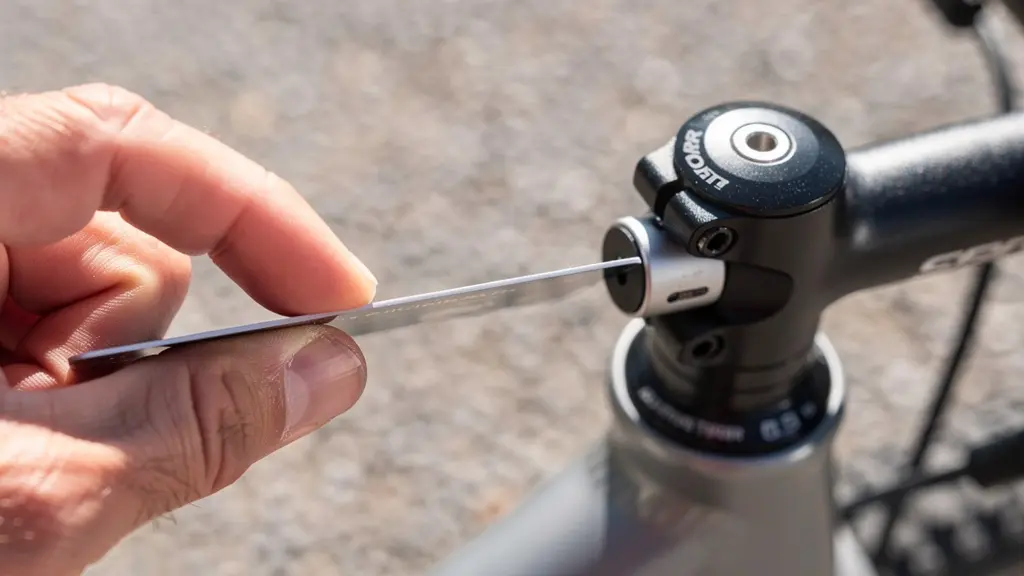
As the image illustrates, achieving the correct spacing is a matter of precision, not specialized tools. Maintaining this alignment is crucial for consistent performance, which in turn helps you maintain an optimal cadence. According to Bosch’s official testing, riders who consistently maintain a cadence between 60-90 RPM achieve the best battery range. A faulty sensor makes maintaining this cadence impossible, directly impacting your bike’s efficiency.
Cadence vs Torque Sensors: Which Provides the Smoothest Ride?
While a basic magnet sensor simply detects if you are pedaling, more advanced e-bike systems use either a cadence sensor or a torque sensor to modulate power. Understanding the difference between them is key to understanding why some bikes feel intuitive and smooth while others feel abrupt and robotic. A cadence sensor delivers a fixed amount of power for each assist level as long as you are turning the pedals. A torque sensor, however, measures *how hard* you are pedaling and delivers assistance proportional to your effort.
This fundamental difference has a massive impact on ride feel and battery efficiency. Cadence-based systems are simple and predictable: if you pedal, the motor turns on. This can sometimes lead to a feeling of “ghost pedaling,” where you can spin the cranks with little effort while the motor does all the work. Torque-based systems, in contrast, feel like an extension of your own body. They amplify your input, providing more help when you push harder on a hill and less when you’re cruising on a flat. This dynamic response is what many riders describe as a “natural” or “bionic” feeling.
As the experts at eBikes.org point out in their technical analysis, this has a direct impact on range:
Torque sensors typically use less battery and provide greater range levels because they only deliver the required help, allowing you to conserve battery power.
– eBikes.org Technical Analysis, Powering Up: A Deep Dive Into E-Bike Cadence and Torque Sensors
The following table, based on industry analysis, breaks down the key differences in performance and efficiency.
| Feature | Cadence Sensor | Torque Sensor |
|---|---|---|
| Battery Efficiency | Standard consumption | 20-30% more efficient |
| Power Delivery | Consistent, predictable | Dynamic, responsive |
| Optimal RPM Range | 60-80 RPM | Variable based on effort |
| Learning Curve | Minimal | Moderate |
The Risk of Starting in High Gear Without Cadence Input
One of the most common and detrimental habits for e-bike riders is starting from a standstill in a high gear. This is the equivalent of trying to drive a manual car away from a stoplight in fourth gear. It forces the motor to overcome massive resistance with very little mechanical advantage, resulting in an enormous and inefficient power draw. This initial surge of power is a primary cause of premature battery drain for many riders who complain about poor range.
From a technical standpoint, this action creates a massive amperage spike. The motor controller demands maximum current from the battery to generate enough torque to get the bike moving at a very low RPM. As motor tuning experts confirm that the highest current draw occurs during acceleration from a standstill, this practice puts an incredible strain on the entire electrical system. Over time, this can reduce the overall lifespan of the battery and put unnecessary stress on the motor itself. It’s the single most inefficient way to use your e-bike’s power.
The consequences extend beyond just the electrical components, as demonstrated by real-world testing.
MBR Magazine Range and Drivetrain Wear Testing
In a comprehensive test, MBR Magazine found that riders who actively used their gears to maintain a cadence of 70-90 RPM not only maximized their motor’s efficiency and range but also significantly reduced wear on their drivetrain. Conversely, their analysis and surveys of bike shop mechanics confirmed that riding at a low cadence (below 60 RPM), especially when starting, causes premature wear on chains, cassettes, and chainrings due to the excessive force being applied.
The lesson is clear: your bike’s gears are not just there for hills. They are your primary tool for managing motor RPM and efficiency. Always start in a low gear that allows you to quickly spin up to a cadence of 70-80 RPM, letting the motor operate in its efficient sweet spot from the very beginning of your acceleration.
Calibrating Your Speed Sensor for Accurate Cut-Off Limits
Your e-bike’s speed sensor does more than just tell you how fast you’re going; it’s a critical component for legal compliance and system performance. It informs the controller when to cut motor assistance as you approach the legal speed limit (e.g., 20 mph in the US or 25 km/h in Europe). An improperly calibrated sensor can lead to two problems: the motor cutting out too early, robbing you of assistance, or cutting out too late, which may be illegal. Furthermore, inaccurate speed data can throw off the bike computer’s range calculations, giving you a false sense of security.
While many bike computers come with pre-set wheel sizes, these are often generic and don’t account for variations in tire width and pressure. For perfect accuracy, you must manually calibrate the wheel circumference. The “roll-out method” is the gold standard for this, providing a precise measurement that factory settings can’t match. This ensures your speed readings are exact, your cut-off is accurate, and your range estimates are as reliable as possible. Keep in mind that external factors also play a huge role in range; for instance, cold weather testing data reveals a potential 20-30% range loss at 0-5°C (32-41°F), an impact that accurate data logging can help you anticipate.
Follow these steps to ensure your system has the most accurate data possible.
Action Plan: The Roll-Out Method for Perfect Calibration
- Mark the start point: Place a chalk mark on your tire’s sidewall and a corresponding mark on the ground, precisely at the valve stem position.
- Perform one full revolution: Carefully roll the bike forward in a straight line until the tire completes exactly one full revolution, with the valve stem at the bottom again.
- Measure the distance: Make a second chalk mark on the ground and measure the exact distance in millimeters between the two ground marks. This is your true wheel circumference.
- Enter the data: Input this precise measurement (e.g., 2215mm) into your bike computer’s wheel circumference setting, overriding any pre-set values.
- Verify accuracy: Test your bike’s displayed speed against a reliable GPS source (like a phone app) to confirm the calibration is correct.
Why High-End Pedal Assist Feels More Natural Than Hub Motors
The difference in ride feel between a basic hub motor e-bike and a high-end mid-drive system is night and day. A hub motor, located in the center of the front or rear wheel, essentially “pushes” or “pulls” the bike along. Its power delivery is independent of your pedaling effort and gearing. In contrast, a mid-drive motor is located at the bike’s bottom bracket, applying power directly to the crankset. This means the motor’s power is channeled through the bike’s own drivetrain (the chain and gears).
This integration is the secret to the natural, intuitive feel of premium pedal-assist systems. The mid-drive motor leverages your bike’s gears, just as you do. When you shift to a lower gear to climb a hill, the motor also benefits from that increased mechanical advantage. This is called torque multiplication. It allows a smaller, lighter motor to produce more effective torque at the wheel, especially on inclines. This design also centralizes mass low on the bike frame, dramatically improving balance and handling compared to the heavy, unbalanced feel of a wheel with a hub motor.
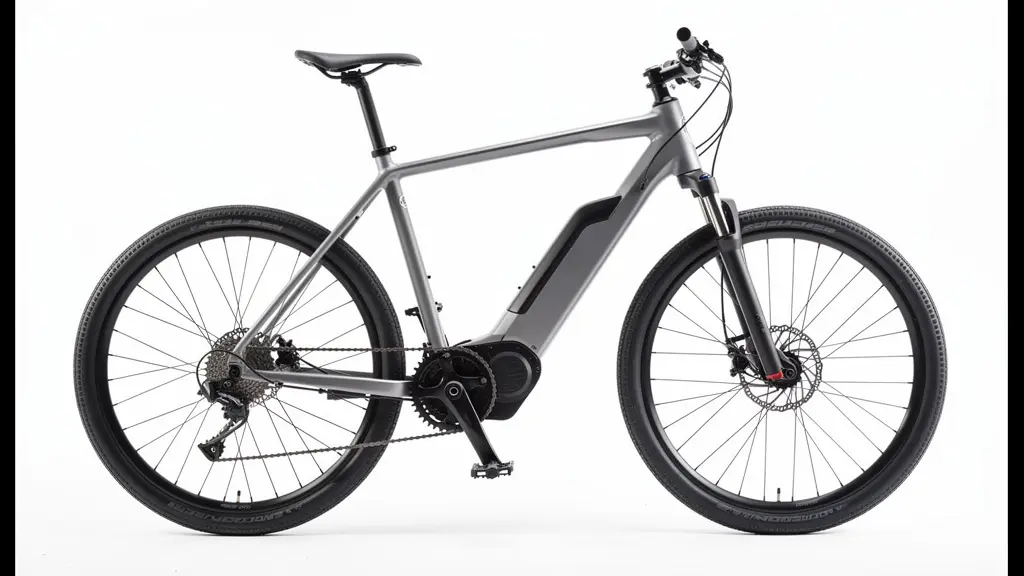
The efficiency gains are significant. By allowing the motor to operate within its optimal RPM range via the bike’s gears, mid-drive systems use energy far more effectively. In fact, a mid-drive system can achieve 20-40% more range from the same battery capacity compared to a hub motor. It’s not just about feeling better; it’s about being fundamentally more efficient by working in symbiosis with the bicycle’s core design.
Cadence Efficiency: Letting the Motor Spin for Max Torque
The central thesis of e-bike efficiency is this: electric motors are designed to spin. They produce their maximum power and operate most efficiently not when they are grinding at low speeds, but when they are spinning freely within a specific RPM range. For the rider, this translates directly to cadence. Fighting the motor by pedaling slowly in a high gear forces it into an inefficient, high-amperage state. The key to unlocking range is to use your gears to keep your pedal speed high, letting the motor do what it does best.
Extensive testing has confirmed this principle. According to research, motor efficiency of over 75% is maintained when the cadence is kept between 60-100 RPM. This is the motor’s “sweet spot.” Within this band, it converts the maximum amount of electrical energy from the battery into mechanical power at the wheel. Drop below this range, and efficiency plummets as the motor struggles against resistance, drawing excess current and generating waste heat instead of forward motion.
Further analysis by publications like E-Mountainbike Magazine reinforces this, pinpointing an ideal target for maximum efficiency. Their testing found that a cadence of around 75 pedal strokes per minute is the peak for motor efficiency. At this speed, you are perfectly synchronized with the motor’s optimal operating state. You are not just a passenger; you are an active part of an efficient system. Shifting gears to maintain this 75-80 RPM cadence, whether on a steep climb or a flat road, is the single most effective technique for maximizing your battery’s range.
Key Takeaways
- Your e-bike’s motor has an optimal “sweet spot” of 75-80 RPM where it achieves maximum efficiency and power output.
- Low-cadence “grinding” in high gears causes massive amperage spikes, which is the primary driver of premature battery drain.
- Mid-drive motors are more efficient, especially on hills, because they leverage the bike’s gears to keep the motor in its optimal RPM range (torque multiplication).
Mid-Drive vs Hub Motor: Which Is Best for Hilly Commutes?
For riders facing hilly terrain, the choice between a mid-drive motor and a hub motor becomes critically important. While both systems provide assistance, their performance on sustained climbs differs dramatically due to their fundamental design. A hub motor’s effectiveness is tied to wheel speed; as you slow down on a steep grade, the motor’s RPM drops, and it quickly falls out of its efficient operating range. This leads to a significant increase in battery consumption and the risk of overheating on long ascents.
A mid-drive motor, however, excels in these conditions. Because it powers the drivetrain directly, it benefits from the bike’s gearing. By shifting to a lower gear, the rider can maintain a high pedaling cadence (e.g., 75-80 RPM), which in turn keeps the motor spinning in its most efficient and powerful RPM band. This ability to multiply torque through gearing means a mid-drive can tackle steep, long climbs with far less strain and energy consumption than a comparable hub motor. As EVELO’s technical analysis notes, a 500W mid-drive can often outperform a 1000W hub motor on steep climbs for this very reason.
This table clearly illustrates the performance gap on challenging terrain.
| Factor | Mid-Drive | Hub Motor |
|---|---|---|
| Hill Efficiency | 85-95% efficient | 70-80% efficient |
| Battery Consumption on 6% Grade | 2x flat ground | 2.5x flat ground |
| Optimal Cadence Range | 60-80 RPM maintained via gears | Speed-dependent |
| Thermal Management | Better heat dissipation | Can overheat on sustained climbs |
The takeaway for commuters is clear. If your route involves significant hills, a mid-drive system is the superior choice for both performance and battery efficiency. It allows you to become an active partner with the motor, using your gearing to conquer climbs effectively while conserving precious battery life for the rest of your journey.
By applying these principles of cadence, gearing, and system understanding, you transform from a passive rider into an efficient operator. The next logical step is to analyze your own riding habits and bike setup to put this knowledge into practice and see a real-world improvement in your battery range.